sql
256 lines · 1 tab
Maria Garcia
Feb 2026
1 tab
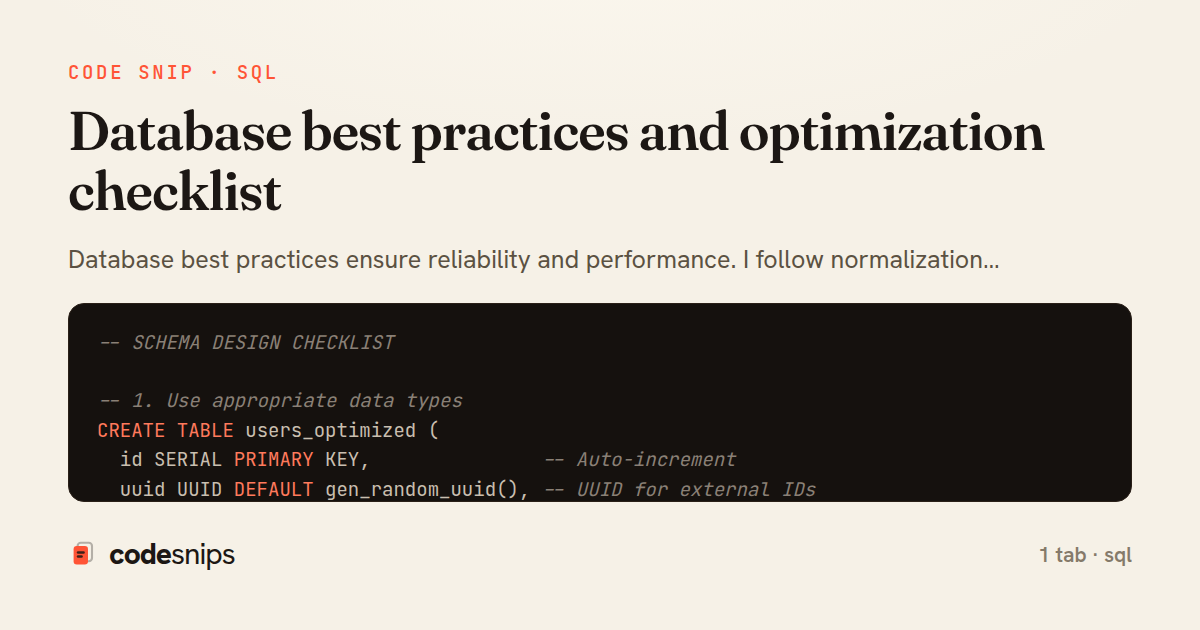
-- SCHEMA DESIGN CHECKLIST

-- 1. Use appropriate data types
CREATE TABLE users_optimized (
  id SERIAL PRIMARY KEY,               -- Auto-increment
  uuid UUID DEFAULT gen_random_uuid(), -- UUID for external IDs
  username VARCHAR(50) NOT NULL,       -- Fixed max length
  email VARCHAR(100) NOT NULL,
  bio TEXT,                             -- Unlimited text
  age SMALLINT,                        -- Small numbers
  balance DECIMAL(12,2),               -- Money (exact)
  is_active BOOLEAN DEFAULT true,
  settings JSONB,                      -- Structured data
  created_at TIMESTAMPTZ DEFAULT NOW() -- Timezone-aware
);

-- DON'T use:
-- VARCHAR without limit
-- CHAR for variable-length
-- FLOAT for money
-- TIMESTAMP without timezone

-- 2. Add constraints for data integrity
ALTER TABLE users_optimized
ADD CONSTRAINT username_length CHECK (char_length(username) >= 3),
ADD CONSTRAINT email_format CHECK (email ~* '^[A-Za-z0-9._%+-]+@[A-Za-z0-9.-]+\.[A-Za-z]{2,}$'),
ADD CONSTRAINT age_range CHECK (age BETWEEN 0 AND 150),
ADD CONSTRAINT balance_positive CHECK (balance >= 0);

-- Unique constraints
ALTER TABLE users_optimized
ADD CONSTRAINT users_username_unique UNIQUE (username),
ADD CONSTRAINT users_email_unique UNIQUE (email);

-- 3. Create indexes strategically
-- Index foreign keys
CREATE INDEX idx_orders_user_id ON orders(user_id);

-- Index frequently queried columns
CREATE INDEX idx_orders_status ON orders(status);
CREATE INDEX idx_orders_created_at ON orders(created_at DESC);

-- Composite index for combined queries
CREATE INDEX idx_orders_user_status ON orders(user_id, status);

-- Partial index for specific conditions
CREATE INDEX idx_orders_pending ON orders(user_id)
WHERE status = 'pending';

-- Covering index (includes additional columns)
CREATE INDEX idx_orders_covering ON orders(user_id)
INCLUDE (total, created_at);

-- DON'T:
-- Index every column
-- Create redundant indexes
-- Forget to index foreign keys

-- 4. Use foreign keys for referential integrity
CREATE TABLE orders (
  id SERIAL PRIMARY KEY,
  user_id INT NOT NULL REFERENCES users(id) ON DELETE CASCADE,
  total DECIMAL(10,2) NOT NULL,
  status VARCHAR(20) DEFAULT 'pending'
);

-- Cascade options:
-- ON DELETE CASCADE: Delete related rows
-- ON DELETE SET NULL: Nullify foreign key
-- ON DELETE RESTRICT: Prevent deletion
-- ON DELETE NO ACTION: Same as RESTRICT

-- 5. Implement proper defaults
CREATE TABLE posts (
  id SERIAL PRIMARY KEY,
  title VARCHAR(200) NOT NULL,
  content TEXT NOT NULL,
  status VARCHAR(20) DEFAULT 'draft',
  views INT DEFAULT 0,
  created_at TIMESTAMPTZ DEFAULT CURRENT_TIMESTAMP,
  updated_at TIMESTAMPTZ DEFAULT CURRENT_TIMESTAMP
);

-- Auto-update trigger
CREATE OR REPLACE FUNCTION update_updated_at()
RETURNS TRIGGER AS $$
BEGIN
  NEW.updated_at = CURRENT_TIMESTAMP;
  RETURN NEW;
END;
$$ LANGUAGE plpgsql;

CREATE TRIGGER posts_updated_at
BEFORE UPDATE ON posts
FOR EACH ROW
EXECUTE FUNCTION update_updated_at();

-- PERFORMANCE CHECKLIST

-- 1. Regular maintenance
-- Vacuum to reclaim space
VACUUM ANALYZE users;

-- Full vacuum (locks table)
VACUUM FULL users;

-- Autovacuum settings (postgresql.conf)
/*
autovacuum = on
autovacuum_vacuum_scale_factor = 0.2
autovacuum_analyze_scale_factor = 0.1
autovacuum_naptime = 1min
*/

-- 2. Monitor slow queries
CREATE EXTENSION IF NOT EXISTS pg_stat_statements;

-- Slowest queries
SELECT
  calls,
  total_exec_time / 1000.0 AS total_time_seconds,
  mean_exec_time / 1000.0 AS mean_time_seconds,
  query
FROM pg_stat_statements
WHERE query NOT LIKE '%pg_stat_statements%'
ORDER BY total_exec_time DESC
LIMIT 10;

-- 3. Optimize common queries
-- Use EXPLAIN ANALYZE
EXPLAIN (ANALYZE, BUFFERS, VERBOSE)
SELECT u.username, COUNT(o.id) AS order_count
FROM users u
LEFT JOIN orders o ON u.id = o.user_id
WHERE u.created_at > NOW() - INTERVAL '30 days'
GROUP BY u.id, u.username
HAVING COUNT(o.id) > 0
ORDER BY order_count DESC
LIMIT 10;

-- 4. Use connection pooling
/*
// pgBouncer configuration
[databases]
myapp = host=localhost port=5432 dbname=myapp

[pgbouncer]
pool_mode = transaction
max_client_conn = 1000
default_pool_size = 20

// Application
const pool = new Pool({
  host: 'pgbouncer-host',
  port: 6432,
  max: 20, // Max connections per app instance
  idleTimeoutMillis: 30000,
  connectionTimeoutMillis: 2000,
});
*/

-- 5. Use transactions appropriately
BEGIN;

INSERT INTO users (username, email) VALUES ('newuser', 'new@example.com');

INSERT INTO profiles (user_id, bio)
VALUES (currval('users_id_seq'), 'Bio text');

COMMIT;
-- Both succeed or both fail

-- SECURITY CHECKLIST

-- 1. Least privilege principle
CREATE ROLE app_readonly;
GRANT CONNECT ON DATABASE myapp TO app_readonly;
GRANT USAGE ON SCHEMA public TO app_readonly;
GRANT SELECT ON ALL TABLES IN SCHEMA public TO app_readonly;

CREATE ROLE app_readwrite;
GRANT CONNECT ON DATABASE myapp TO app_readwrite;
GRANT USAGE ON SCHEMA public TO app_readwrite;
GRANT SELECT, INSERT, UPDATE, DELETE ON ALL TABLES IN SCHEMA public TO app_readwrite;

-- 2. Row Level Security (RLS)
ALTER TABLE documents ENABLE ROW LEVEL SECURITY;

CREATE POLICY user_documents ON documents
FOR ALL
TO app_user
USING (user_id = current_setting('app.current_user_id')::INT);

-- 3. Prepared statements (prevent SQL injection)
-- Always use parameterized queries

-- 4. Encrypt sensitive data
CREATE EXTENSION IF NOT EXISTS pgcrypto;

ALTER TABLE users ADD COLUMN password_hash VARCHAR(255);

UPDATE users
SET password_hash = crypt('password123', gen_salt('bf'))
WHERE id = 1;

-- Verify password
SELECT (password_hash = crypt('password123', password_hash)) AS valid
FROM users WHERE id = 1;

-- 5. Regular backups
/*
# Full backup
pg_dump -U postgres -d myapp -F c -f myapp_backup.dump

# Restore
pg_restore -U postgres -d myapp myapp_backup.dump

# Continuous archiving (WAL)
# postgresql.conf:
wal_level = replica
archive_mode = on
archive_command = 'cp %p /path/to/archive/%f'
*/

-- MONITORING CHECKLIST

-- 1. Connection monitoring
SELECT
  count(*) AS total_connections,
  count(*) FILTER (WHERE state = 'active') AS active,
  count(*) FILTER (WHERE state = 'idle') AS idle,
  count(*) FILTER (WHERE state = 'idle in transaction') AS idle_in_tx
FROM pg_stat_activity;

-- 2. Table bloat
SELECT
  schemaname,
  tablename,
  pg_size_pretty(pg_total_relation_size(schemaname||'.'||tablename)) AS size,
  pg_size_pretty(pg_total_relation_size(schemaname||'.'||tablename) - pg_relation_size(schemaname||'.'||tablename)) AS index_size
FROM pg_tables
WHERE schemaname = 'public'
ORDER BY pg_total_relation_size(schemaname||'.'||tablename) DESC
LIMIT 10;

-- 3. Cache hit ratio
SELECT
  'index hit rate' AS name,
  (sum(idx_blks_hit)) / NULLIF(sum(idx_blks_hit + idx_blks_read), 0) AS ratio
FROM pg_statio_user_indexes
UNION ALL
SELECT
  'table hit rate' AS name,
  sum(heap_blks_hit) / NULLIF(sum(heap_blks_hit) + sum(heap_blks_read), 0) AS ratio
FROM pg_statio_user_tables;
-- Target: > 0.99 (99%)
1 file · sql
Explain with highlit
Database best practices ensure reliability and performance. I follow normalization principles—minimize redundancy. Use appropriate indexes—not too many, not too few. Implement constraints for data integrity. Choose correct data types for efficiency. Regular VACUUM and ANALYZE maintain statistics. Monitor slow queries with pgstatstatements. Connection pooling reduces overhead. Transactions ensure ACID properties. Backup strategies prevent data loss. Security through least privilege. Regular performance reviews identify issues. Proper schema design prevents future problems. Understanding best practices creates robust, scalable databases. Essential for production systems.
Related snips
sql
-- Simple function
CREATE OR REPLACE FUNCTION get_full_name(
  first_name VARCHAR,
  last_name VARCHAR
)
RETURNS VARCHAR AS $$
Stored procedures and functions in PostgreSQL
postgresql
stored-procedures
functions
by Maria Garcia
2 tabs
ruby
payload = {
  sub: user.id,
  iss: 'https://auth.example.com',
  aud: 'codesnips-api',
  exp: 15.minutes.from_now.to_i,
  iat: Time.now.to_i,
JWT issuance and verification without common footguns
jwt
authentication
api
by Kai Nakamura
2 tabs
ruby
# BAD: N+1 query problem
@users = User.all
@users.each do |user|
  puts user.posts.count  # Fires query for each user!
end
ActiveRecord query optimization and N+1 prevention
ruby
rails
activerecord
by Sarah Mitchell
3 tabs
bash
#!/usr/bin/env bash
set -euo pipefail

export VAULT_ADDR="https://vault.internal:8200"
export VAULT_TOKEN="${VAULT_TOKEN:?missing VAULT_TOKEN}"
Secrets management with environment isolation and Vault
secrets-management
vault
environment-variables
by Kai Nakamura
1 tab
typescript
import { randomBytes, createHash } from "crypto";
import jwt from "jsonwebtoken";
import { RefreshTokenStore } from "./store";

const ACCESS_SECRET = process.env.ACCESS_SECRET!;
const ACCESS_TTL = "15m";
JWT access + refresh token rotation (conceptual)
security
node
jwt
by codesnips
3 tabs
go
package files

import (
  "context"
  "time"
Presigned S3 upload URLs (AWS SDK v2)
go
aws
s3
by Leah Thompson
1 tab
Share this code
Here's the card — post it anywhere.