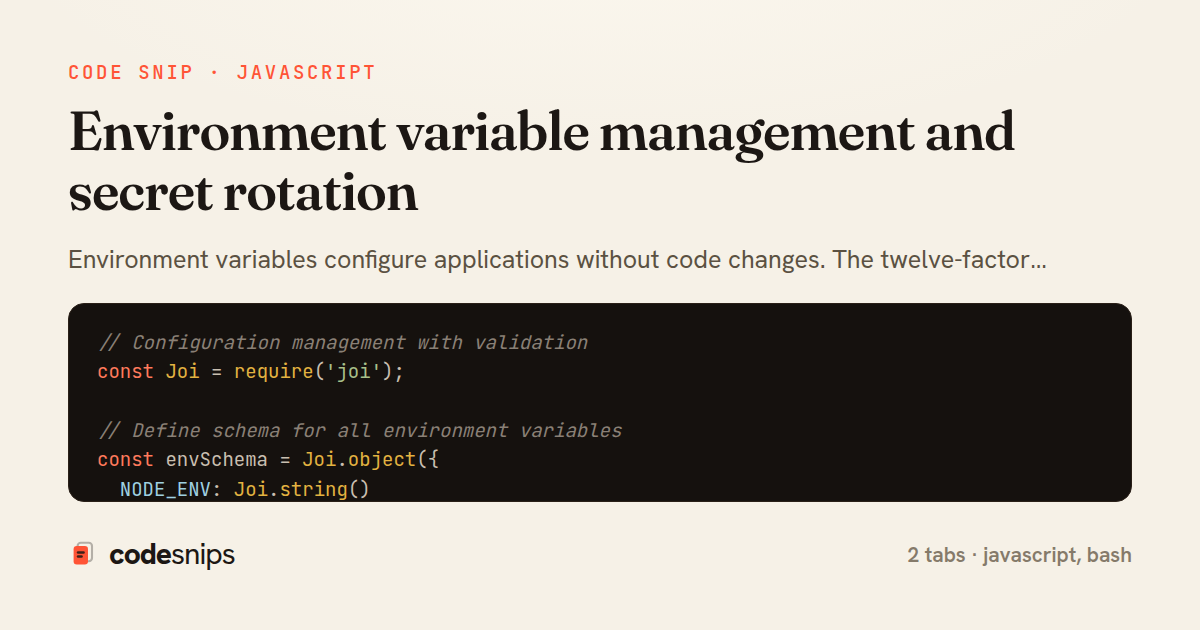
// Configuration management with validation
const Joi = require('joi');

// Define schema for all environment variables
const envSchema = Joi.object({
  NODE_ENV: Joi.string()
    .valid('development', 'staging', 'production', 'test')
    .default('development'),

  PORT: Joi.number().default(3000),
  HOST: Joi.string().default('0.0.0.0'),

  // Database
  DATABASE_URL: Joi.string().uri().required(),
  DB_POOL_MIN: Joi.number().default(2),
  DB_POOL_MAX: Joi.number().default(10),

  // Redis
  REDIS_URL: Joi.string().uri().required(),

  // Auth
  JWT_SECRET: Joi.string().min(32).required(),
  JWT_EXPIRY: Joi.string().default('24h'),

  // AWS
  AWS_REGION: Joi.string().default('us-east-1'),
  S3_BUCKET: Joi.string().required(),

  // External APIs
  STRIPE_SECRET_KEY: Joi.string().when('NODE_ENV', {
    is: 'production',
    then: Joi.required(),
    otherwise: Joi.optional(),
  }),

  // Feature flags
  ENABLE_CACHE: Joi.boolean().default(true),
  ENABLE_RATE_LIMIT: Joi.boolean().default(true),

  // Logging
  LOG_LEVEL: Joi.string()
    .valid('error', 'warn', 'info', 'debug')
    .default('info'),
})
  .unknown(true); // Allow other env vars

// Validate and export
const { error, value: config } = envSchema.validate(process.env, {
  abortEarly: false,
});

if (error) {
  const missing = error.details.map((d) => d.message).join('\n  ');
  console.error(`Configuration validation error:\n  ${missing}`);
  process.exit(1);
}

module.exports = {
  env: config.NODE_ENV,
  isProduction: config.NODE_ENV === 'production',
  isDevelopment: config.NODE_ENV === 'development',

  server: {
    port: config.PORT,
    host: config.HOST,
  },

  database: {
    url: config.DATABASE_URL,
    pool: {
      min: config.DB_POOL_MIN,
      max: config.DB_POOL_MAX,
    },
  },

  redis: {
    url: config.REDIS_URL,
  },

  auth: {
    jwtSecret: config.JWT_SECRET,
    jwtExpiry: config.JWT_EXPIRY,
  },

  aws: {
    region: config.AWS_REGION,
    s3Bucket: config.S3_BUCKET,
  },

  features: {
    cache: config.ENABLE_CACHE,
    rateLimit: config.ENABLE_RATE_LIMIT,
  },

  logging: {
    level: config.LOG_LEVEL,
  },
};
#!/bin/bash
set -euo pipefail

# Secret rotation script for AWS Secrets Manager

SECRET_NAME="myapp/production/database"
DB_HOST="mydb.cluster-abc123.us-east-1.rds.amazonaws.com"
DB_NAME="myapp"
DB_USER="app_user"

log() { echo "[$(date +'%Y-%m-%d %H:%M:%S')] $*"; }

rotate_database_password() {
  log "Starting database password rotation..."

  # 1. Generate new password
  NEW_PASSWORD=$(openssl rand -base64 32 | tr -d '/+=')
  log "New password generated"

  # 2. Update password in database
  CURRENT_SECRET=$(aws secretsmanager get-secret-value     --secret-id "$SECRET_NAME"     --query 'SecretString' --output text)
  CURRENT_PASSWORD=$(echo "$CURRENT_SECRET" | jq -r '.password')

  PGPASSWORD="$CURRENT_PASSWORD" psql     -h "$DB_HOST" -U "$DB_USER" -d "$DB_NAME"     -c "ALTER USER $DB_USER PASSWORD '$NEW_PASSWORD';"
  log "Database password updated"

  # 3. Update secret in Secrets Manager
  NEW_SECRET=$(echo "$CURRENT_SECRET" |     jq --arg pw "$NEW_PASSWORD" '.password = $pw')

  aws secretsmanager put-secret-value     --secret-id "$SECRET_NAME"     --secret-string "$NEW_SECRET"
  log "Secret Manager updated"

  # 4. Restart application to pick up new credentials
  kubectl rollout restart deployment/web-app -n production
  kubectl rollout status deployment/web-app -n production --timeout=300s
  log "Application restarted with new credentials"

  # 5. Verify connectivity
  sleep 10
  HTTP_CODE=$(curl -s -o /dev/null -w '%{http_code}'     https://app.example.com/health)

  if [[ "$HTTP_CODE" == "200" ]]; then
    log "Health check passed - rotation complete!"
  else
    log "ERROR: Health check failed (HTTP $HTTP_CODE)"
    log "Rolling back..."

    # Rollback database password
    PGPASSWORD="$NEW_PASSWORD" psql       -h "$DB_HOST" -U "$DB_USER" -d "$DB_NAME"       -c "ALTER USER $DB_USER PASSWORD '$CURRENT_PASSWORD';"

    aws secretsmanager put-secret-value       --secret-id "$SECRET_NAME"       --secret-string "$CURRENT_SECRET"

    kubectl rollout restart deployment/web-app -n production
    log "Rollback complete"
    exit 1
  fi
}

rotate_database_password
Environment variables configure applications without code changes. The twelve-factor app methodology stores config in the environment. .env files provide local defaults—never commit them to Git. dotenv libraries load .env files in development. Production secrets live in AWS Secrets Manager, HashiCorp Vault, or Kubernetes Secrets. Secret rotation updates credentials without downtime using dual-read patterns. AWS Secrets Manager supports automatic rotation with Lambda functions. Connection pooling libraries handle credential refresh transparently. Config validation at startup fails fast on missing variables. Environment-specific config files (production.env, staging.env) separate concerns. envsubst substitutes variables in templates. Secret scanning in CI prevents accidental credential commits.
Related snips
payload = {
  sub: user.id,
  iss: 'https://auth.example.com',
  aud: 'codesnips-api',
  exp: 15.minutes.from_now.to_i,
  iat: Time.now.to_i,
JWT issuance and verification without common footguns
#!/usr/bin/env bash
set -euo pipefail

export VAULT_ADDR="https://vault.internal:8200"
export VAULT_TOKEN="${VAULT_TOKEN:?missing VAULT_TOKEN}"
Secrets management with environment isolation and Vault
import { randomBytes, createHash } from "crypto";
import jwt from "jsonwebtoken";
import { RefreshTokenStore } from "./store";

const ACCESS_SECRET = process.env.ACCESS_SECRET!;
const ACCESS_TTL = "15m";
JWT access + refresh token rotation (conceptual)
package files

import (
  "context"
  "time"
Presigned S3 upload URLs (AWS SDK v2)
<%# private stream: turbo signs the serialized record name %>
<%= turbo_stream_from current_user %>

<section class="notifications">
  <h1>Notifications</h1>
Turbo Streams + authorization: signed per-user stream name
package api

import (
  "io"
  "net/http"
  "os"
Safe multipart uploads using temp files (bounded memory)
Share this code
Here's the card — post it anywhere.