python
21 lines · 1 tab
Dr. Elena Vasquez
Apr 2026
1 tab
import pandas as pd

customers = pd.read_parquet('customers.parquet')
orders = pd.read_parquet('orders.parquet')

assert customers['customer_id'].is_unique, 'customer table must be unique by customer_id'

enriched = orders.merge(
    customers[['customer_id', 'plan_tier', 'country']],
    on='customer_id',
    how='left',
    validate='many_to_one',
    indicator=True,
)

unmatched = enriched.loc[enriched['_merge'] != 'both', 'customer_id'].unique()
if len(unmatched) > 0:
    raise ValueError(f'missing customer dimension rows for {len(unmatched)} customer_ids')

enriched = enriched.drop(columns=['_merge'])
print(enriched.head())
1 file · python
Explain with highlit
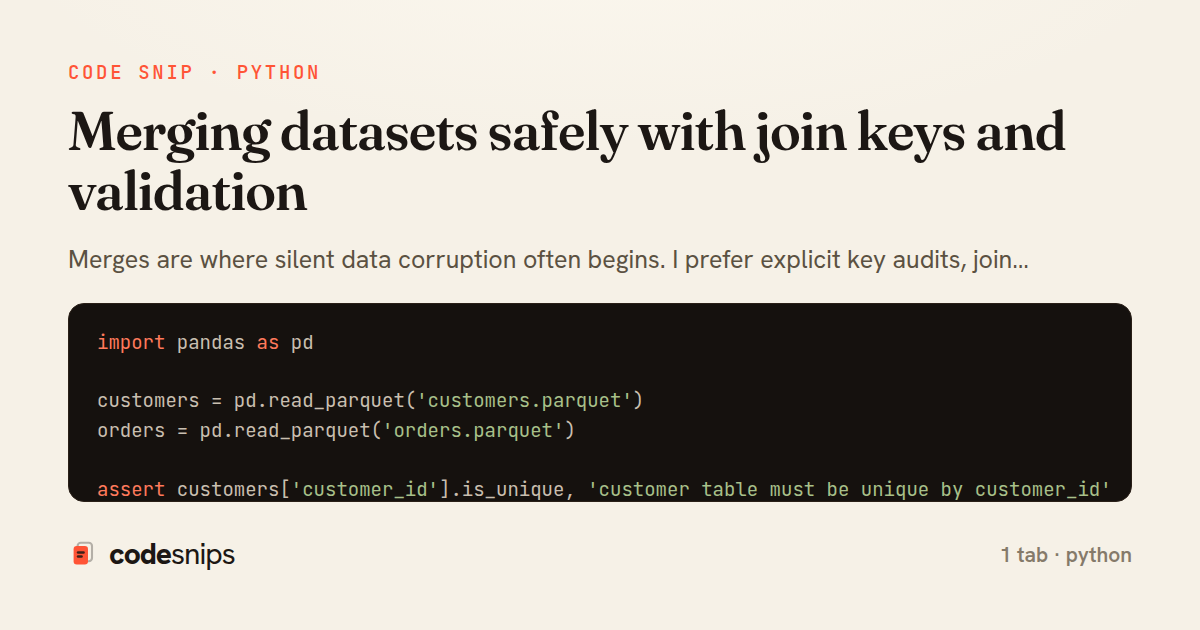
Merges are where silent data corruption often begins. I prefer explicit key audits, join cardinality validation, and indicator columns when investigating row loss or duplication. In production analytics, proving that a join is one_to_one or many_to_one is more valuable than making the code short.
Related snips
ruby
class SignupForm
  include ActiveModel::Model
  include ActiveModel::Attributes

  attribute :account_name, :string
  attribute :email, :string
Shallow Controller, Deep Params: Form Object Pattern
rails
activemodel
form-object
by codesnips
3 tabs
html
<!DOCTYPE html>
<html lang="en">
<head>
  <meta charset="UTF-8">
  <title>Form Validation Example</title>
  <style>
HTML forms with validation and accessibility
html
forms
validation
by Alex Chang
1 tab
typescript
import axios from 'axios';

export type NormalizedErrors = {
  fields: Record<string, string>;
  formLevel: string | null;
};
Frontend: normalize and display server validation errors
ux
typescript
react
by codesnips
3 tabs
python
import pandas as pd

df = pd.read_csv('customers.csv')

df.columns = df.columns.str.strip().str.lower().str.replace(' ', '_', regex=False)
Cleaning missing values and normalizing messy CSV exports
pandas
data-cleaning
missing-values
by Dr. Elena Vasquez
1 tab
python
import pandas as pd

df = pd.read_csv('traffic.csv', parse_dates=['timestamp'])
df['timestamp'] = pd.to_datetime(df['timestamp'], utc=True)
df = df.set_index('timestamp').sort_index()
Time series resampling and rolling windows in pandas
pandas
time-series
resampling
by Dr. Elena Vasquez
1 tab
php
<?php

namespace App\Http\Requests;

use Illuminate\Foundation\Http\FormRequest;
use Illuminate\Validation\Rule;
Laravel form requests for validation
laravel
validation
form-requests
by Carlos Mendez
2 tabs
Share this code
Here's the card — post it anywhere.