python
20 lines · 1 tab
Dr. Elena Vasquez
Apr 2026
1 tab
import pandas as pd

orders = pd.read_parquet('orders.parquet')
orders['ordered_at'] = pd.to_datetime(orders['ordered_at'])

reference_date = orders['ordered_at'].max() + pd.Timedelta(days=1)

features = (
    orders.groupby('customer_id')
    .agg(
        recency_days=('ordered_at', lambda values: (reference_date - values.max()).days),
        frequency=('order_id', 'nunique'),
        monetary=('amount', 'sum'),
        avg_basket=('amount', 'mean'),
    )
    .reset_index()
)

features['monetary_per_order'] = features['monetary'] / features['frequency'].clip(lower=1)
print(features.head())
1 file · python
Explain with highlit
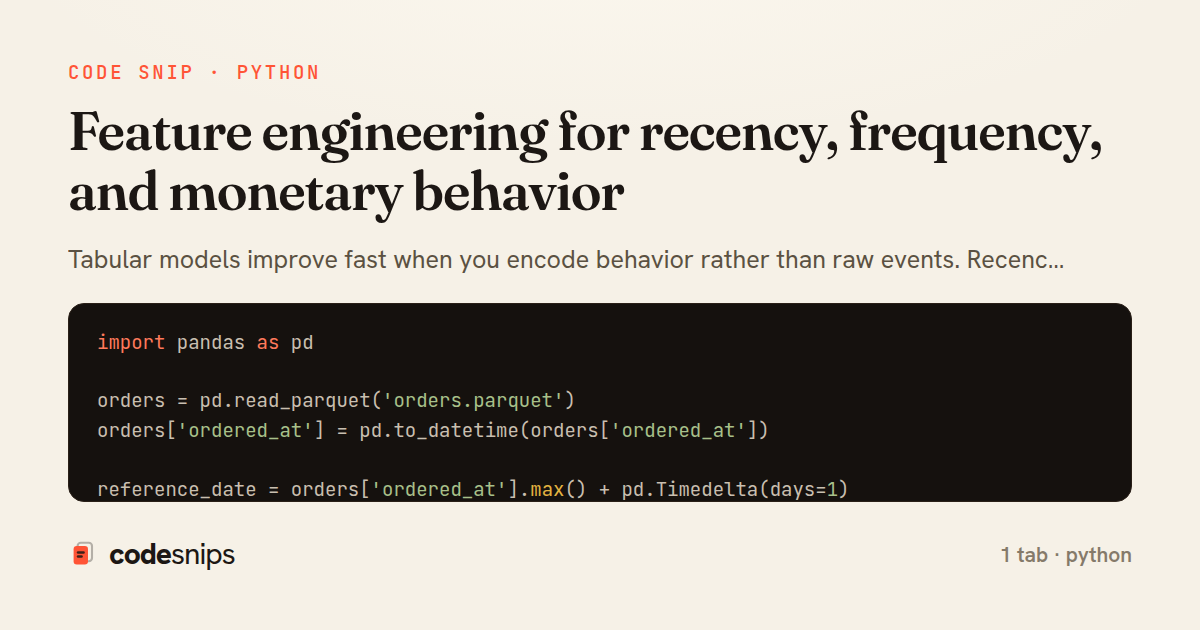
Tabular models improve fast when you encode behavior rather than raw events. Recency, frequency, and monetary aggregates are durable baseline features for retention, fraud, and conversion use cases. I usually build them in pure pandas first, then port them to a scheduled feature pipeline once the signal is proven.
Related snips
python
import pandas as pd

df = pd.read_csv('customers.csv')

df.columns = df.columns.str.strip().str.lower().str.replace(' ', '_', regex=False)
Cleaning missing values and normalizing messy CSV exports
pandas
data-cleaning
missing-values
by Dr. Elena Vasquez
1 tab
python
import pandas as pd

df = pd.read_csv('traffic.csv', parse_dates=['timestamp'])
df['timestamp'] = pd.to_datetime(df['timestamp'], utc=True)
df = df.set_index('timestamp').sort_index()
Time series resampling and rolling windows in pandas
pandas
time-series
resampling
by Dr. Elena Vasquez
1 tab
python
import pandas as pd
from sklearn.compose import ColumnTransformer
from sklearn.impute import SimpleImputer
from sklearn.pipeline import Pipeline
from sklearn.preprocessing import OneHotEncoder, StandardScaler
Encoding categorical variables without creating leakage
categorical-encoding
preprocessing
scikit-learn
by Dr. Elena Vasquez
1 tab
sql
WITH ordered_events AS (
  SELECT
    customer_id,
    event_time,
    revenue,
    ROW_NUMBER() OVER (PARTITION BY customer_id ORDER BY event_time DESC) AS event_rank,
SQL window functions for feature extraction and behavioral ranking
sql
window-functions
feature-engineering
by Dr. Elena Vasquez
1 tab
python
import pandas as pd

df = pd.read_parquet('events.parquet')
df['event_date'] = pd.to_datetime(df['event_date'])
df['month'] = df['event_date'].dt.to_period('M').astype(str)
GroupBy aggregations and pivot tables for business reporting
pandas
groupby
pivot-table
by Dr. Elena Vasquez
1 tab
python
import pandas as pd

df = pd.read_csv(
    'orders.csv',
    parse_dates=['created_at'],
    dtype={
pandas DataFrame essentials: loading, indexing, and selection
pandas
python
dataframe
by Dr. Elena Vasquez
1 tab
Share this code
Here's the card — post it anywhere.