python
22 lines · 1 tab
Dr. Elena Vasquez
Apr 2026
1 tab
from sklearn.pipeline import Pipeline
from sklearn.preprocessing import StandardScaler, MinMaxScaler, RobustScaler
from sklearn.linear_model import LogisticRegression

standard_pipeline = Pipeline([
    ('scaler', StandardScaler()),
    ('model', LogisticRegression(max_iter=1000)),
])

robust_pipeline = Pipeline([
    ('scaler', RobustScaler()),
    ('model', LogisticRegression(max_iter=1000)),
])

minmax_pipeline = Pipeline([
    ('scaler', MinMaxScaler()),
    ('model', LogisticRegression(max_iter=1000)),
])

print(standard_pipeline)
print(robust_pipeline)
print(minmax_pipeline)
1 file · python
Explain with highlit
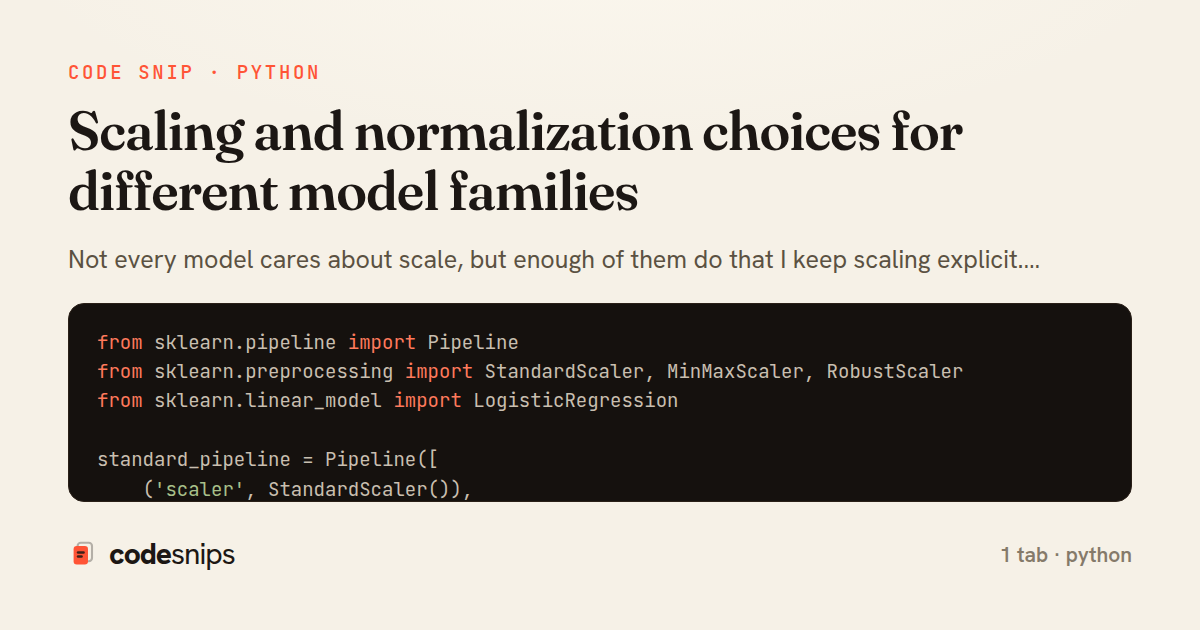
Not every model cares about scale, but enough of them do that I keep scaling explicit. Linear models, SVMs, neural nets, and distance-based methods all benefit from well-behaved inputs. I prefer putting scalers inside the pipeline so train and inference paths cannot drift apart.
Related snips
ruby
module EmailNormalization
  extend ActiveSupport::Concern

  included do
    attr_accessor :soft_warnings
Soft Validation: Normalize + Validate Email
rails
activerecord
validations
by codesnips
4 tabs
ruby
class CreateTags < ActiveRecord::Migration[7.0]
  def change
    create_table :tags do |t|
      t.string :name, null: false
      t.integer :taggings_count, null: false, default: 0
      t.timestamps
Normalize Tags at Write Time
rails
activerecord
callbacks
by codesnips
3 tabs
python
import pandas as pd

df = pd.read_parquet('churn_training.parquet')

print('shape:', df.shape)
print('target balance:', df['churned'].value_counts(normalize=True).round(3))
Exploratory data analysis checklist for tabular ML projects
eda
machine-learning
tabular-data
by Dr. Elena Vasquez
1 tab
go
package workpool

import (
	"context"
	"sync"
)
Bounded Worker Pool Processing Jobs from a Buffered Channel in Go
go
concurrency
worker-pool
by codesnips
3 tabs
typescript
export interface Post {
  id: string;
  title: string;
  updatedAt: string;
}
Deduplicating Paginated API Results With a Normalized Entity Store and Reducer
react
reducer
normalization
by codesnips
3 tabs
python
from sklearn.compose import ColumnTransformer
from sklearn.feature_extraction.text import TfidfVectorizer
from sklearn.impute import SimpleImputer
from sklearn.pipeline import Pipeline
from sklearn.preprocessing import OneHotEncoder, StandardScaler
from sklearn.ensemble import RandomForestClassifier
ColumnTransformer pipelines that keep preprocessing honest
scikit-learn
pipelines
columntransformer
by Dr. Elena Vasquez
1 tab
Share this code
Here's the card — post it anywhere.