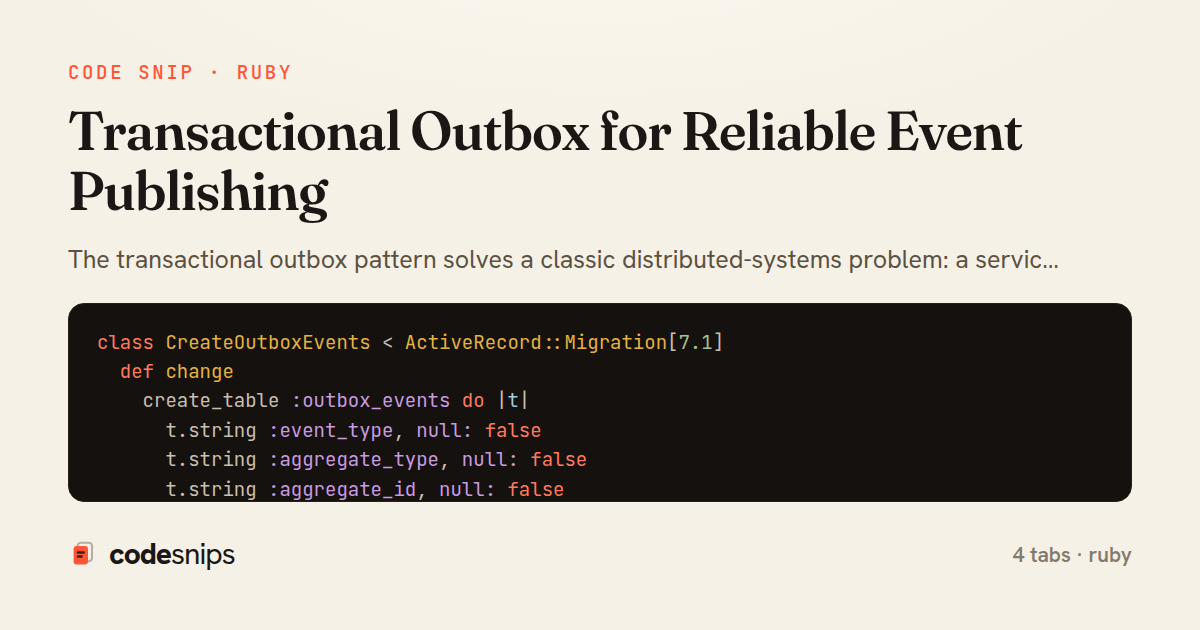
class CreateOutboxEvents < ActiveRecord::Migration[7.1]
  def change
    create_table :outbox_events do |t|
      t.string :event_type, null: false
      t.string :aggregate_type, null: false
      t.string :aggregate_id, null: false
      t.string :dedupe_key, null: false
      t.jsonb :payload, null: false, default: {}
      t.datetime :published_at
      t.integer :attempts, null: false, default: 0
      t.timestamps
    end

    add_index :outbox_events, :dedupe_key, unique: true
    add_index :outbox_events, :id,
              where: "published_at IS NULL",
              name: "index_outbox_events_unpublished"
  end
end
class OutboxEvent < ApplicationRecord
  scope :unpublished, -> { where(published_at: nil).order(:id) }

  def self.record!(event_type:, aggregate:, payload:, dedupe_key: nil)
    key = dedupe_key || default_dedupe_key(event_type, aggregate)

    insert_all(
      [{
        event_type: event_type,
        aggregate_type: aggregate.class.name,
        aggregate_id: aggregate.id.to_s,
        dedupe_key: key,
        payload: payload,
        created_at: Time.current,
        updated_at: Time.current
      }],
      unique_by: :dedupe_key
    )
  end

  def envelope
    {
      id: dedupe_key,
      type: event_type,
      aggregate: { type: aggregate_type, id: aggregate_id },
      data: payload,
      occurred_at: created_at.iso8601
    }
  end

  def mark_published!
    update_columns(published_at: Time.current, updated_at: Time.current)
  end

  def self.default_dedupe_key(event_type, aggregate)
    Digest::SHA256.hexdigest("#{event_type}:#{aggregate.class.name}:#{aggregate.id}")
  end
end
class OrderService
  def self.place(customer:, line_items:)
    order = nil

    ActiveRecord::Base.transaction do
      order = Order.create!(
        customer: customer,
        line_items_attributes: line_items,
        status: "placed"
      )

      OutboxEvent.record!(
        event_type: "order.placed",
        aggregate: order,
        payload: {
          order_id: order.id,
          customer_id: customer.id,
          total_cents: order.total_cents,
          currency: order.currency
        }
      )
    end

    OutboxRelayJob.perform_async
    order
  end
end
class OutboxRelayJob
  include Sidekiq::Job

  sidekiq_options queue: :outbox, retry: 5

  BATCH_SIZE = 100

  def perform
    processed = 0

    ActiveRecord::Base.transaction do
      events = OutboxEvent
               .unpublished
               .lock("FOR UPDATE SKIP LOCKED")
               .limit(BATCH_SIZE)
               .to_a

      events.each do |event|
        publish(event)
        event.mark_published!
        processed += 1
      end
    end

    OutboxRelayJob.perform_async if processed == BATCH_SIZE
  end

  private

  def publish(event)
    EventBroker.publish(
      topic: event.aggregate_type.underscore,
      key: event.aggregate_id,
      message: event.envelope
    )
  rescue EventBroker::PublishError => e
    event.increment!(:attempts)
    raise e
  end
end
The transactional outbox pattern solves a classic distributed-systems problem: a service needs to update its database and publish an event to a broker (Kafka, SNS, RabbitMQ), but there is no shared transaction across the two systems. If the code writes to the DB and then publishes, a crash in between drops the event; if it publishes first, a rolled-back transaction leaves a phantom event. The outbox sidesteps this by writing the event into a table inside the same transaction as the business change, then relaying it asynchronously.
The create_outbox_events migration sets up that durable queue. Each row carries an aggregate_type/aggregate_id for ordering context, a JSONB payload, and a dedupe_key with a unique index so retries never enqueue the same logical event twice. The partial index on published_at IS NULL keeps the relay's polling query fast even as the table grows, since only unpublished rows are indexed.
In OutboxEvent model, record! is the enrolment point. It is called from within the caller's transaction so the event and the aggregate commit atomically. The dedupe_key defaults to a deterministic hash of the event type and aggregate, and insert_all with unique_by makes insertion idempotent under concurrent writers. unpublished orders by id to preserve rough causal order, and mark_published! stamps published_at so the relay skips it next cycle.
The OrderService shows the pattern in use: inside a single transaction block it persists the Order and calls OutboxEvent.record!. Because both writes share the transaction, either both land or neither does — there is no window where an order exists without its event, or vice versa.
The OutboxRelayJob is the poller. It claims a batch with FOR UPDATE SKIP LOCKED, which lets multiple relay workers run in parallel without processing the same row twice. Each event is handed to the broker and marked published individually, so a publish failure only affects one row and leaves the rest recoverable. The job re-enqueues itself when a full batch is drained, draining backlog aggressively. The key trade-off is at-least-once delivery: consumers must be idempotent, which is why the dedupe_key is propagated into the payload envelope.
Related snips
class CommentsController < ApplicationController
  before_action :set_post

  def create
    @comment = @post.comments.build(comment_params)
System test: asserting Turbo Stream responses
class Post < ApplicationRecord
  belongs_to :author, class_name: 'User'
  has_many :comments, dependent: :destroy

  scope :published, -> { where.not(published_at: nil).where('published_at <= ?', Time.current) }
  scope :draft, -> { where(published_at: nil) }
ActiveRecord scopes for reusable query logic
export interface RetryOptions {
  retries: number;
  baseMs: number;
  maxMs: number;
  signal?: AbortSignal;
  onRetry?: (attempt: number, delay: number, err: unknown) => void;
Exponential backoff with jitter for retries
module Api
  module V1
    class UsersController < BaseController
      def show
        user = User.includes(:profile).find(params[:id])
ETags for conditional requests and caching
class PostsController < ApplicationController
  def index
    @posts = Post.includes(:author)
                 .order(created_at: :desc)
                 .page(params[:page])
                 .per(10)
Turbo Frames: infinite scroll with lazy-loading frame
package dbutil

import (
  "context"

  "github.com/jackc/pgconn"
Retry Postgres serialization failures with bounded attempts
Share this code
Here's the card — post it anywhere.