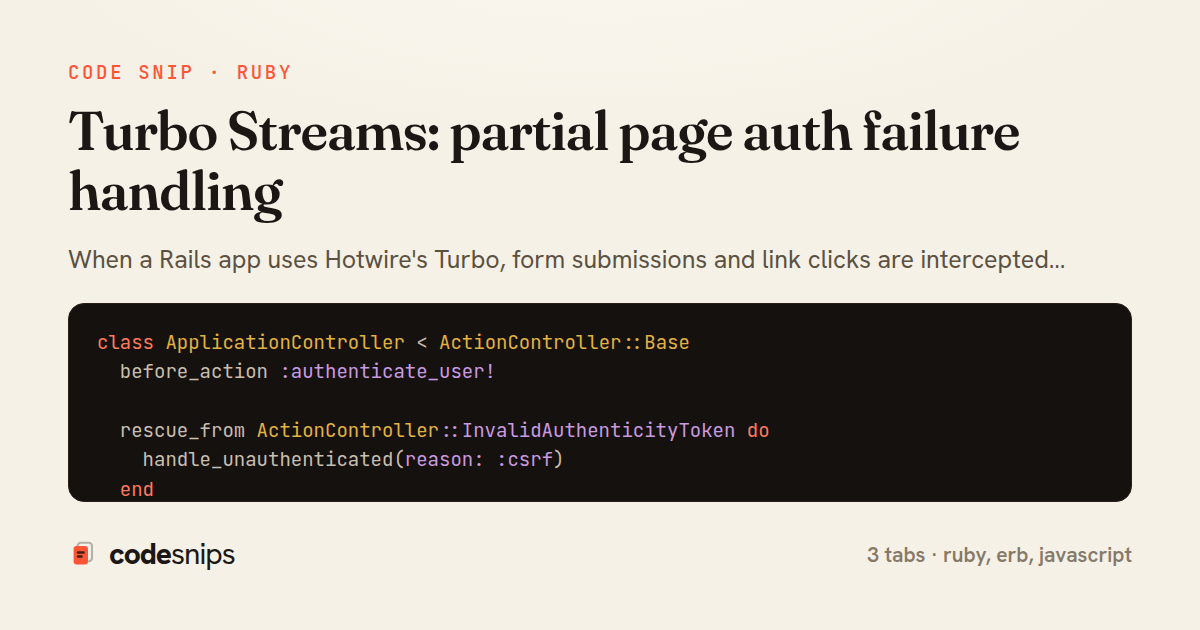
class ApplicationController < ActionController::Base
  before_action :authenticate_user!

  rescue_from ActionController::InvalidAuthenticityToken do
    handle_unauthenticated(reason: :csrf)
  end

  private

  def authenticate_user!
    return if current_user.present?

    handle_unauthenticated(reason: :session)
  end

  def handle_unauthenticated(reason:)
    store_return_location
    flash.now[:alert] = unauthenticated_message(reason)

    respond_to do |format|
      format.html { redirect_to new_session_path, alert: flash.now[:alert] }
      format.turbo_stream do
        @redirect_url = new_session_path
        render "shared/auth_failure", status: :unauthorized
      end
      format.any { head :unauthorized }
    end
  end

  def store_return_location
    return unless request.get? && !request.xhr?

    session[:return_to] = request.fullpath
  end

  def unauthenticated_message(reason)
    reason == :csrf ? "Your session was interrupted. Please sign in again." : "Please sign in to continue."
  end
end
<%= turbo_stream.replace "flash" do %>
  <div id="flash" class="flash flash--alert" role="alert">
    <%= flash.now[:alert] %>
  </div>
<% end %>

<turbo-stream action="redirect" url="<%= @redirect_url %>"></turbo-stream>
import { Turbo } from "@hotwired/turbo-rails"

Turbo.StreamActions.redirect = function () {
  const url = this.getAttribute("url")
  if (!url) return

  const delay = parseInt(this.getAttribute("delay") || "0", 10)

  const navigate = () => {
    Turbo.cache.clear()
    Turbo.visit(url, { action: "replace" })
  }

  if (delay > 0) {
    window.setTimeout(navigate, delay)
  } else {
    navigate()
  }
}
When a Rails app uses Hotwire's Turbo, form submissions and link clicks are intercepted and sent as fetch requests that expect a Turbo Stream or full-page response. This creates a subtle problem: when a session expires mid-session, a normal redirect_to login_path returns a 302 that Turbo silently follows, and the resulting login page HTML gets swapped into a tiny stream target — producing a broken partial render instead of a clean redirect. The files here show a coherent way to make authentication failures behave correctly inside Turbo requests.
In ApplicationController the entry point is authenticate_user!, called via a before_action. Rather than always redirecting, it inspects request.format and branches through handle_unauthenticated. For HTML it redirects as usual, but for a TURBO_STREAM request it renders a Turbo Stream that replaces a global flash region and, crucially, emits a custom redirect stream action. The status: :unauthorized code and Turbo-Frame awareness keep Turbo from treating the body as a normal navigation.
The auth_failure.turbo_stream.erb template is the payload. It uses turbo_stream.replace to update the flash and a custom <turbo-stream action="redirect"> element carrying the target URL in a data attribute. Turbo does not know this action natively, so the browser side must teach it.
That is the role of redirect_controller.js, a Stimulus-style registration of a custom StreamActions.redirect. When Turbo processes the stream it invokes this function, which reads getAttribute("url") and performs Turbo.visit(...) with action: "replace", giving a real navigation to the login page rather than a fragment swap.
The trade-off is a small amount of client code in exchange for correct behavior across every Turbo interaction, including frames and streams. A common pitfall is forgetting the :unauthorized status — without it some flows still try to merge the body. Another is CSRF: expired sessions often also invalidate the token, so rescue_from ActionController::InvalidAuthenticityToken is routed through the same handler for consistency. This pattern is worth reaching for whenever an app mixes long-lived pages with Turbo-driven updates and needs session expiry to feel seamless rather than broken.
Related snips
class CommentsController < ApplicationController
  before_action :set_post

  def create
    @comment = @post.comments.build(comment_params)
System test: asserting Turbo Stream responses
class Post < ApplicationRecord
  belongs_to :author, class_name: 'User'
  has_many :comments, dependent: :destroy

  scope :published, -> { where.not(published_at: nil).where('published_at <= ?', Time.current) }
  scope :draft, -> { where(published_at: nil) }
ActiveRecord scopes for reusable query logic
payload = {
  sub: user.id,
  iss: 'https://auth.example.com',
  aud: 'codesnips-api',
  exp: 15.minutes.from_now.to_i,
  iat: Time.now.to_i,
JWT issuance and verification without common footguns
module Api
  module V1
    class UsersController < BaseController
      def show
        user = User.includes(:profile).find(params[:id])
ETags for conditional requests and caching
class PostsController < ApplicationController
  def index
    @posts = Post.includes(:author)
                 .order(created_at: :desc)
                 .page(params[:page])
                 .per(10)
Turbo Frames: infinite scroll with lazy-loading frame
require "csv"

class PeopleCsvStream
  include Enumerable

  HEADERS = %w[id full_name email signed_up_at plan].freeze
Resilient CSV Export as a Streamed Response
Share this code
Here's the card — post it anywhere.