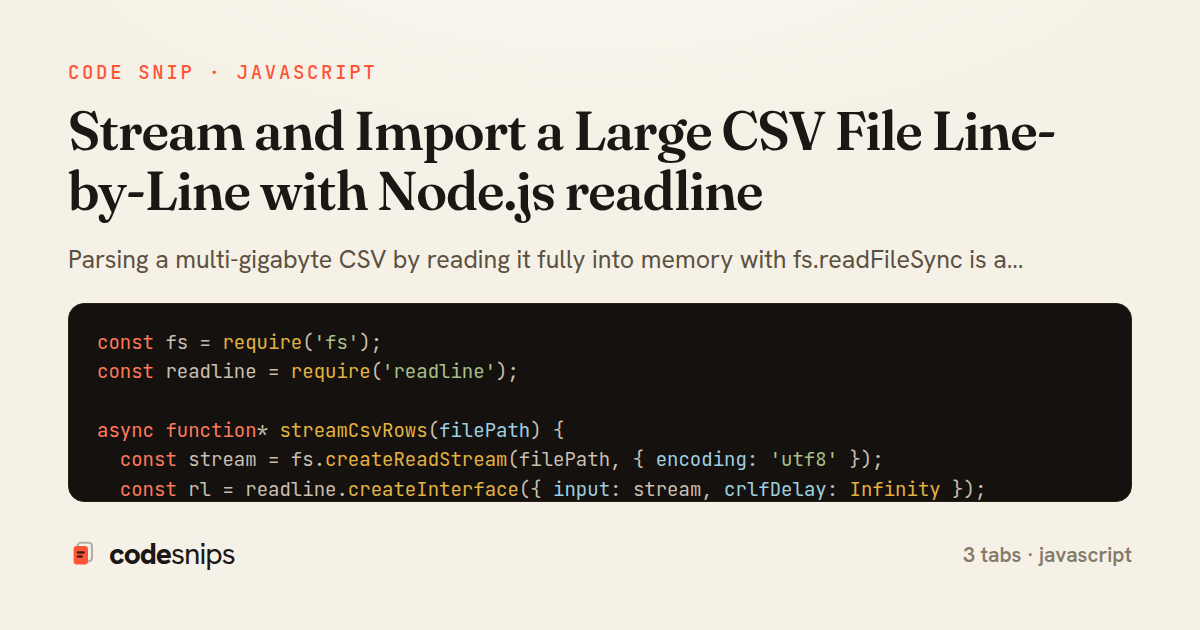
const fs = require('fs');
const readline = require('readline');

async function* streamCsvRows(filePath) {
  const stream = fs.createReadStream(filePath, { encoding: 'utf8' });
  const rl = readline.createInterface({ input: stream, crlfDelay: Infinity });

  let header = null;

  for await (const rawLine of rl) {
    const line = rawLine.trim();
    if (line === '') continue;

    const cells = line.split(',');

    if (header === null) {
      header = cells.map((c) => c.trim());
      continue;
    }

    const row = {};
    for (let i = 0; i < header.length; i++) {
      row[header[i]] = cells[i] !== undefined ? cells[i].trim() : null;
    }
    yield row;
  }
}

module.exports = { streamCsvRows };
const { streamCsvRows } = require('./csvLineStream');

const BATCH_SIZE = 500;

async function flush(pool, rows) {
  if (rows.length === 0) return;

  const values = [];
  const placeholders = rows.map((row, r) => {
    const base = r * 3;
    values.push(row.email, row.name, row.country);
    return `($${base + 1}, $${base + 2}, $${base + 3})`;
  });

  await pool.query(
    `INSERT INTO users (email, name, country)
     VALUES ${placeholders.join(', ')}
     ON CONFLICT (email) DO NOTHING`,
    values
  );
}

async function importCsv(pool, filePath) {
  let batch = [];
  let imported = 0;

  for await (const row of streamCsvRows(filePath)) {
    batch.push(row);
    if (batch.length >= BATCH_SIZE) {
      await flush(pool, batch);
      imported += batch.length;
      batch = [];
    }
  }

  await flush(pool, batch);
  imported += batch.length;
  return imported;
}

module.exports = { importCsv };
const { Pool } = require('pg');
const { importCsv } = require('./batchImport');

async function main() {
  const filePath = process.argv[2];
  if (!filePath) {
    console.error('Usage: node import-users.js <path-to-csv>');
    process.exit(1);
  }

  const pool = new Pool({ connectionString: process.env.DATABASE_URL });

  try {
    const started = Date.now();
    const count = await importCsv(pool, filePath);
    const seconds = ((Date.now() - started) / 1000).toFixed(1);
    console.log(`Imported ${count} rows in ${seconds}s`);
  } catch (err) {
    console.error('Import failed:', err.message);
    process.exitCode = 1;
  } finally {
    await pool.end();
  }
}

main();
Parsing a multi-gigabyte CSV by reading it fully into memory with fs.readFileSync is a common way to crash a Node process. The idiomatic alternative is to treat the file as a stream and consume it one line at a time, which keeps memory bounded regardless of file size. This snippet builds a small CSV import pipeline around Node's built-in readline module, batching rows into database inserts.
In csvLineStream.js, fs.createReadStream opens the file as a readable byte stream and readline.createInterface wraps it, emitting one logical line at a time. The crlfDelay: Infinity option makes readline treat \r\n as a single break so Windows-authored files parse correctly. Because a readline.Interface is an async iterable, the code exposes a clean async function* generator: the first non-empty line is parsed as the header, and every subsequent line is split on commas and zipped into an object keyed by column name. Yielding from a generator gives the consumer natural backpressure — the file is only read as fast as the consumer pulls rows, so a slow database will not let the buffer grow unbounded.
batchImport.js drives that generator with for await...of, which is the modern, readable way to consume async iterators. Rather than inserting one row per statement, rows accumulate into a batch array and are flushed with flush once they reach BATCH_SIZE, dramatically cutting round-trips. A trailing flush after the loop handles the final partial batch. Errors from either the stream or a failed insert propagate out of the await, so a single try/catch at the call site covers the whole pipeline.
import-users.js is the thin entry point wiring a pg Pool to the importer and closing it in a finally. The key trade-off of this design is throughput versus simplicity: it does no CSV-quote handling, so embedded commas or quoted newlines would need a real parser like csv-parse. For clean, well-formed exports it is fast, dependency-light, and constant-memory — exactly what an ETL job streaming from disk needs.
Related snips
package dbutil

import (
  "context"

  "github.com/jackc/pgconn"
Retry Postgres serialization failures with bounded attempts
require "csv"

class PeopleCsvStream
  include Enumerable

  HEADERS = %w[id full_name email signed_up_at plan].freeze
Resilient CSV Export as a Streamed Response
export type Settled<R> =
  | { status: 'fulfilled'; value: R }
  | { status: 'rejected'; reason: unknown };

export interface ConcurrencyOptions {
  limit: number;
Simple concurrency limiter for batch operations
class AddSettingsToAccounts < ActiveRecord::Migration[7.1]
  disable_ddl_transaction!

  def change
    add_column :accounts, :settings, :jsonb, null: false, default: {}
Postgres JSONB Partial Index for Feature Flags
module EmailNormalization
  extend ActiveSupport::Concern

  included do
    attr_accessor :soft_warnings
Soft Validation: Normalize + Validate Email
package pools

import (
  "bytes"
  "sync"
)
sync.Pool for bytes.Buffer to reduce allocations in hot paths
Share this code
Here's the card — post it anywhere.