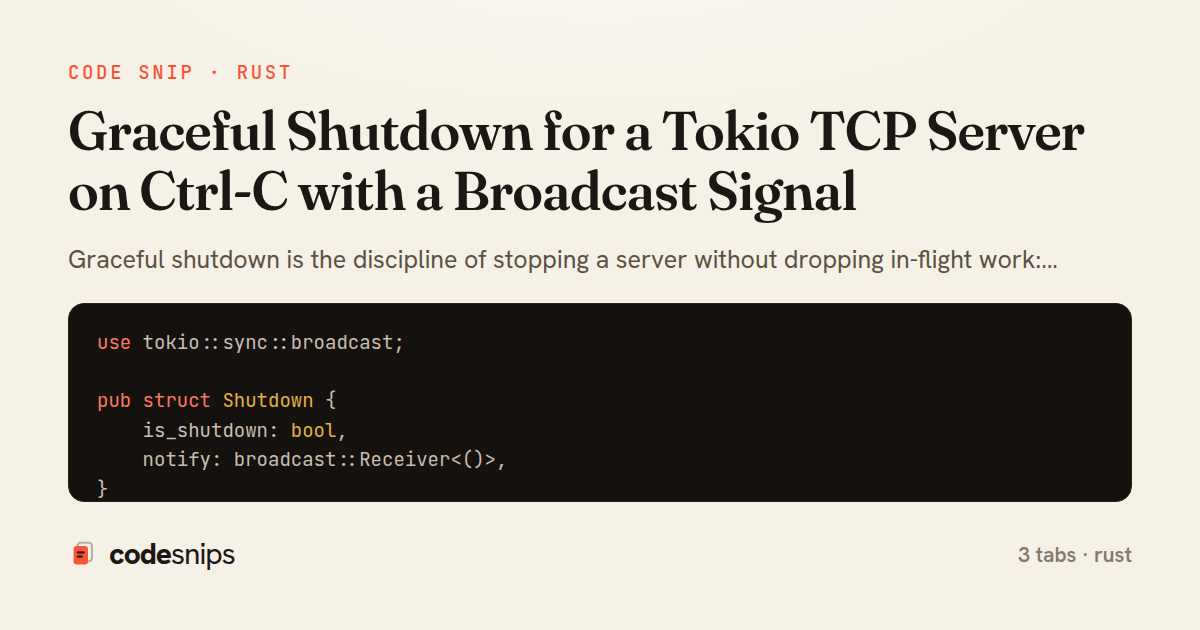
use tokio::sync::broadcast;

pub struct Shutdown {
    is_shutdown: bool,
    notify: broadcast::Receiver<()>,
}

impl Shutdown {
    pub fn new(notify: broadcast::Receiver<()>) -> Shutdown {
        Shutdown {
            is_shutdown: false,
            notify,
        }
    }

    pub fn is_shutdown(&self) -> bool {
        self.is_shutdown
    }

    pub async fn recv(&mut self) {
        if self.is_shutdown {
            return;
        }

        // A closed sender also counts as a shutdown request.
        let _ = self.notify.recv().await;
        self.is_shutdown = true;
    }
}
use crate::shutdown::Shutdown;
use tokio::io::{AsyncReadExt, AsyncWriteExt};
use tokio::net::{TcpListener, TcpStream};
use tokio::sync::broadcast;
use tokio_util::task::TaskTracker;

pub struct Listener {
    pub listener: TcpListener,
    pub notify_shutdown: broadcast::Sender<()>,
    pub tracker: TaskTracker,
}

struct Handler {
    stream: TcpStream,
    shutdown: Shutdown,
}

impl Listener {
    pub async fn run(&mut self) -> std::io::Result<()> {
        loop {
            let (stream, addr) = self.listener.accept().await?;
            tracing::info!(%addr, "accepted connection");

            let mut handler = Handler {
                stream,
                shutdown: Shutdown::new(self.notify_shutdown.subscribe()),
            };

            self.tracker.spawn(async move {
                if let Err(err) = handler.run().await {
                    tracing::warn!(?err, "connection error");
                }
            });
        }
    }
}

impl Handler {
    async fn run(&mut self) -> std::io::Result<()> {
        let mut buf = [0u8; 1024];

        while !self.shutdown.is_shutdown() {
            let n = tokio::select! {
                res = self.stream.read(&mut buf) => res?,
                _ = self.shutdown.recv() => {
                    self.stream.write_all(b"server shutting down\n").await?;
                    return Ok(());
                }
            };

            if n == 0 {
                return Ok(()); // client closed the socket
            }
            self.stream.write_all(&buf[..n]).await?;
        }

        Ok(())
    }
}
mod server;
mod shutdown;

use server::Listener;
use tokio::net::TcpListener;
use tokio::signal;
use tokio::sync::broadcast;
use tokio_util::task::TaskTracker;

#[tokio::main]
async fn main() -> std::io::Result<()> {
    tracing_subscriber::fmt::init();

    let listener = TcpListener::bind("127.0.0.1:6379").await?;
    let (notify_shutdown, _) = broadcast::channel::<()>(1);
    let tracker = TaskTracker::new();

    let mut server = Listener {
        listener,
        notify_shutdown: notify_shutdown.clone(),
        tracker: tracker.clone(),
    };

    tokio::select! {
        res = server.run() => {
            if let Err(err) = res {
                tracing::error!(?err, "accept loop failed");
            }
        }
        _ = signal::ctrl_c() => {
            tracing::info!("ctrl-c received, draining connections");
        }
    }

    // Dropping every sender broadcasts the shutdown to live handlers.
    drop(notify_shutdown);
    drop(server);

    tracker.close();
    tracker.wait().await;

    tracing::info!("shutdown complete");
    Ok(())
}
Graceful shutdown is the discipline of stopping a server without dropping in-flight work: the listener stops accepting new connections, existing connections are given a chance to finish, and the process exits only once everything has drained. This snippet wires that behavior into a tokio TCP server using a broadcast channel as a fan-out cancellation signal plus a TaskTracker to wait for outstanding tasks.
In shutdown.rs, the Shutdown type wraps a single-value broadcast::Receiver<()>. Every connection handler holds its own clone-derived receiver, and Shutdown::recv awaits the signal exactly once, latching is_shutdown so subsequent calls return immediately. A broadcast channel is chosen over a one-shot because the same shutdown notification must reach an arbitrary number of live connections simultaneously; sending on the paired Sender wakes them all. The notified flag guards against the common pitfall of awaiting an already-closed channel in a loop.
In server.rs, Listener::run owns the TcpListener, the broadcast::Sender used to hand out receivers, and a TaskTracker that records every spawned handler. The core is a tokio::select! that races listener.accept() against notify_shutdown in the handler; when a connection arrives, a new Handler is spawned onto the tracker with its own Shutdown::new(notify_shutdown.subscribe()). Each Handler::run again uses select! so a blocking read on the socket is interruptible — if the shutdown fires mid-read, the branch cancels the pending future and the handler returns cleanly rather than hanging.
In main.rs, signal::ctrl_c is awaited alongside the server via select!. When Ctrl-C lands, the server future is dropped (halting accept), then dropping the notify_shutdown sender broadcasts the signal, tracker.close() marks the tracker complete, and tracker.wait() blocks until every in-flight Handler finishes. This ordering matters: closing the tracker before all tasks are spawned would let wait() return early. The trade-off is that truly stuck handlers can still stall exit, so production code usually wraps the final wait() in a tokio::time::timeout to bound the drain window. This pattern generalizes to any accept-loop service where clean draining beats an abrupt process::exit.
Related snips
export interface RetryOptions {
  retries: number;
  baseMs: number;
  maxMs: number;
  signal?: AbortSignal;
  onRetry?: (attempt: number, delay: number, err: unknown) => void;
Exponential backoff with jitter for retries
class Product(models.Model):
    name = models.CharField(max_length=200)
    slug = models.SlugField(blank=True)
    price = models.DecimalField(max_digits=10, decimal_places=2)
    cost = models.DecimalField(max_digits=10, decimal_places=2)
    margin = models.DecimalField(max_digits=5, decimal_places=2, blank=True)
Django model signals vs overriding save
// Creating a Promise
const myPromise = new Promise((resolve, reject) => {
  const success = true;

  setTimeout(() => {
    if (success) {
Promises and async/await patterns for asynchronous JavaScript
use crossbeam::channel::unbounded;
use std::thread;

fn main() {
    let (tx, rx) = unbounded();
Crossbeam for advanced concurrent data structures
use std::sync::mpsc;
use std::thread;

fn main() {
    let (tx, rx) = mpsc::channel();
Channels (mpsc) for message passing between threads
export type Settled<R> =
  | { status: 'fulfilled'; value: R }
  | { status: 'rejected'; reason: unknown };

export interface ConcurrencyOptions {
  limit: number;
Simple concurrency limiter for batch operations
Share this code
Here's the card — post it anywhere.