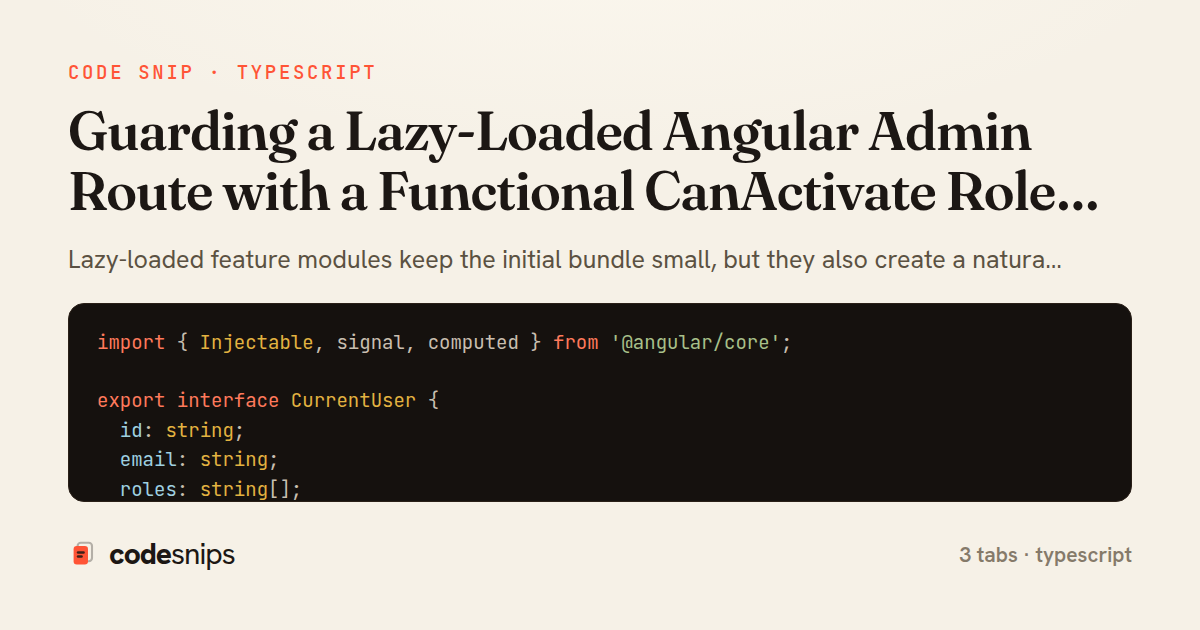
import { Injectable, signal, computed } from '@angular/core';

export interface CurrentUser {
  id: string;
  email: string;
  roles: string[];
}

@Injectable({ providedIn: 'root' })
export class AuthService {
  private readonly user = signal<CurrentUser | null>(null);

  readonly isLoggedIn = computed(() => this.user() !== null);

  setUser(user: CurrentUser | null): void {
    this.user.set(user);
  }

  hasRole(role: string): boolean {
    const current = this.user();
    return current !== null && current.roles.includes(role);
  }
}
import { inject } from '@angular/core';
import { CanActivateFn, Router } from '@angular/router';
import { AuthService } from './auth.service';

export function requireRole(role: string): CanActivateFn {
  return (route, state) => {
    const auth = inject(AuthService);
    const router = inject(Router);

    if (!auth.isLoggedIn()) {
      return router.parseUrl(`/login?returnUrl=${encodeURIComponent(state.url)}`);
    }

    if (auth.hasRole(role)) {
      return true;
    }

    // Authenticated but unauthorized: send to a friendly denial page.
    return router.parseUrl('/forbidden');
  };
}

export const authGuard: CanActivateFn = (route, state) => {
  const auth = inject(AuthService);
  const router = inject(Router);
  return auth.isLoggedIn()
    ? true
    : router.parseUrl(`/login?returnUrl=${encodeURIComponent(state.url)}`);
};
import { Routes } from '@angular/router';
import { authGuard, requireRole } from './admin.guard';

export const routes: Routes = [
  {
    path: '',
    loadComponent: () =>
      import('./home/home.component').then((m) => m.HomeComponent),
  },
  {
    path: 'dashboard',
    canActivate: [authGuard],
    loadComponent: () =>
      import('./dashboard/dashboard.component').then((m) => m.DashboardComponent),
  },
  {
    path: 'admin',
    canActivate: [requireRole('admin')],
    loadChildren: () =>
      import('./admin/admin.routes').then((m) => m.ADMIN_ROUTES),
  },
  {
    path: 'login',
    loadComponent: () =>
      import('./login/login.component').then((m) => m.LoginComponent),
  },
  {
    path: 'forbidden',
    loadComponent: () =>
      import('./errors/forbidden.component').then((m) => m.ForbiddenComponent),
  },
  { path: '**', redirectTo: '' },
];
Lazy-loaded feature modules keep the initial bundle small, but they also create a natural authorization boundary: the admin chunk should never even download for a user who lacks the right role, and its routes should never render if the role check fails. This snippet wires a functional CanActivate guard onto a loadChildren route so both concerns are handled in one place.
In auth.service.ts, the current user is exposed through a signal, and hasRole derives authorization state synchronously from that signal. Keeping roles in a signal means the guard can read them without subscribing, and any component can react to login changes reactively. The service is providedIn: 'root' so the same instance is shared by the guard, the components, and the app shell.
admin.guard.ts shows the modern functional guard style: authGuard is a plain CanActivateFn, so it runs inside an injection context and uses inject() to pull in AuthService and Router rather than being a class with a constructor. The requireRole factory closes over a role string and returns a fresh CanActivateFn, which makes the same logic reusable for admin, editor, or any future role. When the check fails, the guard returns a UrlTree from router.parseUrl instead of false; returning a UrlTree tells the router to cancel the current navigation and redirect atomically, avoiding a flash of a blank or partially-activated route. The returnUrl query param preserves where the user was heading so login can bounce them back.
app.routes.ts attaches requireRole('admin') to the canActivate array of the lazily loadChildren-ed admin route. Because guards run before the router fetches the lazy chunk, an unauthorized user never triggers the network request for the admin code — a real security and performance win over guarding only inside the component.
A subtle pitfall worth noting: guards protect navigation, not the API. The server must still enforce roles, since a determined user can call endpoints directly. This client-side guard is about UX and defense in depth, not the final authority. The functional style also composes cleanly — multiple CanActivateFns in the array run in order, short-circuiting on the first that denies.
Related snips
payload = {
  sub: user.id,
  iss: 'https://auth.example.com',
  aud: 'codesnips-api',
  exp: 15.minutes.from_now.to_i,
  iat: Time.now.to_i,
JWT issuance and verification without common footguns
class PostsController < ApplicationController
  def index
    @posts = Post.includes(:author)
                 .order(created_at: :desc)
                 .page(params[:page])
                 .per(10)
Turbo Frames: infinite scroll with lazy-loading frame
class Product(models.Model):
    name = models.CharField(max_length=200)
    slug = models.SlugField(blank=True)
    price = models.DecimalField(max_digits=10, decimal_places=2)
    cost = models.DecimalField(max_digits=10, decimal_places=2)
    margin = models.DecimalField(max_digits=5, decimal_places=2, blank=True)
Django model signals vs overriding save
package com.example.myapp

import android.app.Application
import dagger.hilt.android.HiltAndroidApp

@HiltAndroidApp
Dependency injection with Hilt
from django.urls import path
from . import views

app_name = 'blog'

urlpatterns = [
Django URL namespacing and reverse lookups
#!/usr/bin/env bash
set -euo pipefail

export VAULT_ADDR="https://vault.internal:8200"
export VAULT_TOKEN="${VAULT_TOKEN:?missing VAULT_TOKEN}"
Secrets management with environment isolation and Vault
Share this code
Here's the card — post it anywhere.