class AddSlugToArticles < ActiveRecord::Migration[7.1]
  def change
    add_column :articles, :slug, :string
    add_index :articles, :slug, unique: true

    reversible do |dir|
      dir.up do
        Article.reset_column_information
        Article.where(slug: nil).find_each do |article|
          article.send(:set_slug)
          article.update_column(:slug, article.slug)
        end
      end
    end
  end
end
module Sluggable
  extend ActiveSupport::Concern

  included do
    class_attribute :slug_source_column, default: :title
    before_validation :set_slug
  end

  class_methods do
    def slug_from(column)
      self.slug_source_column = column.to_sym
    end
  end

  def to_param
    slug.presence || super
  end

  private

  def set_slug
    return if slug.present? && !source_changed?

    candidate = slug_candidate
    self.slug = generate_unique_slug(candidate) if candidate.present?
  end

  def source_changed?
    changed.include?(slug_source_column.to_s)
  end

  def slug_candidate
    public_send(slug_source_column).to_s.parameterize
  end

  def generate_unique_slug(base)
    slug = base
    scope = self.class.where.not(id: id)

    while scope.exists?(slug: slug)
      slug = "#{base}-#{SecureRandom.hex(3)}"
    end

    slug
  end
end
class Article < ApplicationRecord
  include Sluggable

  slug_from :title

  belongs_to :author, class_name: "User"
  has_many :comments, dependent: :destroy

  validates :title, presence: true, length: { maximum: 160 }
  validates :slug, presence: true, uniqueness: true

  scope :published, -> { where.not(published_at: nil) }

  def published?
    published_at.present?
  end
end
class ArticlesController < ApplicationController
  before_action :set_article, only: %i[show edit update destroy]

  def show
  end

  def create
    @article = current_user.articles.build(article_params)

    if @article.save
      redirect_to @article, notice: "Article created."
    else
      render :new, status: :unprocessable_entity
    end
  end

  def update
    if @article.update(article_params)
      redirect_to @article, notice: "Article updated."
    else
      render :edit, status: :unprocessable_entity
    end
  end

  private

  def set_article
    @article = Article.published.find_by!(slug: params[:id])
  end

  def article_params
    params.require(:article).permit(:title, :body, :published_at)
  end
end
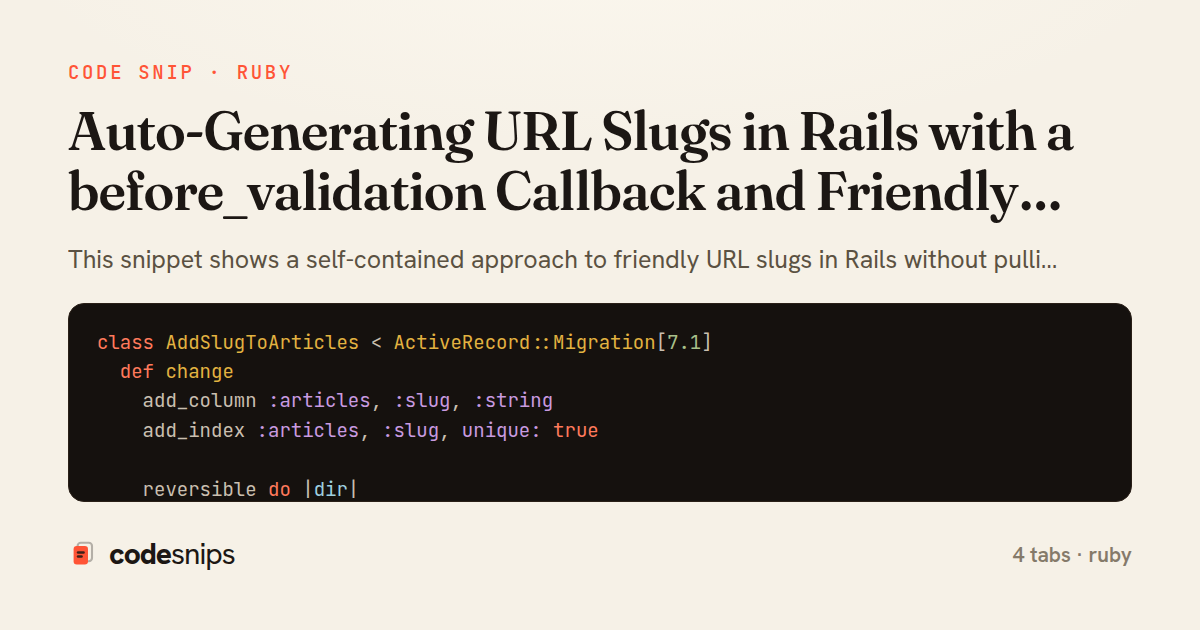
This snippet shows a self-contained approach to friendly URL slugs in Rails without pulling in the friendly_id gem, favoring a small, auditable concern instead. The pattern turns a human-readable title into a stable, URL-safe slug that is generated automatically, guaranteed unique, and usable directly in routes via to_param.
The add_slug.rb (migration) tab sets up the storage: a string column plus a unique index. The uniqueness constraint at the database level is the real safety net — application-level validation can race under concurrency, so the index is what ultimately prevents two records from sharing a slug. It is written as a partial-friendly plain unique index here for portability.
The Sluggable concern tab holds the logic. Including it wires up a before_validation callback, set_slug, that only fills the slug when it is blank or when the source attribute changed, so hand-edited slugs and existing rows are left alone. slug_candidate parameterizes the source text, and generate_unique_slug appends a short random suffix if the base slug already exists, looping until it finds a free value. This candidate-and-check loop is the same core idea friendly_id uses. The concern also overrides to_param so link_to article and article_path(article) emit the slug instead of the numeric id, and it centralizes the source column through slug_source_column so different models can slug off different fields.
The Article model tab shows how thin the model stays: it includes Sluggable, declares its source column, and validates presence and uniqueness of slug. The uniqueness validation mostly produces friendly errors; the DB index handles true races.
The ArticlesController tab demonstrates the finder side. Using find_by!(slug: params[:id]) means routes keep working with /articles/:id while resolving by slug, and find_by! raises RecordNotFound so Rails returns a proper 404. A key pitfall this design accepts is that changing a title changes the slug, which can break old links; teams that care about permalinks typically freeze the slug after first save or keep a history table. For most content this trade-off is acceptable and the implementation stays small and dependency-free.
Related snips
class CommentsController < ApplicationController
  before_action :set_post

  def create
    @comment = @post.comments.build(comment_params)
System test: asserting Turbo Stream responses
class Post < ApplicationRecord
  belongs_to :author, class_name: 'User'
  has_many :comments, dependent: :destroy

  scope :published, -> { where.not(published_at: nil).where('published_at <= ?', Time.current) }
  scope :draft, -> { where(published_at: nil) }
ActiveRecord scopes for reusable query logic
module Api
  module V1
    class UsersController < BaseController
      def show
        user = User.includes(:profile).find(params[:id])
ETags for conditional requests and caching
class PostsController < ApplicationController
  def index
    @posts = Post.includes(:author)
                 .order(created_at: :desc)
                 .page(params[:page])
                 .per(10)
Turbo Frames: infinite scroll with lazy-loading frame
<!DOCTYPE html>
<html lang="en">
<head>
  <meta charset="UTF-8">
  <meta name="viewport" content="width=device-width, initial-scale=1.0">
  <title>Semantic HTML Example</title>
Semantic HTML5 elements and accessibility best practices
package dbutil

import (
  "context"

  "github.com/jackc/pgconn"
Retry Postgres serialization failures with bounded attempts
Share this code
Here's the card — post it anywhere.