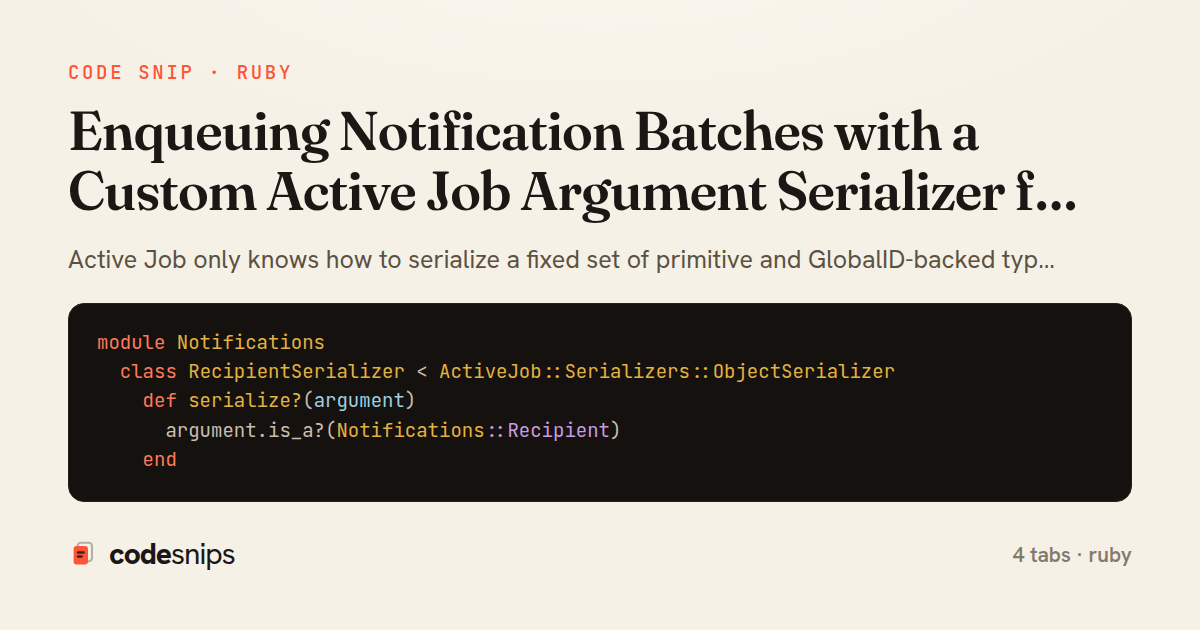
module Notifications
  class RecipientSerializer < ActiveJob::Serializers::ObjectSerializer
    def serialize?(argument)
      argument.is_a?(Notifications::Recipient)
    end

    def serialize(recipient)
      super(
        "channel" => recipient.channel.to_s,
        "address" => recipient.address,
        "name" => recipient.name
      )
    end

    def deserialize(hash)
      Notifications::Recipient.new(
        channel: hash["channel"],
        address: hash["address"],
        name: hash["name"]
      )
    end
  end
end
require_relative "boot"
require "rails/all"

Bundler.require(*Rails.groups)

module MyApp
  class Application < Rails::Application
    config.load_defaults 7.1

    config.active_job.queue_adapter = :sidekiq
    config.active_job.custom_serializers << "Notifications::RecipientSerializer"
  end
end
module Notifications
  class Recipient
    ATTRS = %i[channel address name].freeze

    attr_reader(*ATTRS)

    def initialize(channel:, address:, name: nil)
      @channel = channel.to_sym
      @address = address
      @name = name
      freeze
    end

    def to_h
      { channel: channel, address: address, name: name }
    end

    def ==(other)
      other.is_a?(Recipient) && to_h == other.to_h
    end
    alias eql? ==

    def hash
      to_h.hash
    end
  end
end
module Notifications
  class NotificationBatchJob < ApplicationJob
    queue_as :notifications
    retry_on Net::OpenTimeout, wait: :polynomially_longer, attempts: 5

    def self.enqueue_batch(recipients, dedupe_key:)
      raise ArgumentError, "empty batch" if recipients.blank?

      perform_later(recipients, dedupe_key)
    end

    def perform(recipients, dedupe_key)
      return if DeliveryLog.exists?(dedupe_key: dedupe_key)

      DeliveryLog.transaction do
        DeliveryLog.create!(dedupe_key: dedupe_key, size: recipients.size)

        recipients.each do |recipient|
          Dispatcher.for(recipient.channel).deliver(
            to: recipient.address,
            name: recipient.name
          )
        end
      end
    end
  end
end
Active Job only knows how to serialize a fixed set of primitive and GlobalID-backed types by default, so passing a plain Ruby value object as a job argument raises ActiveJob::SerializationError. This snippet shows the idiomatic Rails escape hatch: registering a custom ActiveJob::Serializer so a domain value object survives the round trip through Redis (or any queue backend) without leaking its internals into raw hashes.
In Notifications::Recipient, the value object is a frozen Struct with a channel and address. Making it immutable and comparable by value is what lets it behave as a stable payload — two recipients with the same fields are ==, which matters for dedup and testing. It knows nothing about jobs; it stays a pure domain type.
RecipientSerializer subclasses ActiveJob::Serializer::ObjectSerializer and implements the three required hooks. serialize? guards which objects this serializer claims, serialize returns a plain hash (the superclass injects the class key needed to route deserialization back here), and deserialize rebuilds the object from that hash. It is registered in config/application.rb via Rails.application.config.active_job.custom_serializers, which is the supported registration point.
NotificationBatchJob is where the batching happens. Rather than enqueuing one job per recipient, enqueue_batch accepts an array of Recipient value objects and pushes a single job — Active Job serializes each element of the array through the registered serializer transparently. The dedupe_key argument gives the job an idempotency anchor: perform checks a DeliveryLog before sending so a retried or double-enqueued batch does not double-notify.
The trade-off worth understanding is that custom serializers couple your queue payload format to the serializer's serialize/deserialize contract; changing the hash shape later requires handling old in-flight payloads, so keys are treated as a stable wire format. Value objects are preferred over passing GlobalID records here because recipients may not be persisted rows — they can be ad-hoc addresses computed at enqueue time. This pattern is the right reach whenever a job needs a rich, type-safe argument that is neither a primitive nor an Active Record model, keeping call sites clean while preserving type identity across the async boundary.
Related snips
class CommentsController < ApplicationController
  before_action :set_post

  def create
    @comment = @post.comments.build(comment_params)
System test: asserting Turbo Stream responses
class Money
  include Comparable

  attr_reader :amount, :currency

  def initialize(amount, currency = 'USD')
Value objects for domain modeling
class Post < ApplicationRecord
  belongs_to :author, class_name: 'User'
  has_many :comments, dependent: :destroy

  scope :published, -> { where.not(published_at: nil).where('published_at <= ?', Time.current) }
  scope :draft, -> { where(published_at: nil) }
ActiveRecord scopes for reusable query logic
module Api
  module V1
    class UsersController < BaseController
      def show
        user = User.includes(:profile).find(params[:id])
ETags for conditional requests and caching
class PostsController < ApplicationController
  def index
    @posts = Post.includes(:author)
                 .order(created_at: :desc)
                 .page(params[:page])
                 .per(10)
Turbo Frames: infinite scroll with lazy-loading frame
require "csv"

class PeopleCsvStream
  include Enumerable

  HEADERS = %w[id full_name email signed_up_at plan].freeze
Resilient CSV Export as a Streamed Response
Share this code
Here's the card — post it anywhere.