import { useCallback, useEffect, useState } from 'react';

function parseSearch(search) {
  const params = new URLSearchParams(search);
  const out = {};
  for (const [key, value] of params.entries()) out[key] = value;
  return out;
}

function buildSearch(state) {
  const params = new URLSearchParams();
  Object.entries(state).forEach(([key, value]) => {
    if (value !== '' && value != null) params.set(key, String(value));
  });
  const qs = params.toString();
  return qs ? '?' + qs : window.location.pathname;
}

export function useUrlState() {
  const [state, setInternal] = useState(() => parseSearch(window.location.search));

  const setState = useCallback((patch, { push = false } = {}) => {
    setInternal((prev) => {
      const next = { ...prev, ...patch };
      const url = buildSearch(next);
      if (push) window.history.pushState(next, '', url);
      else window.history.replaceState(next, '', url);
      return next;
    });
  }, []);

  useEffect(() => {
    const onPop = () => setInternal(parseSearch(window.location.search));
    window.addEventListener('popstate', onPop);
    return () => window.removeEventListener('popstate', onPop);
  }, []);

  return [state, setState];
}
import { useCallback, useEffect, useRef, useState } from 'react';
import { useUrlState } from './useUrlState';

export function useDebouncedUrlState(delay = 350) {
  const [committed, setCommitted] = useUrlState();
  const [draft, setDraft] = useState(committed);
  const timer = useRef(null);

  useEffect(() => {
    return () => {
      if (timer.current) clearTimeout(timer.current);
    };
  }, []);

  const set = useCallback((patch) => {
    setDraft((prev) => {
      const next = { ...prev, ...patch };
      if (timer.current) clearTimeout(timer.current);
      timer.current = setTimeout(() => setCommitted(next), delay);
      return next;
    });
  }, [delay, setCommitted]);

  const commit = useCallback((patch = {}, options) => {
    if (timer.current) clearTimeout(timer.current);
    setDraft((prev) => {
      const next = { ...prev, ...patch };
      setCommitted(next, options);
      return next;
    });
  }, [setCommitted]);

  const flush = useCallback((options) => commit({}, options), [commit]);

  return { draft, committed, set, commit, flush };
}
import React from 'react';
import { useDebouncedUrlState } from './useDebouncedUrlState';

export default function ProductFilters({ onChange }) {
  const { draft, committed, set, commit, flush } = useDebouncedUrlState();

  React.useEffect(() => {
    onChange && onChange(committed);
  }, [committed, onChange]);

  const handleSubmit = (event) => {
    event.preventDefault();
    flush({ push: true });
  };

  return (
    <form className="product-filters" onSubmit={handleSubmit}>
      <input
        type="search"
        name="q"
        placeholder="Search products"
        value={draft.q || ''}
        onChange={(e) => set({ q: e.target.value })}
      />

      <select
        name="category"
        value={draft.category || ''}
        onChange={(e) => commit({ category: e.target.value })}
      >
        <option value="">All categories</option>
        <option value="books">Books</option>
        <option value="audio">Audio</option>
      </select>

      <select
        name="sort"
        value={draft.sort || 'relevance'}
        onChange={(e) => commit({ sort: e.target.value })}
      >
        <option value="relevance">Relevance</option>
        <option value="price_asc">Price: low to high</option>
        <option value="price_desc">Price: high to low</option>
      </select>

      <button type="submit">Apply</button>
    </form>
  );
}
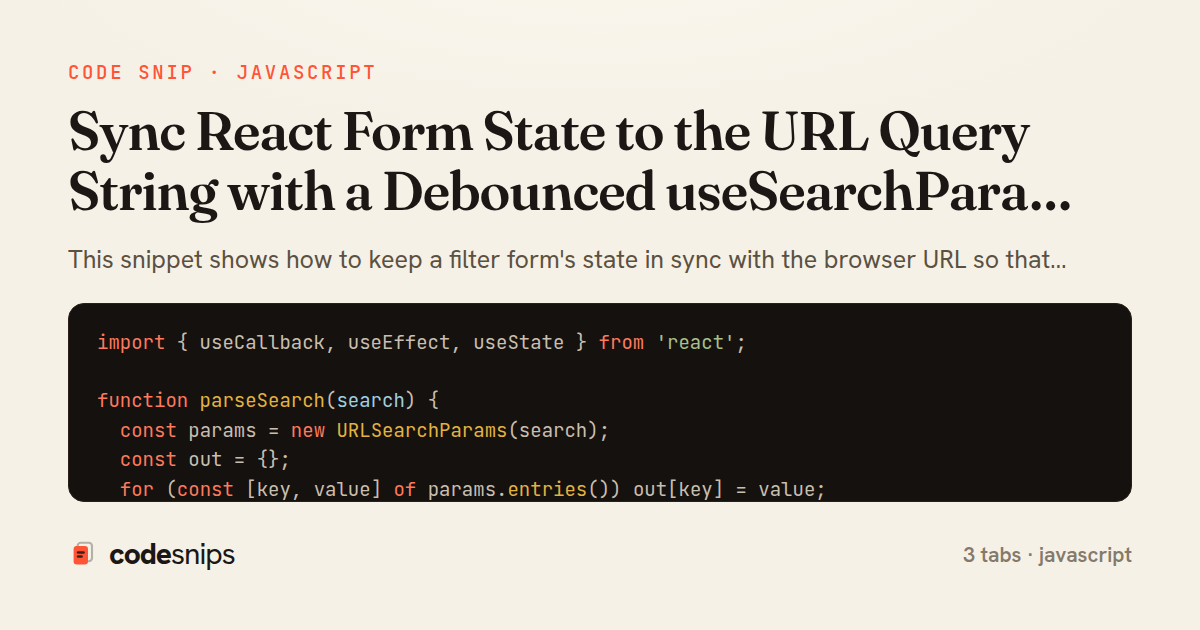
This snippet shows how to keep a filter form's state in sync with the browser URL so that searches are shareable, bookmarkable, and survive a page refresh. Instead of storing filters only in component state, the URL becomes the single source of truth, and the form simply reflects and mutates the query string.
The useUrlState hook tab wraps URLSearchParams in a small stateful API. It seeds its initial value by parsing window.location.search, then exposes a setState that merges partial updates, drops empty values, and rewrites the URL. A key detail is that it uses history.replaceState for high-frequency updates (like typing) and history.pushState only when the caller opts in, avoiding a flood of history entries the user would have to click through. It also registers a popstate listener so browser back/forward buttons re-hydrate the state, and cleans that listener up on unmount.
The useDebouncedUrlState hook tab composes on top of that. It keeps a synchronous draft for snappy input rendering while debouncing the actual URL write through a setTimeout, so typing does not thrash the address bar or trigger a network request on every keystroke. The flush helper cancels the pending timer and commits immediately, which the form uses on submit.
The ProductFilters component tab ties it together. It reads q, category, and sort straight from the URL-backed draft and treats them as controlled inputs. Text typing goes through the debounced path, while the select changes call commit directly since a discrete choice should update the URL at once. Submitting the form calls flush and pushes a real history entry so the result is a durable, back-button-friendly link.
The main trade-off is that the URL only cleanly represents flat string values; nested or large state needs encoding and can bloat links. Empty-value pruning keeps URLs tidy, and reading from location.search on mount makes deep links work. This pattern fits search pages, dashboards, and any filter UI where the current view should be a copyable address.
Related snips
import { Controller } from "@hotwired/stimulus"

export default class extends Controller {
  static targets = ["form"]
  static values = { delay: { type: Number, default: 250 } }
Debounced live search with Stimulus + Turbo Streams
import axios, { AxiosError } from 'axios'
import { v4 as uuidv4 } from 'uuid'

const api = axios.create({
  baseURL: import.meta.env.VITE_API_URL || 'http://localhost:3000/api/v1',
  timeout: 15000,
Axios API client with interceptors
import { create } from 'zustand'
import { persist } from 'zustand/middleware'

interface FilterState {
  search: string
  category: string | null
Zustand for lightweight state management
<!DOCTYPE html>
<html lang="en">
<head>
  <meta charset="UTF-8">
  <title>Form Validation Example</title>
  <style>
HTML forms with validation and accessibility
import { Application } from "@hotwired/stimulus"
import FormSubmitController from "./controllers/form_submit_controller"

const application = Application.start()
application.debug = false
Disable submit button while Turbo form is submitting
import { Controller } from "@hotwired/stimulus"

export default class extends Controller {
  static values = {
    url: String,
    delay: { type: Number, default: 800 },
Stimulus: autosave draft with Turbo-friendly requests
Share this code
Here's the card — post it anywhere.