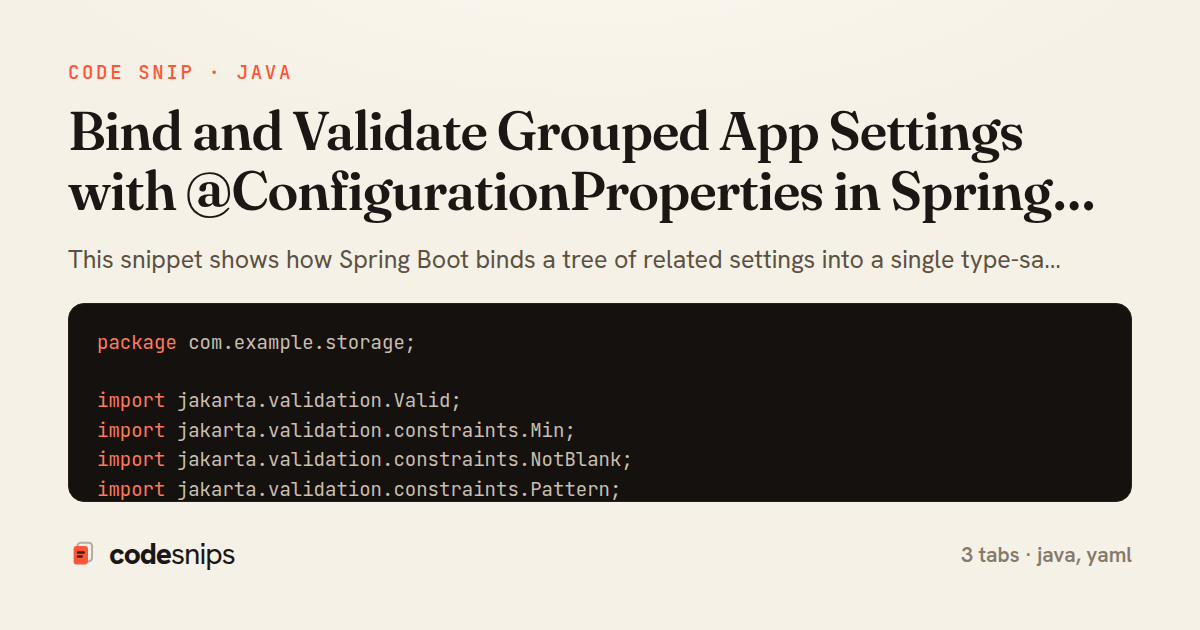
package com.example.storage;

import jakarta.validation.Valid;
import jakarta.validation.constraints.Min;
import jakarta.validation.constraints.NotBlank;
import jakarta.validation.constraints.Pattern;
import java.time.Duration;
import java.time.temporal.ChronoUnit;
import org.springframework.boot.context.properties.ConfigurationProperties;
import org.springframework.boot.convert.DurationUnit;
import org.springframework.validation.annotation.Validated;

@Validated
@ConfigurationProperties(prefix = "app.storage")
public class StorageProperties {

    @NotBlank
    private String endpoint;

    @NotBlank
    @Pattern(regexp = "[a-z0-9.\\-]{3,63}", message = "bucket must be a valid DNS-style name")
    private String bucket;

    @DurationUnit(ChronoUnit.SECONDS)
    private Duration timeout = Duration.ofSeconds(10);

    @Valid
    private final Retry retry = new Retry();

    public String getEndpoint() { return endpoint; }
    public void setEndpoint(String endpoint) { this.endpoint = endpoint; }

    public String getBucket() { return bucket; }
    public void setBucket(String bucket) { this.bucket = bucket; }

    public Duration getTimeout() { return timeout; }
    public void setTimeout(Duration timeout) { this.timeout = timeout; }

    public Retry getRetry() { return retry; }

    public static class Retry {

        @Min(1)
        private int maxAttempts = 3;

        @DurationUnit(ChronoUnit.MILLIS)
        private Duration initialBackoff = Duration.ofMillis(100);

        public int getMaxAttempts() { return maxAttempts; }
        public void setMaxAttempts(int maxAttempts) { this.maxAttempts = maxAttempts; }

        public Duration getInitialBackoff() { return initialBackoff; }
        public void setInitialBackoff(Duration initialBackoff) { this.initialBackoff = initialBackoff; }
    }
}
package com.example.storage;

import org.springframework.boot.context.properties.EnableConfigurationProperties;
import org.springframework.context.annotation.Bean;
import org.springframework.context.annotation.Configuration;

@Configuration
@EnableConfigurationProperties(StorageProperties.class)
public class StorageConfig {

    @Bean
    public StorageClient storageClient(StorageProperties props) {
        return StorageClient.builder()
                .endpoint(props.getEndpoint())
                .bucket(props.getBucket())
                .requestTimeout(props.getTimeout())
                .maxAttempts(props.getRetry().getMaxAttempts())
                .initialBackoff(props.getRetry().getInitialBackoff())
                .build();
    }
}
app:
  storage:
    endpoint: https://s3.eu-west-1.amazonaws.com
    bucket: reports-prod-eu
    timeout: 5s
    retry:
      max-attempts: 5
      initial-backoff: 200ms
This snippet shows how Spring Boot binds a tree of related settings into a single type-safe object and fails fast at startup when the configuration is wrong. The pattern replaces scattered @Value injections with one cohesive, validated class, which is the recommended approach once a group of properties starts to grow related sub-settings.
In StorageProperties, the class is annotated with @ConfigurationProperties(prefix = "app.storage") and @Validated. The @Validated annotation is what activates JSR-380 constraint checking on the bound object; without it the annotations are inert. Constraints like @NotBlank, @Min, and @Pattern describe the contract the configuration must satisfy, and @DurationUnit lets a plain number in YAML be interpreted as seconds and bound to a java.time.Duration. Nested settings live in the inner Retry type, exposed through a getter so binding recurses into app.storage.retry.*; @Valid on that field cascades validation into the nested object, a step developers frequently forget.
The @ConstructorBinding-free, mutable-getter style is used here for compatibility with older Spring Boot versions, though modern versions also support immutable constructor binding.
In StorageConfig, @EnableConfigurationProperties(StorageProperties.class) registers the properties class as a bean so it can be injected anywhere, and a StorageClient bean is wired from the already-validated settings. Because validation runs during bean creation, an invalid bucket or a negative maxAttempts aborts the context refresh with a clear BindValidationException rather than surfacing as a runtime NullPointerException deep in a request.
In application.yml, the app.storage block mirrors the property structure exactly, including the human-friendly timeout: 5s and initial-backoff: 200ms values that Spring parses into Duration. Note the relaxed binding: kebab-case keys map to camelCase fields automatically.
The trade-off is a little boilerplate up front in exchange for one authoritative, documented, validated settings object. The main pitfall is forgetting @Validated or @Valid, which silently skips the checks. This approach is worth reaching for as soon as configuration becomes structured or safety-critical.
Related snips
type User {
    id: ID!
    name: String!
    email: String!
    posts: [Post!]!
    createdAt: String!
GraphQL API with Spring Boot
class SignupForm
  include ActiveModel::Model
  include ActiveModel::Attributes

  attribute :account_name, :string
  attribute :email, :string
Shallow Controller, Deep Params: Form Object Pattern
package com.example.starter.config;

import com.example.starter.properties.CustomProperties;
import com.example.starter.service.CustomService;
import org.springframework.boot.autoconfigure.AutoConfiguration;
import org.springframework.boot.autoconfigure.condition.ConditionalOnClass;
Custom Spring Boot starters
<!DOCTYPE html>
<html lang="en">
<head>
  <meta charset="UTF-8">
  <title>Form Validation Example</title>
  <style>
HTML forms with validation and accessibility
package com.example.demo.config;

import org.apache.kafka.clients.consumer.ConsumerConfig;
import org.apache.kafka.clients.producer.ProducerConfig;
import org.apache.kafka.common.serialization.StringDeserializer;
import org.apache.kafka.common.serialization.StringSerializer;
Messaging with Apache Kafka
import axios from 'axios';

export type NormalizedErrors = {
  fields: Record<string, string>;
  formLevel: string | null;
};
Frontend: normalize and display server validation errors
Share this code
Here's the card — post it anywhere.