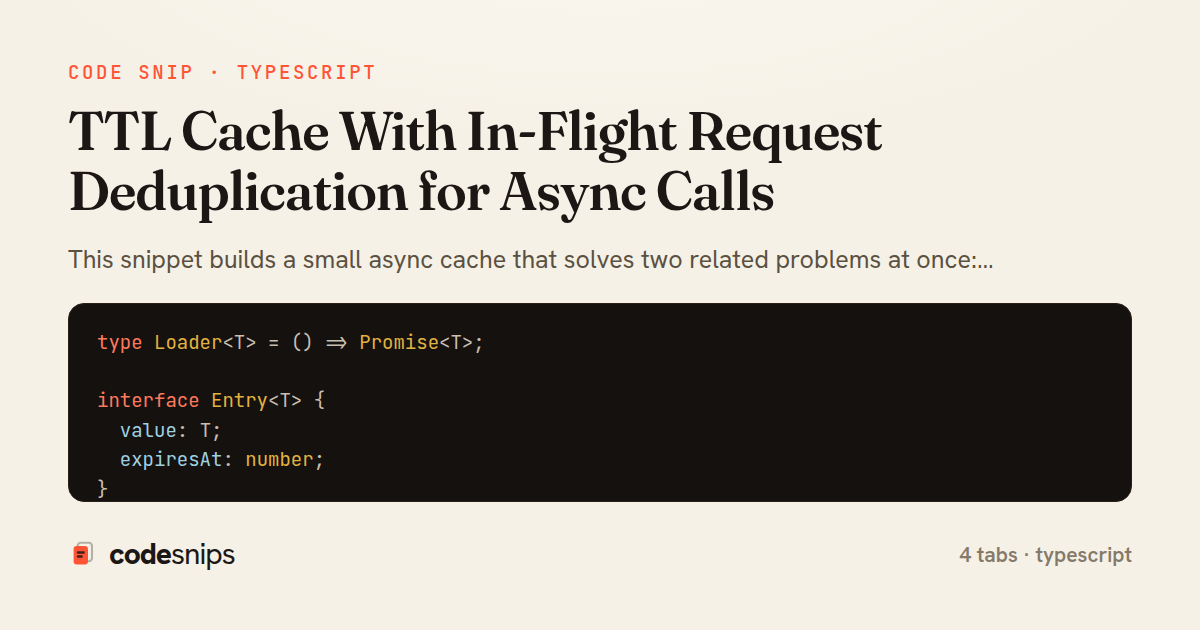
type Loader<T> = () => Promise<T>;

interface Entry<T> {
  value: T;
  expiresAt: number;
}

export class AsyncTtlCache<T> {
  private fresh = new Map<string, Entry<T>>();
  private inflight = new Map<string, Promise<T>>();

  constructor(private readonly ttlMs: number) {}

  get(key: string, loader: Loader<T>): Promise<T> {
    const cached = this.fresh.get(key);
    if (cached && cached.expiresAt > Date.now()) {
      return Promise.resolve(cached.value);
    }

    const pending = this.inflight.get(key);
    if (pending) {
      return pending;
    }

    const request = loader()
      .then((value) => {
        this.fresh.set(key, { value, expiresAt: Date.now() + this.ttlMs });
        this.inflight.delete(key);
        return value;
      })
      .catch((err) => {
        // Do not cache failures; let the next caller retry.
        this.inflight.delete(key);
        throw err;
      });

    this.inflight.set(key, request);
    return request;
  }

  invalidate(key: string): void {
    this.fresh.delete(key);
    this.inflight.delete(key);
  }

  clear(): void {
    this.fresh.clear();
    this.inflight.clear();
  }

  stats(): { fresh: number; inflight: number } {
    return { fresh: this.fresh.size, inflight: this.inflight.size };
  }
}
import { AsyncTtlCache } from "./AsyncTtlCache";

interface User {
  id: string;
  name: string;
  email: string;
}

// One shared instance so every caller dedupes and shares the TTL window.
export const userCache = new AsyncTtlCache<User>(30_000);

export async function fetchUser(id: string): Promise<User> {
  return userCache.get(`user:${id}`, async () => {
    const res = await fetch(`/api/users/${id}`);
    if (!res.ok) {
      throw new Error(`Failed to load user ${id}: ${res.status}`);
    }
    return (await res.json()) as User;
  });
}

export function invalidateUser(id: string): void {
  userCache.invalidate(`user:${id}`);
}
import { useEffect, useState } from "react";

interface ResourceState<T> {
  data: T | null;
  error: Error | null;
  loading: boolean;
}

export function useCachedResource<T>(
  key: string,
  loader: () => Promise<T>,
): ResourceState<T> {
  const [state, setState] = useState<ResourceState<T>>({
    data: null,
    error: null,
    loading: true,
  });

  useEffect(() => {
    let cancelled = false;
    setState((prev) => ({ ...prev, loading: true }));

    loader()
      .then((data) => {
        if (!cancelled) {
          setState({ data, error: null, loading: false });
        }
      })
      .catch((error: Error) => {
        if (!cancelled) {
          setState({ data: null, error, loading: false });
        }
      });

    return () => {
      cancelled = true;
    };
  }, [key]);

  return state;
}
import { useCachedResource } from "./useCachedResource";
import { fetchUser } from "./userCache";

interface Props {
  userId: string;
}

export function UserBadge({ userId }: Props) {
  const { data, error, loading } = useCachedResource(
    `user:${userId}`,
    () => fetchUser(userId),
  );

  if (loading) return <span className="badge badge--loading">Loading…</span>;
  if (error) return <span className="badge badge--error">{error.message}</span>;
  if (!data) return null;

  return (
    <span className="badge" title={data.email}>
      {data.name}
    </span>
  );
}
This snippet builds a small async cache that solves two related problems at once: repeated expensive calls returning the same data (solved with a time-to-live cache) and the thundering-herd problem where many callers request the same key simultaneously before any result is cached (solved with in-flight deduplication).
The AsyncTtlCache tab stores two maps: fresh holds resolved values with an expiresAt timestamp, and inflight holds the pending Promise for keys currently being fetched. The core method get first checks fresh; if an entry exists and has not expired it is returned immediately. If a fetch for the same key is already running, get returns that same shared Promise instead of starting a second one — this is the deduplication step, and it is what prevents ten concurrent components from firing ten identical network requests.
When neither a fresh value nor an in-flight promise exists, get calls the supplied loader, stores the resulting promise in inflight, and attaches handlers. On success the value is written to fresh with expiresAt = now + ttlMs and the in-flight entry is cleared. Crucially, on failure the in-flight entry is also cleared inside a finally-style path so a rejected fetch does not poison the key forever; the next caller retries cleanly. Errors are intentionally not cached, since caching a transient failure is usually worse than retrying.
The invalidate and clear methods let callers evict stale data after a mutation, and stats exposes counts for debugging. A subtle detail is that expiresAt is checked lazily on read rather than with timers, avoiding a background sweep and keeping the structure simple; expired entries are simply overwritten on next access.
The useCachedResource hook tab shows real usage in React. It reads through a shared cache instance so multiple mounted components hitting the same key share one request, tracks data, error, and loading state, and guards against setting state after unmount with a cancelled flag. This pattern is ideal for autocomplete, dashboards, and any UI where the same expensive query is requested from many places at once.
Related snips
export interface RetryOptions {
  retries: number;
  baseMs: number;
  maxMs: number;
  signal?: AbortSignal;
  onRetry?: (attempt: number, delay: number, err: unknown) => void;
Exponential backoff with jitter for retries
module Api
  module V1
    class UsersController < BaseController
      def show
        user = User.includes(:profile).find(params[:id])
ETags for conditional requests and caching
// Creating a Promise
const myPromise = new Promise((resolve, reject) => {
  const success = true;

  setTimeout(() => {
    if (success) {
Promises and async/await patterns for asynchronous JavaScript
use crossbeam::channel::unbounded;
use std::thread;

fn main() {
    let (tx, rx) = unbounded();
Crossbeam for advanced concurrent data structures
use std::sync::mpsc;
use std::thread;

fn main() {
    let (tx, rx) = mpsc::channel();
Channels (mpsc) for message passing between threads
export type Settled<R> =
  | { status: 'fulfilled'; value: R }
  | { status: 'rejected'; reason: unknown };

export interface ConcurrencyOptions {
  limit: number;
Simple concurrency limiter for batch operations
Share this code
Here's the card — post it anywhere.