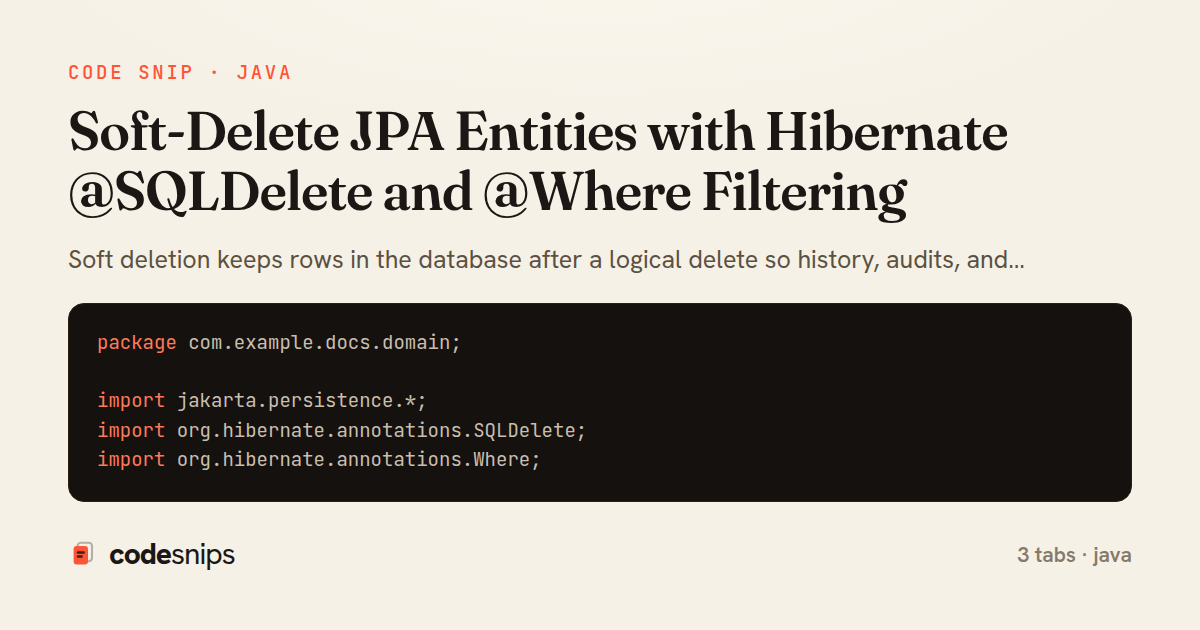
package com.example.docs.domain;

import jakarta.persistence.*;
import org.hibernate.annotations.SQLDelete;
import org.hibernate.annotations.Where;

import java.time.Instant;

@Entity
@Table(name = "documents")
@SQLDelete(sql = "UPDATE documents SET deleted = true, deleted_at = now() WHERE id = ?")
@Where(clause = "deleted = false")
public class Document {

    @Id
    @GeneratedValue(strategy = GenerationType.IDENTITY)
    private Long id;

    @Column(nullable = false)
    private String title;

    @Column(columnDefinition = "text")
    private String body;

    @Column(nullable = false)
    private boolean deleted = false;

    @Column(name = "deleted_at")
    private Instant deletedAt;

    @Column(name = "deleted_by")
    private String deletedBy;

    protected Document() {
    }

    public Document(String title, String body) {
        this.title = title;
        this.body = body;
    }

    public void markDeletedBy(String actor) {
        this.deletedBy = actor;
    }

    public Long getId() {
        return id;
    }

    public String getTitle() {
        return title;
    }

    public boolean isDeleted() {
        return deleted;
    }
}
package com.example.docs.repository;

import com.example.docs.domain.Document;
import org.springframework.data.jpa.repository.JpaRepository;
import org.springframework.data.jpa.repository.Modifying;
import org.springframework.data.jpa.repository.Query;
import org.springframework.data.repository.query.Param;

import java.util.List;
import java.util.Optional;

public interface DocumentRepository extends JpaRepository<Document, Long> {

    Optional<Document> findByTitle(String title);

    // Native query bypasses @Where so archived rows are visible again.
    @Modifying(clearAutomatically = true)
    @Query(value = "UPDATE documents SET deleted = false, deleted_at = null, "
            + "deleted_by = null WHERE id = :id", nativeQuery = true)
    int restore(@Param("id") Long id);

    @Query(value = "SELECT * FROM documents WHERE deleted = true "
            + "ORDER BY deleted_at DESC", nativeQuery = true)
    List<Document> findArchived();

    @Query(value = "SELECT * FROM documents WHERE id = :id AND deleted = true",
            nativeQuery = true)
    Optional<Document> findArchivedById(@Param("id") Long id);
}
package com.example.docs.service;

import com.example.docs.domain.Document;
import com.example.docs.repository.DocumentRepository;
import jakarta.persistence.EntityNotFoundException;
import org.springframework.stereotype.Service;
import org.springframework.transaction.annotation.Transactional;

import java.util.List;

@Service
public class DocumentService {

    private final DocumentRepository documents;

    public DocumentService(DocumentRepository documents) {
        this.documents = documents;
    }

    @Transactional
    public void archive(Long id, String actor) {
        Document doc = documents.findById(id)
                .orElseThrow(() -> new EntityNotFoundException("Document " + id));
        doc.markDeletedBy(actor);
        documents.flush(); // persist deleted_by before the @SQLDelete update
        documents.deleteById(id); // fires UPDATE ... SET deleted = true
    }

    @Transactional
    public void restore(Long id) {
        int rows = documents.restore(id);
        if (rows == 0) {
            throw new EntityNotFoundException("No archived document " + id);
        }
    }

    @Transactional(readOnly = true)
    public List<Document> listArchived() {
        return documents.findArchived();
    }
}
Soft deletion keeps rows in the database after a logical delete so history, audits, and foreign-key references stay intact, while application queries behave as if the record is gone. This snippet shows the idiomatic Hibernate way to implement it without scattering WHERE deleted = false across every query.
In Document entity, the class carries a deleted boolean plus deletedAt and deletedBy audit columns. The @SQLDelete annotation rewrites the SQL that Hibernate emits when an entity is removed: instead of issuing DELETE FROM documents, it runs an UPDATE that flips the flag and stamps the timestamp. The companion @Where(clause = "deleted = false") is applied to every SELECT Hibernate generates for the entity, so a normal findById or JPQL query silently excludes archived rows. Together these two annotations make repository.delete(doc) and a fetch feel exactly like a hard delete, which is why callers need no special-casing.
The key trade-off is that @Where is a static filter baked into the mapping — it cannot be turned off per query, so retrieving archived rows requires a native query or a dedicated method that bypasses the managed entity. It also does not apply to @ManyToOne eager loads through the second-level cache identically across all Hibernate versions, so lazy associations are the safer default.
In DocumentRepository, restore and findArchived are declared with @Query(nativeQuery = true) precisely because @Where would otherwise hide the very rows these methods need to see. The native UPDATE in restore is marked @Modifying and clears the persistence context so stale managed instances are not returned afterward.
In DocumentService, archive loads the entity, records who performed the action, and lets deleteById trigger the @SQLDelete statement inside a transaction. restore and listArchived expose the escape hatches. This layering keeps the soft-delete mechanics in the mapping while the service owns the audit intent, which is exactly where a developer reaches for this pattern: entities that must never truly disappear but should stay invisible to ordinary reads.
Related snips
import os
import stat

for root, _dirs, files in os.walk('/etc'):
    for name in files:
        path = os.path.join(root, name)
Python security audit script for exposed risky filesystem state
package dbutil

import (
  "context"

  "github.com/jackc/pgconn"
Retry Postgres serialization failures with bounded attempts
require "csv"

class PeopleCsvStream
  include Enumerable

  HEADERS = %w[id full_name email signed_up_at plan].freeze
Resilient CSV Export as a Streamed Response
type User {
    id: ID!
    name: String!
    email: String!
    posts: [Post!]!
    createdAt: String!
GraphQL API with Spring Boot
class SignupForm
  include ActiveModel::Model
  include ActiveModel::Attributes

  attribute :account_name, :string
  attribute :email, :string
Shallow Controller, Deep Params: Form Object Pattern
package com.example.starter.config;

import com.example.starter.properties.CustomProperties;
import com.example.starter.service.CustomService;
import org.springframework.boot.autoconfigure.AutoConfiguration;
import org.springframework.boot.autoconfigure.condition.ConditionalOnClass;
Custom Spring Boot starters
Share this code
Here's the card — post it anywhere.