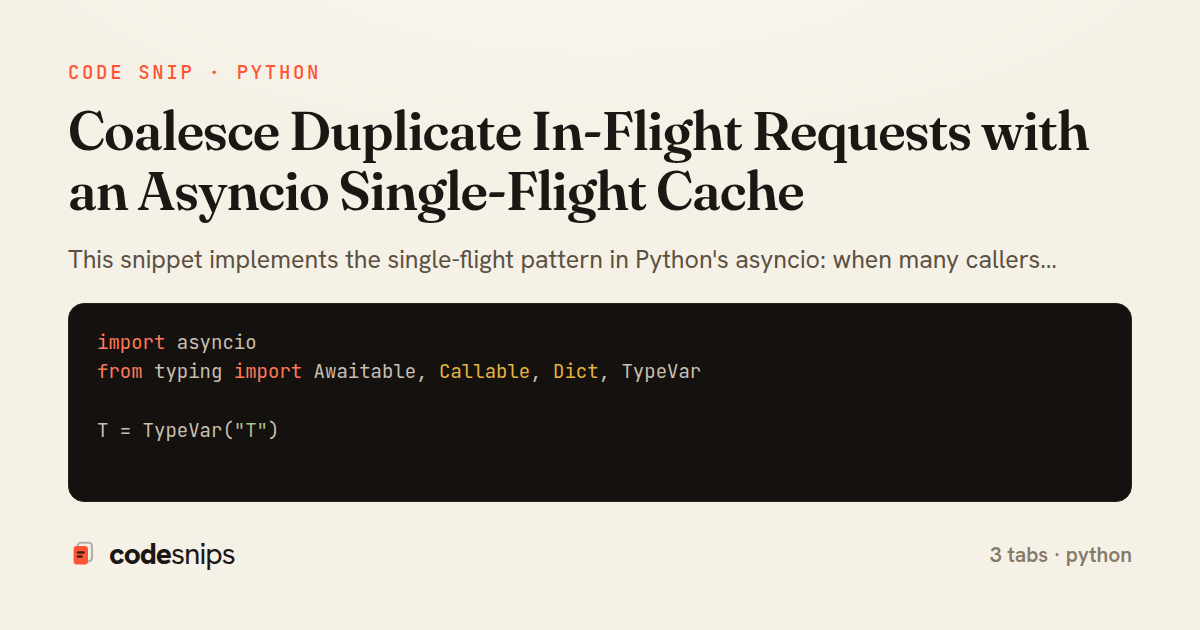
import asyncio
from typing import Awaitable, Callable, Dict, TypeVar

T = TypeVar("T")


class SingleFlight:
    def __init__(self) -> None:
        self._inflight: Dict[str, asyncio.Future] = {}

    async def do(self, key: str, factory: Callable[[], Awaitable[T]]) -> T:
        existing = self._inflight.get(key)
        if existing is not None:
            return await existing

        loop = asyncio.get_event_loop()
        future: asyncio.Future = loop.create_future()
        self._inflight[key] = future

        try:
            result = await factory()
        except BaseException as exc:
            if not future.done():
                future.set_exception(exc)
            raise
        else:
            if not future.done():
                future.set_result(result)
            return result
        finally:
            self._inflight.pop(key, None)

    def inflight_count(self) -> int:
        return len(self._inflight)
import asyncio
from typing import Dict

import httpx

from singleflight import SingleFlight


class PriceService:
    def __init__(self, base_url: str) -> None:
        self._base_url = base_url
        self._client = httpx.AsyncClient(timeout=5.0)
        self._flight = SingleFlight()
        self.upstream_calls = 0

    async def _fetch_upstream(self, symbol: str) -> float:
        self.upstream_calls += 1
        resp = await self._client.get(f"{self._base_url}/quote/{symbol}")
        resp.raise_for_status()
        return float(resp.json()["price"])

    async def get_price(self, symbol: str) -> float:
        symbol = symbol.upper()

        async def factory() -> float:
            return await self._fetch_upstream(symbol)

        return await self._flight.do(symbol, factory)

    async def warm(self, symbol: str, concurrency: int = 50) -> Dict[str, float]:
        tasks = [self.get_price(symbol) for _ in range(concurrency)]
        results = await asyncio.gather(*tasks)
        return {"price": results[0], "upstream_calls": self.upstream_calls}

    async def close(self) -> None:
        await self._client.aclose()
from fastapi import APIRouter, Depends, HTTPException
import httpx

from price_service import PriceService

router = APIRouter()
_service = PriceService(base_url="https://quotes.internal")


def get_service() -> PriceService:
    return _service


@router.get("/price/{symbol}")
async def read_price(symbol: str, service: PriceService = Depends(get_service)):
    try:
        price = await service.get_price(symbol)
    except httpx.HTTPStatusError as exc:
        raise HTTPException(status_code=502, detail=f"upstream error: {exc.response.status_code}")
    except httpx.HTTPError:
        raise HTTPException(status_code=504, detail="upstream unavailable")

    return {"symbol": symbol.upper(), "price": price}


@router.on_event("shutdown")
async def shutdown() -> None:
    await _service.close()
This snippet implements the single-flight pattern in Python's asyncio: when many callers ask for the same key at the same time, only one underlying computation runs and everyone else waits on and shares its result. It solves the thundering-herd problem, where a cache miss on a hot key would otherwise fire N identical database or upstream calls simultaneously.
In singleflight.py, the core idea is that the first caller for a key creates a shared asyncio.Future and stores it in self._inflight under that key, then runs the coroutine factory. Later callers that arrive while the computation is still running find the existing future and simply await it — they never invoke the factory. Because asyncio runs on a single thread and there are no await points between the dictionary lookup and the insertion, the check-and-insert in do is atomic without an explicit lock; a Lock is only needed if the code path yields between those steps. The finally block removes the key from _inflight so the next request after completion starts fresh, and both success and failure are propagated to every waiter via set_result and set_exception. Sharing the exception matters: all coalesced callers see the same failure rather than one succeeding while the rest hang.
The key trade-off is that a shared future means a shared fate — one slow or failing computation blocks all waiters, so this pattern coalesces identical work but does not add retries or per-caller timeouts. It also deduplicates only concurrent requests, not sequential ones; pairing it with a TTL cache handles that.
In price_service.py, SingleFlight guards an expensive upstream fetch. get_price wraps the real call in a factory closure passed to flight.do, so a burst of requests for the same symbol collapses into one HTTP round trip. warm demonstrates that concurrent get_price calls for one symbol trigger exactly one _fetch_upstream.
In routes.py, a FastAPI endpoint calls the shared service instance, meaning a spike of clients hitting /price/{symbol} naturally coalesces at the service layer. This is where the pattern shines: read-heavy endpoints with hot keys, cache stampede protection, and any idempotent-but-expensive lookup where duplicate concurrent work is pure waste.
Related snips
export interface RetryOptions {
  retries: number;
  baseMs: number;
  maxMs: number;
  signal?: AbortSignal;
  onRetry?: (attempt: number, delay: number, err: unknown) => void;
Exponential backoff with jitter for retries
module Api
  module V1
    class UsersController < BaseController
      def show
        user = User.includes(:profile).find(params[:id])
ETags for conditional requests and caching
// Creating a Promise
const myPromise = new Promise((resolve, reject) => {
  const success = true;

  setTimeout(() => {
    if (success) {
Promises and async/await patterns for asynchronous JavaScript
use crossbeam::channel::unbounded;
use std::thread;

fn main() {
    let (tx, rx) = unbounded();
Crossbeam for advanced concurrent data structures
use std::sync::mpsc;
use std::thread;

fn main() {
    let (tx, rx) = mpsc::channel();
Channels (mpsc) for message passing between threads
export type Settled<R> =
  | { status: 'fulfilled'; value: R }
  | { status: 'rejected'; reason: unknown };

export interface ConcurrencyOptions {
  limit: number;
Simple concurrency limiter for batch operations
Share this code
Here's the card — post it anywhere.