class AddSlugToArticles < ActiveRecord::Migration[7.1]
  def change
    add_column :articles, :slug, :string, null: false, default: ""
    add_index :articles, :slug, unique: true

    # Backfill existing rows before the unique index is relied upon in code.
    reversible do |dir|
      dir.up do
        Article.reset_column_information
        Article.find_each do |article|
          article.update_column(:slug, article.send(:slugify, article.title))
        end
      end
    end
  end
end
class Article < ApplicationRecord
  validates :title, presence: true
  validates :slug, presence: true, uniqueness: true,
                   format: { with: /\A[a-z0-9]+(?:-[a-z0-9]+)*\z/ }

  before_validation :assign_slug, if: :assign_slug?

  def self.create_with_slug(attributes)
    article = new(attributes)
    attempts = 0
    begin
      article.save!
    rescue ActiveRecord::RecordNotUnique
      attempts += 1
      raise if attempts > 3
      article.send(:assign_slug)
      retry
    end
    article
  end

  def to_param
    slug
  end

  private

  def assign_slug?
    new_record? || will_save_change_to_title?
  end

  def assign_slug
    self.slug = ensure_unique_slug(slugify(title))
  end

  def slugify(value)
    value.to_s.parameterize
  end

  def ensure_unique_slug(base)
    candidate = base
    suffix = 1
    while self.class.where.not(id: id).exists?(slug: candidate)
      suffix += 1
      candidate = "#{base}-#{suffix}"
    end
    candidate
  end
end
class ArticlesController < ApplicationController
  before_action :set_article, only: %i[show edit update destroy]

  def show
  end

  def create
    @article = Article.create_with_slug(article_params)
    redirect_to @article, notice: "Article published."
  rescue ActiveRecord::RecordInvalid => e
    @article = e.record
    render :new, status: :unprocessable_entity
  end

  def update
    if @article.update(article_params)
      redirect_to @article, notice: "Article updated."
    else
      render :edit, status: :unprocessable_entity
    end
  end

  private

  def set_article
    @article = Article.find_by!(slug: params[:slug])
  end

  def article_params
    params.require(:article).permit(:title, :body)
  end
end
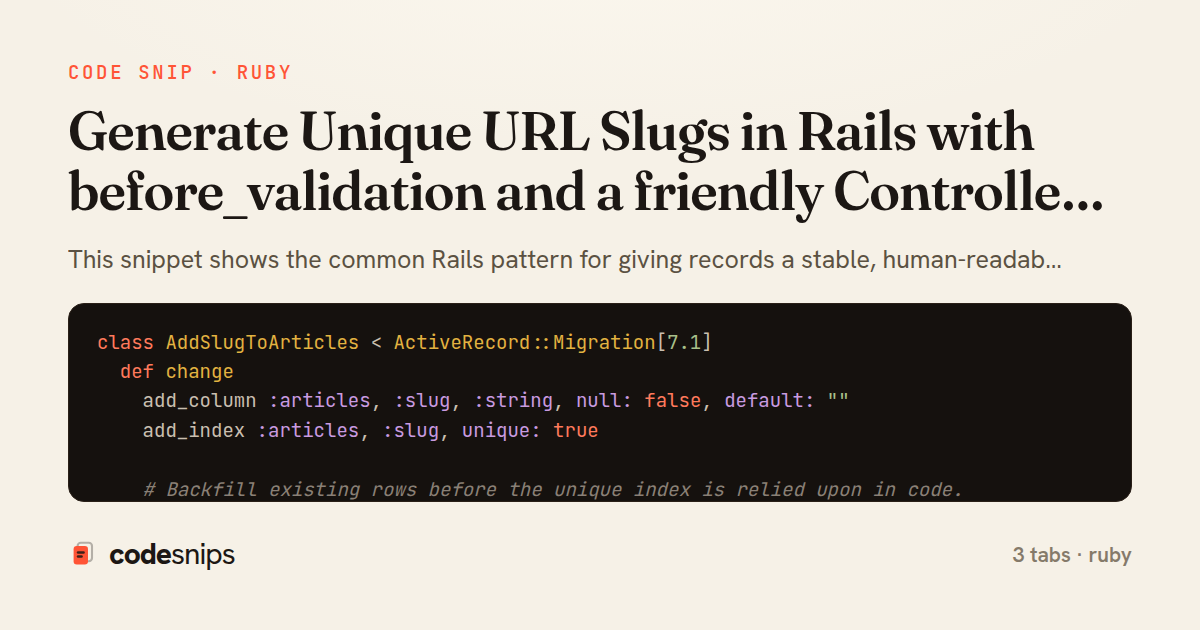
This snippet shows the common Rails pattern for giving records a stable, human-readable URL slug that is guaranteed unique, without pulling in a gem. It spans three collaborating files: the migration that shapes the column, the model that fills it in, and the controller that reads it back.
In db/migrate slug migration, the slug is treated as first-class data rather than a derived string. The column is null: false and backed by a unique index, so the database itself is the final arbiter of uniqueness. Enforcing this at the storage layer matters because application-level checks alone are racy: two concurrent inserts can both pass an ActiveRecord uniqueness validation and then collide. The unique: true index turns that race into a catchable RecordNotUnique rather than duplicate rows.
Article model builds the slug in a before_validation callback, assign_slug, that only fires on: :create or when the title changes, so editing unrelated fields never churns the URL. The slugify helper parameterizes the title into a lowercase, hyphenated base. ensure_unique_slug then probes the table with where.not(id: id) — excluding the current record so re-saving is a no-op — and appends -2, -3, and so on until it finds a free value. Doing this in before_validation means the presence and uniqueness validators see the final slug, giving clean error messages instead of a raw database exception in the normal case.
Because a generated suffix can still lose a race under real concurrency, the create_with_slug class method wraps the save and retries on ActiveRecord::RecordNotUnique, regenerating the slug on the next attempt. This combines the friendly UX of pre-computed slugs with the hard guarantee of the unique index — the belt-and-suspenders approach worth reaching for whenever a URL segment must be both readable and collision-free.
ArticlesController closes the loop. Its routes use :slug as the identifier, so set_article calls find_by!(slug: params[:slug]), which raises RecordNotFound and yields a proper 404 for unknown slugs. Overriding to_param in the model keeps article_path(@article) emitting the slug automatically, so links and lookups stay in sync without manual URL building anywhere in the app.
Related snips
class CommentsController < ApplicationController
  before_action :set_post

  def create
    @comment = @post.comments.build(comment_params)
System test: asserting Turbo Stream responses
class Post < ApplicationRecord
  belongs_to :author, class_name: 'User'
  has_many :comments, dependent: :destroy

  scope :published, -> { where.not(published_at: nil).where('published_at <= ?', Time.current) }
  scope :draft, -> { where(published_at: nil) }
ActiveRecord scopes for reusable query logic
module Api
  module V1
    class UsersController < BaseController
      def show
        user = User.includes(:profile).find(params[:id])
ETags for conditional requests and caching
class PostsController < ApplicationController
  def index
    @posts = Post.includes(:author)
                 .order(created_at: :desc)
                 .page(params[:page])
                 .per(10)
Turbo Frames: infinite scroll with lazy-loading frame
<!DOCTYPE html>
<html lang="en">
<head>
  <meta charset="UTF-8">
  <meta name="viewport" content="width=device-width, initial-scale=1.0">
  <title>Semantic HTML Example</title>
Semantic HTML5 elements and accessibility best practices
package dbutil

import (
  "context"

  "github.com/jackc/pgconn"
Retry Postgres serialization failures with bounded attempts
Share this code
Here's the card — post it anywhere.