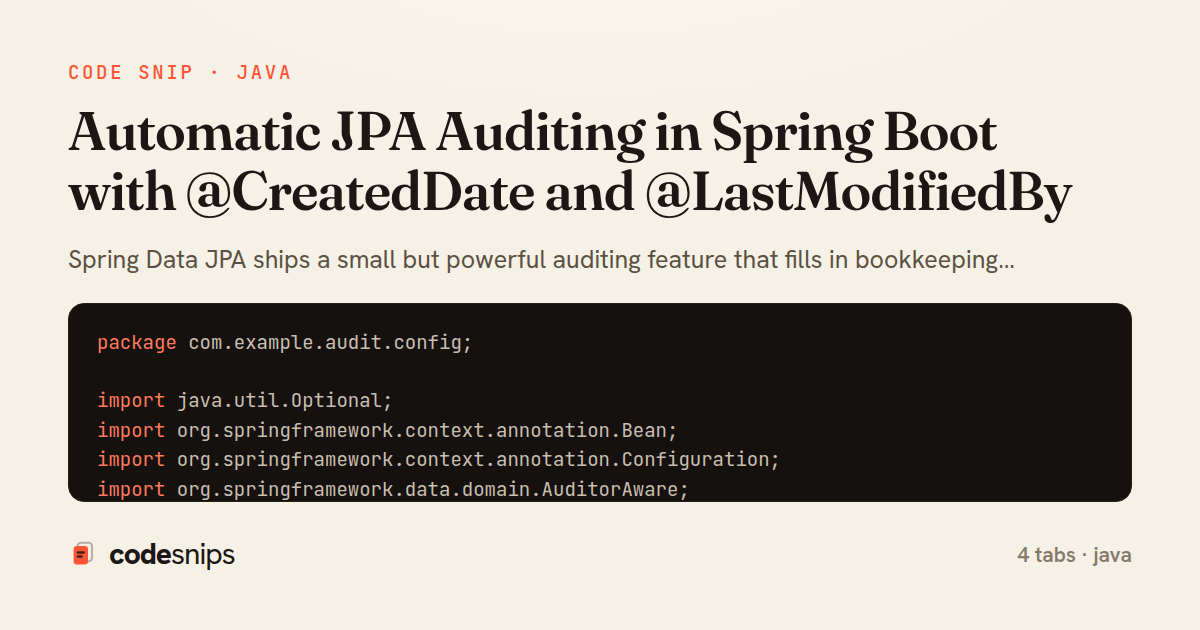
package com.example.audit.config;

import java.util.Optional;
import org.springframework.context.annotation.Bean;
import org.springframework.context.annotation.Configuration;
import org.springframework.data.domain.AuditorAware;
import org.springframework.data.jpa.repository.config.EnableJpaAuditing;
import org.springframework.security.core.Authentication;
import org.springframework.security.core.context.SecurityContextHolder;

@Configuration
@EnableJpaAuditing(auditorAwareRef = "auditorProvider")
public class JpaAuditingConfig {

    @Bean
    public AuditorAware<String> auditorProvider() {
        return new SecurityAuditorAware();
    }

    static class SecurityAuditorAware implements AuditorAware<String> {
        @Override
        public Optional<String> getCurrentAuditor() {
            Authentication authentication =
                    SecurityContextHolder.getContext().getAuthentication();

            if (authentication == null
                    || !authentication.isAuthenticated()
                    || "anonymousUser".equals(authentication.getPrincipal())) {
                return Optional.empty();
            }
            return Optional.of(authentication.getName());
        }
    }
}
package com.example.audit.domain;

import java.time.Instant;
import javax.persistence.Column;
import javax.persistence.EntityListeners;
import javax.persistence.MappedSuperclass;
import org.springframework.data.annotation.CreatedBy;
import org.springframework.data.annotation.CreatedDate;
import org.springframework.data.annotation.LastModifiedBy;
import org.springframework.data.annotation.LastModifiedDate;
import org.springframework.data.jpa.domain.support.AuditingEntityListener;

@MappedSuperclass
@EntityListeners(AuditingEntityListener.class)
public abstract class Auditable {

    @CreatedBy
    @Column(name = "created_by", updatable = false, length = 100)
    private String createdBy;

    @CreatedDate
    @Column(name = "created_date", updatable = false, nullable = false)
    private Instant createdDate;

    @LastModifiedBy
    @Column(name = "last_modified_by", length = 100)
    private String lastModifiedBy;

    @LastModifiedDate
    @Column(name = "last_modified_date", nullable = false)
    private Instant lastModifiedDate;

    public String getCreatedBy() {
        return createdBy;
    }

    public Instant getCreatedDate() {
        return createdDate;
    }

    public String getLastModifiedBy() {
        return lastModifiedBy;
    }

    public Instant getLastModifiedDate() {
        return lastModifiedDate;
    }
}
package com.example.audit.domain;

import javax.persistence.Column;
import javax.persistence.Entity;
import javax.persistence.GeneratedValue;
import javax.persistence.GenerationType;
import javax.persistence.Id;
import javax.persistence.Table;

@Entity
@Table(name = "documents")
public class Document extends Auditable {

    @Id
    @GeneratedValue(strategy = GenerationType.IDENTITY)
    private Long id;

    @Column(nullable = false)
    private String title;

    @Column(columnDefinition = "text")
    private String body;

    protected Document() {
    }

    public Document(String title, String body) {
        this.title = title;
        this.body = body;
    }

    public Long getId() {
        return id;
    }

    public String getTitle() {
        return title;
    }

    public void setTitle(String title) {
        this.title = title;
    }

    public String getBody() {
        return body;
    }

    public void setBody(String body) {
        this.body = body;
    }
}
package com.example.audit.service;

import com.example.audit.domain.Document;
import com.example.audit.repository.DocumentRepository;
import javax.persistence.EntityNotFoundException;
import org.springframework.stereotype.Service;
import org.springframework.transaction.annotation.Transactional;

@Service
public class DocumentService {

    private final DocumentRepository documents;

    public DocumentService(DocumentRepository documents) {
        this.documents = documents;
    }

    @Transactional
    public Document create(String title, String body) {
        // no audit fields set here; the listener fills created_by/created_date on INSERT
        return documents.save(new Document(title, body));
    }

    @Transactional
    public Document rename(Long id, String newTitle) {
        Document doc = documents.findById(id)
                .orElseThrow(() -> new EntityNotFoundException("document " + id));
        doc.setTitle(newTitle);
        // last_modified_by/last_modified_date are refreshed on flush of this UPDATE
        return doc;
    }
}
Spring Data JPA ships a small but powerful auditing feature that fills in bookkeeping columns — who created a row, when, who last touched it, and when — without scattering entity.setUpdatedAt(...) calls across the service layer. This snippet wires that feature end to end and shows the two moving parts that make it work: an AuditorAware bean that answers "who is the current user?" and an auditable base class whose lifecycle hooks Spring populates automatically.
In JpaAuditingConfig, @EnableJpaAuditing turns the feature on and points at the auditorProvider bean via auditorAwareRef. The AuditorAware<String> implementation reads the SecurityContextHolder to derive the current principal's username. It deliberately returns Optional.empty() when there is no authentication or the request is anonymous — that matters because background jobs, migrations, and startup seeders run without a security context, and returning empty lets Spring leave @CreatedBy/@LastModifiedBy null rather than blowing up.
Auditable is a @MappedSuperclass, so its four columns are folded into every subclass table instead of living in a separate table. It carries @EntityListeners(AuditingEntityListener.class), which is the hook Spring uses to intercept persist and update events. @CreatedDate and @LastModifiedBy are set by that listener: creation fields fire once on the initial INSERT, and the modification fields fire on every UPDATE. The createdBy and createdDate columns are marked updatable = false so an accidental re-save can never rewrite the original author or timestamp. Using Instant keeps timestamps timezone-neutral in the database.
Document entity shows the payoff: it simply extends Auditable and declares its own domain fields. Nothing in the entity references auditing directly.
DocumentService demonstrates that the service code stays clean — create and rename never touch the audit columns, yet after save those columns are populated. A key pitfall worth noting is that auditing only fires through the JPA lifecycle, so bulk @Modifying JPQL updates bypass it entirely. This pattern is the idiomatic way to get consistent, tamper-resistant audit metadata across an entire domain model with almost no per-entity code.
Related snips
payload = {
  sub: user.id,
  iss: 'https://auth.example.com',
  aud: 'codesnips-api',
  exp: 15.minutes.from_now.to_i,
  iat: Time.now.to_i,
JWT issuance and verification without common footguns
import os
import stat

for root, _dirs, files in os.walk('/etc'):
    for name in files:
        path = os.path.join(root, name)
Python security audit script for exposed risky filesystem state
type User {
    id: ID!
    name: String!
    email: String!
    posts: [Post!]!
    createdAt: String!
GraphQL API with Spring Boot
package com.example.starter.config;

import com.example.starter.properties.CustomProperties;
import com.example.starter.service.CustomService;
import org.springframework.boot.autoconfigure.AutoConfiguration;
import org.springframework.boot.autoconfigure.condition.ConditionalOnClass;
Custom Spring Boot starters
#!/usr/bin/env bash
set -euo pipefail

export VAULT_ADDR="https://vault.internal:8200"
export VAULT_TOKEN="${VAULT_TOKEN:?missing VAULT_TOKEN}"
Secrets management with environment isolation and Vault
import { randomBytes, createHash } from "crypto";
import jwt from "jsonwebtoken";
import { RefreshTokenStore } from "./store";

const ACCESS_SECRET = process.env.ACCESS_SECRET!;
const ACCESS_TTL = "15m";
JWT access + refresh token rotation (conceptual)
Share this code
Here's the card — post it anywhere.