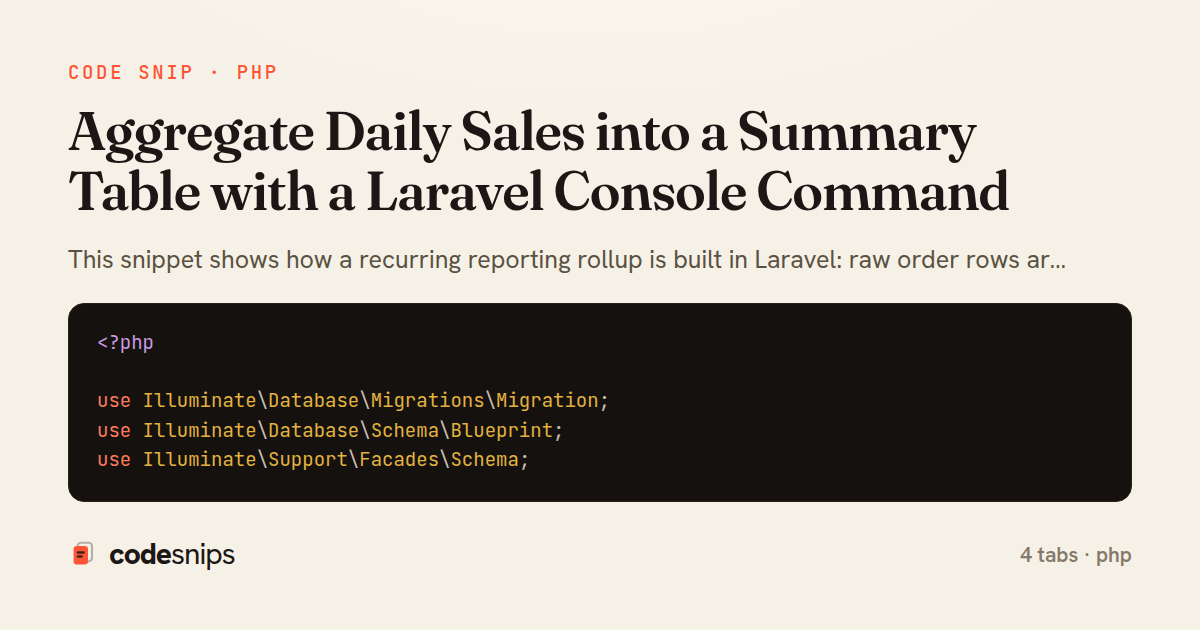
<?php

use Illuminate\Database\Migrations\Migration;
use Illuminate\Database\Schema\Blueprint;
use Illuminate\Support\Facades\Schema;

return new class extends Migration
{
    public function up(): void
    {
        Schema::create('daily_sales_summaries', function (Blueprint $table) {
            $table->id();
            $table->date('summary_date')->unique();
            $table->unsignedInteger('orders_count')->default(0);
            $table->decimal('gross_total', 12, 2)->default(0);
            $table->decimal('refunds_total', 12, 2)->default(0);
            $table->timestamps();
        });
    }

    public function down(): void
    {
        Schema::dropIfExists('daily_sales_summaries');
    }
};
<?php

namespace App\Models;

use Illuminate\Database\Eloquent\Builder;
use Illuminate\Database\Eloquent\Model;

class DailySalesSummary extends Model
{
    protected $fillable = [
        'summary_date',
        'orders_count',
        'gross_total',
        'refunds_total',
    ];

    protected $casts = [
        'summary_date' => 'date',
        'gross_total' => 'decimal:2',
        'refunds_total' => 'decimal:2',
    ];

    public function netRevenue(): string
    {
        return bcsub($this->gross_total, $this->refunds_total, 2);
    }

    public function scopeForRange(Builder $query, $start, $end): Builder
    {
        return $query->whereBetween('summary_date', [$start, $end])
            ->orderBy('summary_date');
    }
}
<?php

namespace App\Console\Commands;

use App\Models\DailySalesSummary;
use Illuminate\Console\Command;
use Illuminate\Support\Carbon;
use Illuminate\Support\Facades\DB;

class AggregateDailySales extends Command
{
    protected $signature = 'sales:aggregate-daily {--date= : Day to summarize (Y-m-d), defaults to yesterday}';

    protected $description = 'Roll up paid orders into a daily sales summary row';

    public function handle(): int
    {
        $day = $this->option('date')
            ? Carbon::parse($this->option('date'))->startOfDay()
            : Carbon::yesterday()->startOfDay();

        $end = $day->copy()->addDay();

        $totals = DB::table('orders')
            ->selectRaw('COUNT(*) as orders_count')
            ->selectRaw('COALESCE(SUM(total_amount), 0) as gross_total')
            ->selectRaw('COALESCE(SUM(refunded_amount), 0) as refunds_total')
            ->where('status', 'paid')
            ->where('created_at', '>=', $day)
            ->where('created_at', '<', $end)
            ->first();

        $summary = DailySalesSummary::updateOrCreate(
            ['summary_date' => $day->toDateString()],
            [
                'orders_count' => (int) $totals->orders_count,
                'gross_total' => $totals->gross_total,
                'refunds_total' => $totals->refunds_total,
            ]
        );

        $this->info(sprintf(
            'Summarized %s: %d orders, net %s',
            $day->toDateString(),
            $summary->orders_count,
            $summary->netRevenue()
        ));

        return self::SUCCESS;
    }
}
<?php

namespace App\Console;

use App\Console\Commands\AggregateDailySales;
use Illuminate\Console\Scheduling\Schedule;
use Illuminate\Foundation\Console\Kernel as ConsoleKernel;

class Kernel extends ConsoleKernel
{
    protected function schedule(Schedule $schedule): void
    {
        $schedule->command('sales:aggregate-daily')
            ->dailyAt('01:15')
            ->withoutOverlapping()
            ->onOneServer()
            ->runInBackground();
    }

    protected function commands(): void
    {
        $this->load(__DIR__ . '/Commands');

        require base_path('routes/console.php');
    }
}
This snippet shows how a recurring reporting rollup is built in Laravel: raw order rows are collapsed into one summary row per day so dashboards read from a small, indexed table instead of scanning the full orders table on every request. The pattern is a classic pre-aggregation, trading a little write-time work and some data staleness for cheap, predictable reads.
The create_daily_sales_summaries_table migration defines the target table. Each row is keyed by summary_date with a unique constraint, which is the linchpin of the whole design: it lets the command re-run for the same day without creating duplicates, using an idempotent upsert. Money is stored as decimal to avoid float rounding, and orders_count plus refunds_total give enough detail for a basic revenue view.
The DailySalesSummary model is a thin Eloquent model. summary_date is cast to a date and the netRevenue() accessor derives net figures on read rather than storing a redundant column that could drift out of sync. The forRange() scope keeps reporting queries expressive and reusable.
The heart of the feature is AggregateDailySales command. Its handle() method resolves a target day from the optional --date argument, defaulting to yesterday so a nightly run summarizes a complete day. It builds a single grouped aggregate query with selectRaw over the orders table, computing SUM and COUNT in the database — far cheaper than pulling rows into PHP. The result is written with updateOrCreate, matched on summary_date, so running the command twice simply overwrites the day's totals; this makes backfills and retries safe.
Because the query only touches paid orders within a half-open [start, end) interval, it avoids double-counting boundary timestamps and naturally ignores pending or cancelled orders. The --date argument also enables backfilling historical days in a loop from a shell.
The Console schedule registration wires the command into Laravel's scheduler with dailyAt('01:15') and withoutOverlapping(), so a long-running rollup never stacks on top of itself. Reaching for this approach makes sense once report queries grow slow; the main trade-offs are eventual consistency and the need to re-aggregate when historical orders change.
Related snips
<?php

namespace App\Providers;

use App\Contracts\PaymentGateway;
use App\Services\StripePaymentGateway;
Laravel service container and dependency injection
{
  "private": true,
  "scripts": {
    "dev": "vite",
    "build": "vite build"
  },
Laravel mix/Vite for asset compilation
class ReportQuery
  SQL = <<~SQL.freeze
    SELECT date_trunc('day', events.created_at) AS day,
           count(*) AS total,
           count(*) FILTER (WHERE events.kind = 'purchase') AS purchases
    FROM events
Safe Raw SQL with exec_query + Binds
<?php

use Illuminate\Database\Migrations\Migration;
use Illuminate\Database\Schema\Blueprint;
use Illuminate\Support\Facades\Schema;
Laravel database migrations for schema management
class Tag < ApplicationRecord
  has_many :taggings, dependent: :destroy

  scope :top, ->(limit = 20) {
    joins(:taggings)
      .group(Arel.sql("tags.id"))
Memory-Safe “top tags” aggregation with pluck + group
<?php

namespace App\Http\Requests;

use Illuminate\Foundation\Http\FormRequest;
use Illuminate\Validation\Rule;
Laravel form requests for validation
Share this code
Here's the card — post it anywhere.