use std::time::{Duration, Instant};

pub struct LeakyBucket {
    level: f64,
    capacity: f64,
    rate_per_sec: f64,
    last_leak: Instant,
}

impl LeakyBucket {
    pub fn new(capacity: f64, rate_per_sec: f64) -> Self {
        LeakyBucket {
            level: 0.0,
            capacity,
            rate_per_sec,
            last_leak: Instant::now(),
        }
    }

    fn leak(&mut self, now: Instant) {
        let elapsed = now.duration_since(self.last_leak).as_secs_f64();
        let drained = elapsed * self.rate_per_sec;
        self.level = (self.level - drained).max(0.0);
        self.last_leak = now;
    }

    pub fn try_add(&mut self, now: Instant) -> bool {
        self.leak(now);
        if self.level + 1.0 <= self.capacity {
            self.level += 1.0;
            true
        } else {
            false
        }
    }

    pub fn time_until_available(&mut self, now: Instant) -> Duration {
        self.leak(now);
        let overflow = (self.level + 1.0) - self.capacity;
        if overflow <= 0.0 {
            return Duration::ZERO;
        }
        Duration::from_secs_f64(overflow / self.rate_per_sec)
    }
}
use std::sync::Arc;
use std::time::Instant;
use tokio::sync::Mutex;
use tokio::time::sleep;

use crate::leaky_bucket::LeakyBucket;

#[derive(Clone)]
pub struct RateShaper {
    bucket: Arc<Mutex<LeakyBucket>>,
}

impl RateShaper {
    pub fn new(capacity: f64, rate_per_sec: f64) -> Self {
        RateShaper {
            bucket: Arc::new(Mutex::new(LeakyBucket::new(capacity, rate_per_sec))),
        }
    }

    pub async fn acquire(&self) {
        loop {
            let wait = {
                let mut bucket = self.bucket.lock().await;
                let now = Instant::now();
                if bucket.try_add(now) {
                    return;
                }
                bucket.time_until_available(now)
            }; // guard dropped here, before awaiting

            sleep(wait).await;
        }
    }
}
use tokio::sync::mpsc::Receiver;

use crate::shaper::RateShaper;

pub struct Message {
    pub id: u64,
    pub payload: Vec<u8>,
}

pub async fn run_consumer(mut rx: Receiver<Message>, shaper: RateShaper) {
    while let Some(msg) = rx.recv().await {
        shaper.acquire().await;

        if let Err(err) = handle(&msg).await {
            eprintln!("failed to process message {}: {}", msg.id, err);
        }
    }
}

async fn handle(msg: &Message) -> Result<(), Box<dyn std::error::Error>> {
    // downstream call paced by the shaper
    println!("processing message {} ({} bytes)", msg.id, msg.payload.len());
    Ok(())
}

#[tokio::main]
async fn main() {
    let (tx, rx) = tokio::sync::mpsc::channel(1024);
    let shaper = RateShaper::new(20.0, 10.0); // burst 20, drain 10/s

    let consumer = tokio::spawn(run_consumer(rx, shaper));

    for id in 0..100 {
        let _ = tx.send(Message { id, payload: vec![0u8; 64] }).await;
    }
    drop(tx);

    let _ = consumer.await;
}
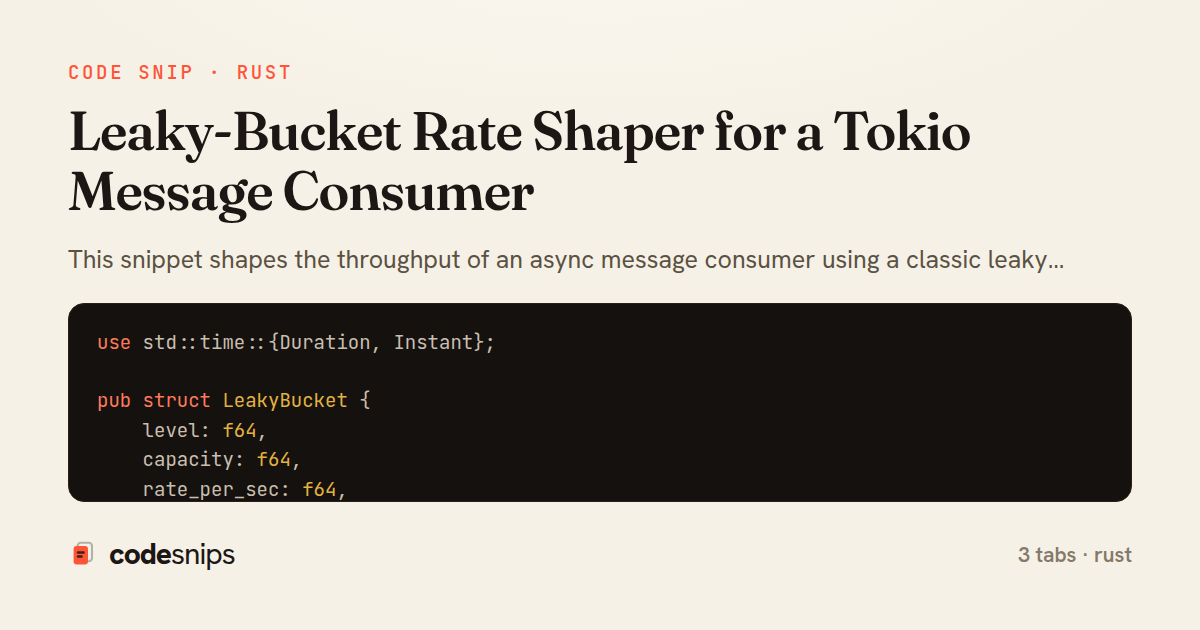
This snippet shapes the throughput of an async message consumer using a classic leaky-bucket algorithm. Unlike a token bucket that permits bursts up to its capacity, a leaky bucket enforces a smooth, constant drain rate: the bucket holds queued "water" (pending work), and it leaks at a fixed rate no matter how fast messages arrive. That property makes it a good fit for protecting a fragile downstream — a database, a third-party API, or a socket — from spikes while still absorbing short backlogs up to a bounded capacity.
In leaky_bucket.rs, the LeakyBucket tracks level (current water) and capacity, and computes leakage lazily. Rather than spawning a timer, leak measures elapsed wall-clock time since last_leak and subtracts rate_per_sec * elapsed, clamping at zero. try_add first leaks, then admits one unit only if there is room, returning false when the bucket is full — this is the immediate drop path. time_until_available computes how long a caller must wait for one unit of headroom, which is what turns a hard drop into graceful backpressure. Keeping the math time-based means accuracy doesn't depend on how often the bucket is polled.
shaper.rs wraps the bucket in a Mutex inside a RateShaper so it can be shared across tasks via Arc. Its acquire method loops: it locks, tries to add, and if the bucket is full it reads time_until_available, releases the lock (dropping the guard before awaiting is essential to avoid holding the mutex across .await), and sleeps with tokio::time::sleep. This yields cooperatively so other tasks make progress. The loop then retries, guaranteeing eventual admission at the shaped rate.
consumer.rs ties it together: run_consumer pulls from an mpsc::Receiver, calls shaper.acquire().await before every handle call, and thereby paces processing to the configured rate. Because the shaper is Arc-shared, multiple consumer tasks would share one global rate limit rather than each getting their own. The main trade-off is latency: shaping deliberately delays work to protect the downstream, so capacity should be tuned to tolerate expected bursts without unbounded queue growth. A developer reaches for this pattern whenever a consumer can outrun what it feeds.
Related snips
export interface RetryOptions {
  retries: number;
  baseMs: number;
  maxMs: number;
  signal?: AbortSignal;
  onRetry?: (attempt: number, delay: number, err: unknown) => void;
Exponential backoff with jitter for retries
package dbutil

import (
  "context"

  "github.com/jackc/pgconn"
Retry Postgres serialization failures with bounded attempts
require "csv"

class PeopleCsvStream
  include Enumerable

  HEADERS = %w[id full_name email signed_up_at plan].freeze
Resilient CSV Export as a Streamed Response
// Creating a Promise
const myPromise = new Promise((resolve, reject) => {
  const success = true;

  setTimeout(() => {
    if (success) {
Promises and async/await patterns for asynchronous JavaScript
use crossbeam::channel::unbounded;
use std::thread;

fn main() {
    let (tx, rx) = unbounded();
Crossbeam for advanced concurrent data structures
use std::sync::mpsc;
use std::thread;

fn main() {
    let (tx, rx) = mpsc::channel();
Channels (mpsc) for message passing between threads
Share this code
Here's the card — post it anywhere.