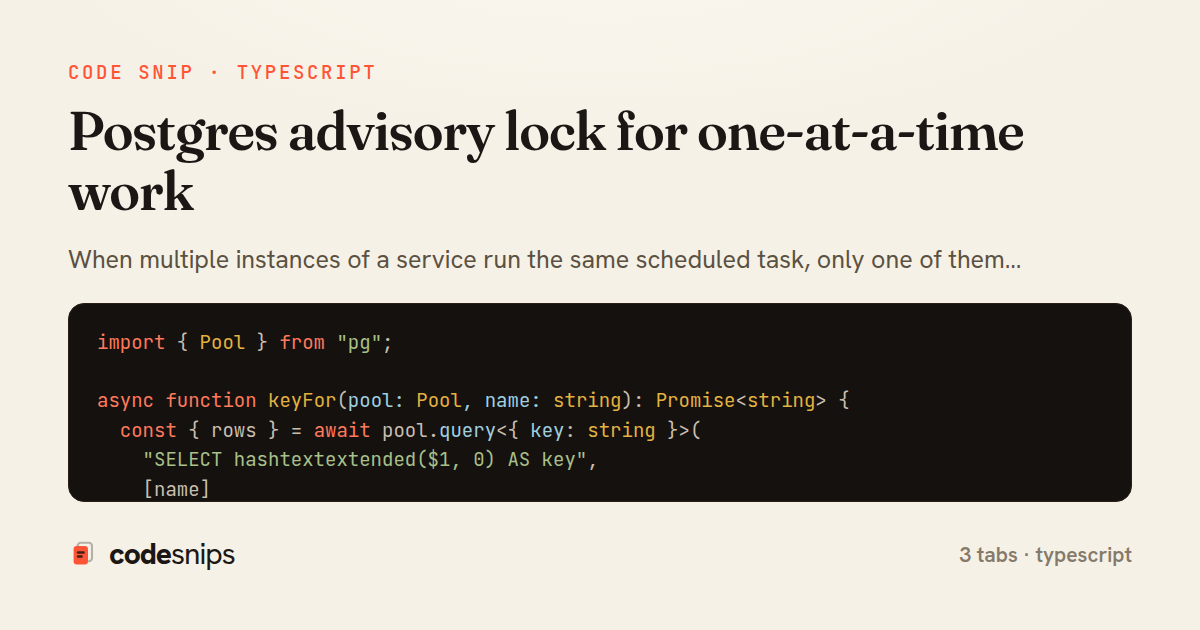
import { Pool } from "pg";

async function keyFor(pool: Pool, name: string): Promise<string> {
  const { rows } = await pool.query<{ key: string }>(
    "SELECT hashtextextended($1, 0) AS key",
    [name]
  );
  return rows[0].key;
}

export async function withAdvisoryLock<T>(
  pool: Pool,
  name: string,
  fn: () => Promise<T>
): Promise<{ ran: false } | { ran: true; result: T }> {
  const key = await keyFor(pool, name);
  const client = await pool.connect();

  try {
    const { rows } = await client.query<{ locked: boolean }>(
      "SELECT pg_try_advisory_lock($1) AS locked",
      [key]
    );

    if (!rows[0].locked) {
      return { ran: false };
    }

    try {
      const result = await fn();
      return { ran: true, result };
    } finally {
      await client.query("SELECT pg_advisory_unlock($1)", [key]);
    }
  } finally {
    client.release();
  }
}
import { Pool } from "pg";
import { withAdvisoryLock } from "./advisoryLock";

export class ReportJob {
  constructor(private readonly pool: Pool) {}

  async run(): Promise<void> {
    const outcome = await withAdvisoryLock(this.pool, "reports:daily", () =>
      this.generateDailyReport()
    );

    if (!outcome.ran) {
      console.log("[reports:daily] lock held elsewhere, skipping this run");
      return;
    }

    console.log(`[reports:daily] finished, rows=${outcome.result}`);
  }

  private async generateDailyReport(): Promise<number> {
    const { rowCount } = await this.pool.query(
      `INSERT INTO daily_reports (day, total_orders, total_revenue)
       SELECT current_date, count(*), coalesce(sum(amount_cents), 0)
       FROM orders
       WHERE created_at >= current_date
       ON CONFLICT (day) DO UPDATE
         SET total_orders = excluded.total_orders,
             total_revenue = excluded.total_revenue`
    );
    return rowCount ?? 0;
  }
}
import cron from "node-cron";
import { Pool } from "pg";
import { ReportJob } from "./ReportJob";

const pool = new Pool({
  connectionString: process.env.DATABASE_URL,
  max: 10,
});

const reportJob = new ReportJob(pool);

// Every instance registers this; the advisory lock ensures only one runs it.
cron.schedule("*/5 * * * *", async () => {
  try {
    await reportJob.run();
  } catch (err) {
    console.error("[reports:daily] failed", err);
  }
});

process.on("SIGTERM", async () => {
  await pool.end();
  process.exit(0);
});
When multiple instances of a service run the same scheduled task, only one of them should actually do the work at any given moment. This snippet shows how to enforce that with a Postgres session-level advisory lock, which acts as a distributed mutex without needing a dedicated locking table or an external system like Redis.
The withAdvisoryLock helper in the advisoryLock util tab is the core. Advisory locks in Postgres are keyed by one 64-bit integer (or two 32-bit ints), so the helper first hashes a human-readable name into a stable bigint via pg_advisory_lock_key, which uses hashtextextended. It then calls pg_try_advisory_lock, the non-blocking variant that returns immediately with true or false instead of waiting. This matters: a cron job that blocks waiting for a lock will pile up and eventually exhaust the connection pool, so try semantics let a losing instance simply skip the run.
A crucial detail is that the lock must be acquired and released on the same physical connection. The helper checks out a dedicated client with pool.connect() rather than using pool.query, because pool queries can land on different backends. The try/finally guarantees pg_advisory_unlock runs even if the callback throws, and the client is always released back to the pool. Session-level locks are also auto-released if the connection dies, which is the safety net for crashes.
The ReportJob service tab wraps a real unit of work, generateDailyReport, in withAdvisoryLock under the key reports:daily. When the lock is not obtained, it logs and returns cleanly rather than erroring, so a skipped run is a normal outcome.
The scheduler tab wires it into node-cron and shows the payoff: every instance schedules the same job, but only the one that wins the lock executes the body. This pattern is ideal for idempotency-sensitive tasks — report generation, cache warming, cleanup sweeps — where double execution is wasteful or unsafe. The main trade-off is that advisory locks are advisory: nothing forces unrelated code to respect them, so the key naming convention must be shared and disciplined across the codebase.
Related snips
export interface RetryOptions {
  retries: number;
  baseMs: number;
  maxMs: number;
  signal?: AbortSignal;
  onRetry?: (attempt: number, delay: number, err: unknown) => void;
Exponential backoff with jitter for retries
package dbutil

import (
  "context"

  "github.com/jackc/pgconn"
Retry Postgres serialization failures with bounded attempts
require "csv"

class PeopleCsvStream
  include Enumerable

  HEADERS = %w[id full_name email signed_up_at plan].freeze
Resilient CSV Export as a Streamed Response
// Creating a Promise
const myPromise = new Promise((resolve, reject) => {
  const success = true;

  setTimeout(() => {
    if (success) {
Promises and async/await patterns for asynchronous JavaScript
use crossbeam::channel::unbounded;
use std::thread;

fn main() {
    let (tx, rx) = unbounded();
Crossbeam for advanced concurrent data structures
use std::sync::mpsc;
use std::thread;

fn main() {
    let (tx, rx) = mpsc::channel();
Channels (mpsc) for message passing between threads
Share this code
Here's the card — post it anywhere.