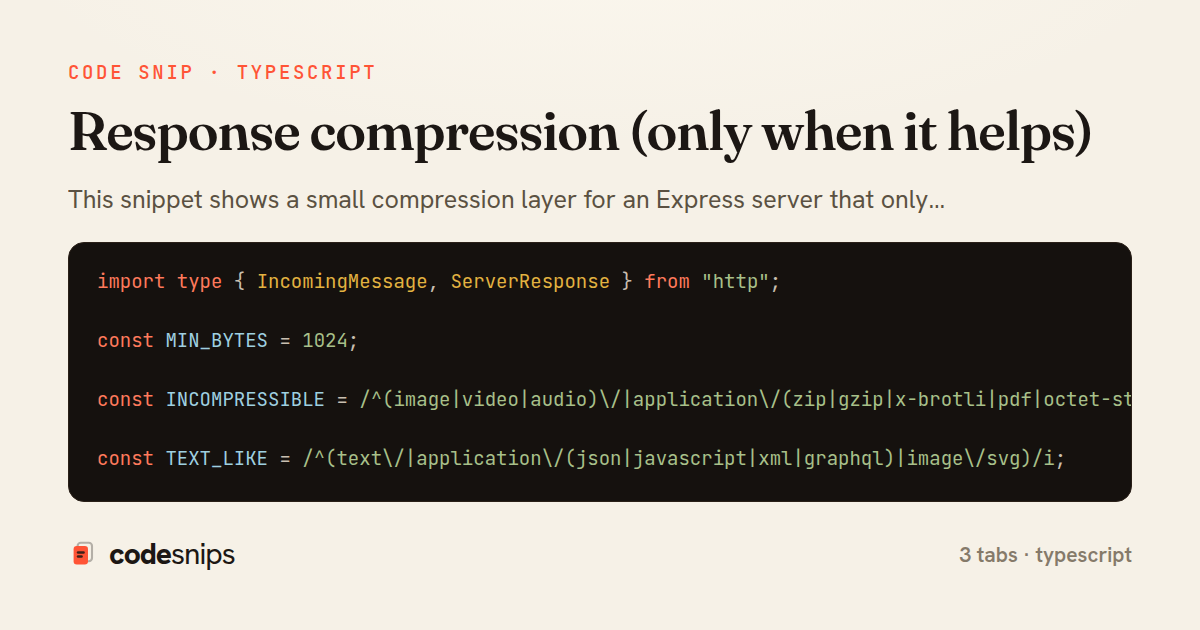
import type { IncomingMessage, ServerResponse } from "http";

const MIN_BYTES = 1024;

const INCOMPRESSIBLE = /^(image|video|audio)\/|application\/(zip|gzip|x-brotli|pdf|octet-stream)/i;

const TEXT_LIKE = /^(text\/|application\/(json|javascript|xml|graphql)|image\/svg)/i;

export function shouldCompress(req: IncomingMessage, res: ServerResponse): boolean {
  const type = String(res.getHeader("Content-Type") || "");

  if (INCOMPRESSIBLE.test(type)) {
    return false;
  }

  const rawLength = res.getHeader("Content-Length");
  if (rawLength === undefined) {
    // Streamed/chunked response: only compress predictable text payloads.
    return TEXT_LIKE.test(type);
  }

  const length = Number(rawLength);
  if (Number.isFinite(length) && length < MIN_BYTES) {
    return false;
  }

  return true;
}
import compression from "compression";
import type { Request, Response, RequestHandler } from "express";
import { shouldCompress } from "./compressionPolicy";

export function adaptiveCompression(): RequestHandler {
  return compression({
    threshold: 0, // size gating is handled entirely by our policy
    filter(req: Request, res: Response): boolean {
      if (res.locals.noCompression === true) {
        return false;
      }

      // Never re-encode assets that arrive already compressed.
      if (res.getHeader("Content-Encoding")) {
        return false;
      }

      return shouldCompress(req, res);
    },
  });
}
import express, { Request, Response } from "express";
import { adaptiveCompression } from "./adaptiveCompression";

const app = express();

app.use(adaptiveCompression());

app.get("/api/report", (_req: Request, res: Response) => {
  const rows = Array.from({ length: 5000 }, (_, i) => ({ id: i, label: `row-${i}` }));
  res.json({ generatedAt: Date.now(), rows });
});

app.get("/events", (_req: Request, res: Response) => {
  res.locals.noCompression = true; // SSE must flush immediately, not buffer
  res.set({
    "Content-Type": "text/event-stream",
    "Cache-Control": "no-cache",
    Connection: "keep-alive",
  });

  const timer = setInterval(() => {
    res.write(`data: ${JSON.stringify({ ts: Date.now() })}\n\n`);
  }, 1000);

  res.on("close", () => clearInterval(timer));
});

app.listen(3000, () => console.log("listening on :3000"));
This snippet shows a small compression layer for an Express server that only compresses responses when doing so is actually worthwhile. Naive compression() usage wastes CPU compressing tiny payloads, already-compressed formats like JPEG or MP4, and streamed responses where buffering hurts latency. The three tabs together implement a policy engine, a middleware that applies it, and the wiring that registers it.
In compressionPolicy.ts, shouldCompress centralizes the decision. It reads the Content-Type and Content-Length headers and returns false for anything under MIN_BYTES (1 KB), because the gzip header and CPU cost outweigh the savings on small bodies. It also rejects content types already matching INCOMPRESSIBLE — images, video, audio, and zip archives are entropy-dense and shrink by almost nothing. When Content-Length is absent (a streamed or chunked response) the policy is conservative and allows compression only for known text-like types, since compressing an unbounded stream can add latency for interactive endpoints. This keeps the rule readable and unit-testable in isolation from Express.
In adaptiveCompression.ts, the middleware delegates the buffered path to the standard compression package but supplies a custom filter backed by shouldCompress, so the library still handles content negotiation, Accept-Encoding parsing, and the actual gzip/brotli codecs. The wrapper also honors a per-response opt-out: handlers can set res.locals.noCompression = true (for example on Server-Sent Events) and the filter bails out early. Crucially it respects an existing Content-Encoding header so pre-compressed assets served from disk are never double-encoded, a common corruption bug.
In server.ts, the middleware is registered before the routes with a threshold of 0 because the size gate now lives entirely in the policy, avoiding two competing thresholds. The SSE route demonstrates the escape hatch by flagging res.locals.noCompression before streaming.
The trade-off is explicit: spend CPU only where bytes-on-the-wire genuinely drop. The main pitfall to watch is the BREACH attack surface — compressing responses that mix secrets with attacker-controlled input — so security-sensitive endpoints should opt out via the same noCompression flag.
Related snips
export interface RetryOptions {
  retries: number;
  baseMs: number;
  maxMs: number;
  signal?: AbortSignal;
  onRetry?: (attempt: number, delay: number, err: unknown) => void;
Exponential backoff with jitter for retries
require "csv"

class PeopleCsvStream
  include Enumerable

  HEADERS = %w[id full_name email signed_up_at plan].freeze
Resilient CSV Export as a Streamed Response
Rails.application.configure do
  config.after_initialize do
    Bullet.enable = true
    Bullet.alert = false
    Bullet.bullet_logger = true
    Bullet.console = true
N+1 query detection with Bullet gem
json.array! @posts do |post|
  json.cache! ['v1', post], expires_in: 1.hour do
    json.id post.id
    json.title post.title
    json.excerpt post.excerpt
    json.published_at post.published_at
Fragment caching for expensive JSON serialization
import { randomBytes, createHash } from "crypto";
import jwt from "jsonwebtoken";
import { RefreshTokenStore } from "./store";

const ACCESS_SECRET = process.env.ACCESS_SECRET!;
const ACCESS_TTL = "15m";
JWT access + refresh token rotation (conceptual)
package deps

import (
  "net"
  "net/http"
  "time"
HTTP client tuned for production: timeouts, transport, and connection reuse
Share this code
Here's the card — post it anywhere.