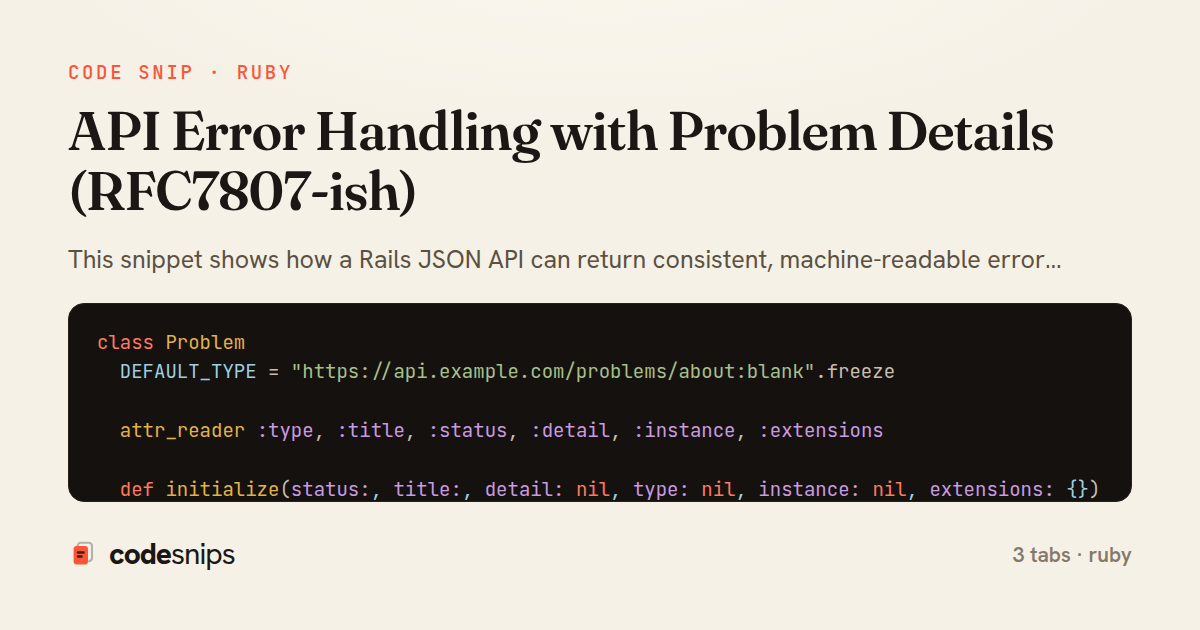
class Problem
  DEFAULT_TYPE = "https://api.example.com/problems/about:blank".freeze

  attr_reader :type, :title, :status, :detail, :instance, :extensions

  def initialize(status:, title:, detail: nil, type: nil, instance: nil, extensions: {})
    @status = status
    @title = title
    @detail = detail
    @type = type || DEFAULT_TYPE
    @instance = instance
    @extensions = extensions
  end

  def self.for_status(status, detail: nil, type: nil, extensions: {})
    title = Rack::Utils::HTTP_STATUS_CODES.fetch(status, "Unknown Error")
    new(status: status, title: title, detail: detail, type: type, extensions: extensions)
  end

  def to_h
    {
      type: type,
      title: title,
      status: status,
      detail: detail,
      instance: instance
    }.merge(extensions).compact
  end
end
module ProblemDetails
  extend ActiveSupport::Concern

  CONTENT_TYPE = "application/problem+json".freeze

  included do
    rescue_from StandardError, with: :render_unexpected
    rescue_from ActionController::ParameterMissing, with: :render_bad_request
    rescue_from ActiveRecord::RecordNotFound, with: :render_not_found
    rescue_from ActiveRecord::RecordInvalid, with: :render_unprocessable
  end

  private

  def render_bad_request(error)
    render_problem Problem.for_status(400, detail: error.message)
  end

  def render_not_found(error)
    render_problem Problem.for_status(404, detail: error.message)
  end

  def render_unprocessable(error)
    problem = Problem.for_status(
      422,
      detail: "Validation failed",
      extensions: { errors: error.record.errors.group_by_attribute.transform_values { |errs| errs.map(&:message) } }
    )
    render_problem problem
  end

  def render_unexpected(error)
    Rails.logger.error("[#{error.class}] #{error.message}\n#{error.backtrace&.first(10)&.join("\n")}")
    render_problem Problem.for_status(500, detail: "An unexpected error occurred")
  end

  def render_problem(problem)
    problem_with_instance = Problem.new(
      status: problem.status,
      title: problem.title,
      detail: problem.detail,
      type: problem.type,
      instance: request.path,
      extensions: problem.extensions
    )
    response.set_header("Content-Type", CONTENT_TYPE)
    render json: problem_with_instance.to_h, status: problem.status
  end
end
class ArticlesController < ApplicationController
  include ProblemDetails

  def show
    render json: find_article!
  end

  def create
    article = Article.new(article_params)
    article.save!
    render json: article, status: :created
  end

  def update
    article = find_article!
    article.update!(article_params)
    render json: article
  end

  private

  def find_article!
    Article.find(params[:id])
  end

  def article_params
    params.require(:article).permit(:title, :body, :published)
  end
end
This snippet shows how a Rails JSON API can return consistent, machine-readable error bodies using the Problem Details format described in RFC 7807. Instead of every controller inventing its own error shape, the API standardizes on an application/problem+json document with type, title, status, detail, and instance members, plus room for extension fields like errors.
In Problem value object, the error is modeled as an immutable struct-like class built from Keyword init. It holds the core RFC members and an extensions hash for domain-specific data. The type defaults to a stable URI so clients can dereference documentation, and to_h uses compact so absent members are omitted rather than serialized as null. Modeling the problem as a plain object keeps it decoupled from HTTP: the same Problem can be logged, tested, or rendered anywhere. A small for_status factory pulls a human-readable title from Rack::Utils::HTTP_STATUS_CODES, guaranteeing the title and status stay in agreement.
ProblemDetails concern is the glue mounted into the controller stack. It registers rescue_from handlers in a deliberate order — most specific first, StandardError last — because Rails matches handlers bottom-to-top against the ancestor chain. ActiveRecord::RecordInvalid is mapped to a 422 carrying the model's field errors under the errors extension, which is exactly the kind of structured validation feedback a form client needs. ActiveRecord::RecordNotFound becomes a clean 404, and ActionController::ParameterMissing a 400. The catch-all render_unexpected logs the backtrace server-side but returns a generic 500 body, avoiding leaking internal messages to callers.
The private render_problem method is where the response is actually written: it sets content_type to application/problem+json so intermediaries and clients can distinguish problem bodies from normal payloads, and echoes the request path into instance. A key trade-off is centralization versus flexibility — handling everything in one concern keeps controllers thin but means unusual cases still need explicit raises of typed exceptions.
ArticlesController demonstrates the payoff: its actions contain no rescue blocks at all. find_article! simply calls find, and create calls save!; any failure bubbles up to the concern and emerges as a correct Problem Details response. This pattern is worth reaching for whenever an API has more than a handful of endpoints and clients that need to parse errors programmatically.
Related snips
class CommentsController < ApplicationController
  before_action :set_post

  def create
    @comment = @post.comments.build(comment_params)
System test: asserting Turbo Stream responses
class Post < ApplicationRecord
  belongs_to :author, class_name: 'User'
  has_many :comments, dependent: :destroy

  scope :published, -> { where.not(published_at: nil).where('published_at <= ?', Time.current) }
  scope :draft, -> { where(published_at: nil) }
ActiveRecord scopes for reusable query logic
payload = {
  sub: user.id,
  iss: 'https://auth.example.com',
  aud: 'codesnips-api',
  exp: 15.minutes.from_now.to_i,
  iat: Time.now.to_i,
JWT issuance and verification without common footguns
export interface RetryOptions {
  retries: number;
  baseMs: number;
  maxMs: number;
  signal?: AbortSignal;
  onRetry?: (attempt: number, delay: number, err: unknown) => void;
Exponential backoff with jitter for retries
module Api
  module V1
    class UsersController < BaseController
      def show
        user = User.includes(:profile).find(params[:id])
ETags for conditional requests and caching
class PostsController < ApplicationController
  def index
    @posts = Post.includes(:author)
                 .order(created_at: :desc)
                 .page(params[:page])
                 .per(10)
Turbo Frames: infinite scroll with lazy-loading frame
Share this code
Here's the card — post it anywhere.