python
59 lines · 1 tab
Priya Sharma
Jan 2026
1 tab
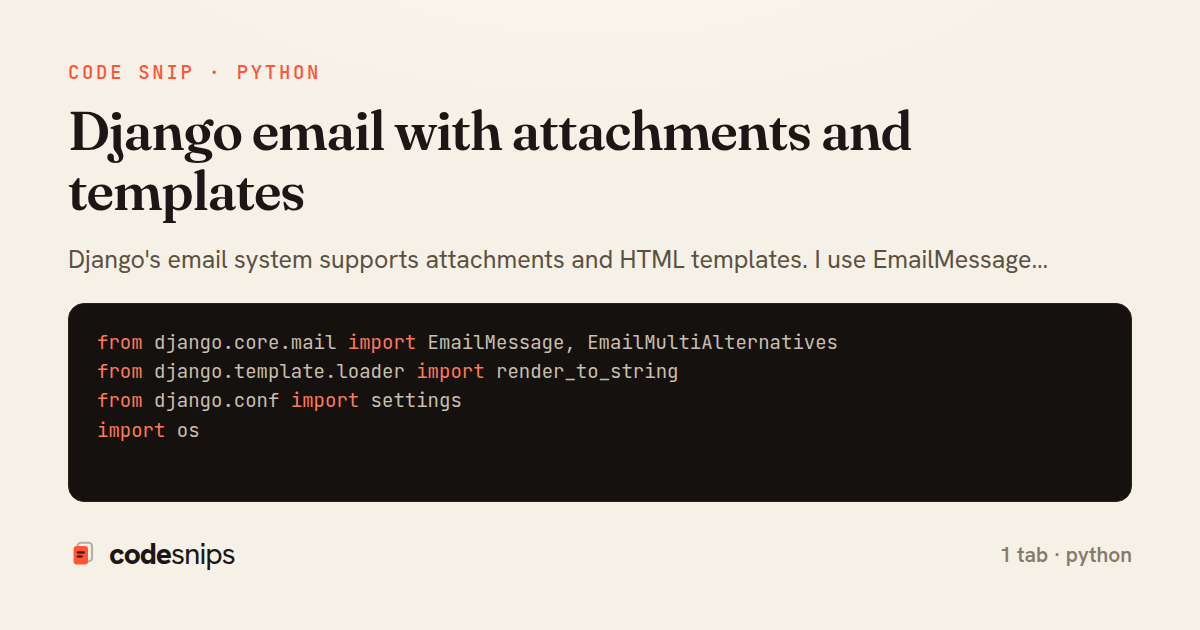
from django.core.mail import EmailMessage, EmailMultiAlternatives
from django.template.loader import render_to_string
from django.conf import settings
import os


def send_invoice_email(order):
    """Send invoice with PDF attachment."""
    subject = f'Invoice #{order.id}'

    # Render email from template
    context = {'order': order, 'site_url': settings.SITE_URL}
    html_content = render_to_string('emails/invoice.html', context)
    text_content = render_to_string('emails/invoice.txt', context)

    email = EmailMultiAlternatives(
        subject=subject,
        body=text_content,
        from_email=settings.DEFAULT_FROM_EMAIL,
        to=[order.customer.email],
        cc=['accounting@example.com'],
        bcc=['archive@example.com'],
    )

    email.attach_alternative(html_content, 'text/html')

    # Attach PDF file
    pdf_path = f'/tmp/invoice_{order.id}.pdf'
    if os.path.exists(pdf_path):
        email.attach_file(pdf_path, mimetype='application/pdf')

    # Attach in-memory file
    csv_data = generate_csv_data(order)
    email.attach('order_items.csv', csv_data, 'text/csv')

    email.send()


def send_bulk_newsletter(subscribers, subject, template_name):
    """Send newsletter to many subscribers efficiently."""
    messages = []

    for subscriber in subscribers:
        context = {'subscriber': subscriber}
        html_content = render_to_string(f'emails/{template_name}.html', context)

        msg = EmailMultiAlternatives(
            subject=subject,
            body='Newsletter',
            from_email=settings.DEFAULT_FROM_EMAIL,
            to=[subscriber.email],
        )
        msg.attach_alternative(html_content, 'text/html')
        messages.append(msg)

    # Send all at once
    from django.core.mail import get_connection
    connection = get_connection()
    connection.send_messages(messages)
1 file · python
Explain with highlit
Django's email system supports attachments and HTML templates. I use EmailMessage for full control or EmailMultiAlternatives for HTML+text versions. For attachments, I use attach_file() or attach() methods. I render email content from templates for consistency. For bulk emails, I send in batches to avoid rate limits. I use Celery for async sending. I track bounces and unsubscribes for deliverability. SMTP settings go in environment variables. This enables rich, professional emails from Django apps.
Related snips
python
import os
import stat

for root, _dirs, files in os.walk('/etc'):
    for name in files:
        path = os.path.join(root, name)
Python security audit script for exposed risky filesystem state
python
auditing
host-security
by Kai Nakamura
1 tab
python
class Product(models.Model):
    name = models.CharField(max_length=200)
    slug = models.SlugField(blank=True)
    price = models.DecimalField(max_digits=10, decimal_places=2)
    cost = models.DecimalField(max_digits=10, decimal_places=2)
    margin = models.DecimalField(max_digits=5, decimal_places=2, blank=True)
Django model signals vs overriding save
django
python
models
by Priya Sharma
2 tabs
python
from django.urls import path
from . import views

app_name = 'blog'

urlpatterns = [
Django URL namespacing and reverse lookups
django
python
urls
by Priya Sharma
3 tabs
ruby
# app/mailers/user_mailer.rb
class UserMailer < ApplicationMailer
  default from: 'noreply@example.com'

  def welcome_email(user)
    @user = user
ActionMailer advanced patterns for transactional emails
ruby
rails
action-mailer
by Sarah Mitchell
2 tabs
python
import graphene
from graphene_django import DjangoObjectType
from blog.models import Post, Comment


class PostType(DjangoObjectType):
Django GraphQL with Graphene
django
python
graphql
by Priya Sharma
2 tabs
ruby
module EmailNormalization
  extend ActiveSupport::Concern

  included do
    attr_accessor :soft_warnings
Soft Validation: Normalize + Validate Email
rails
activerecord
validations
by codesnips
4 tabs
Share this code
Here's the card — post it anywhere.