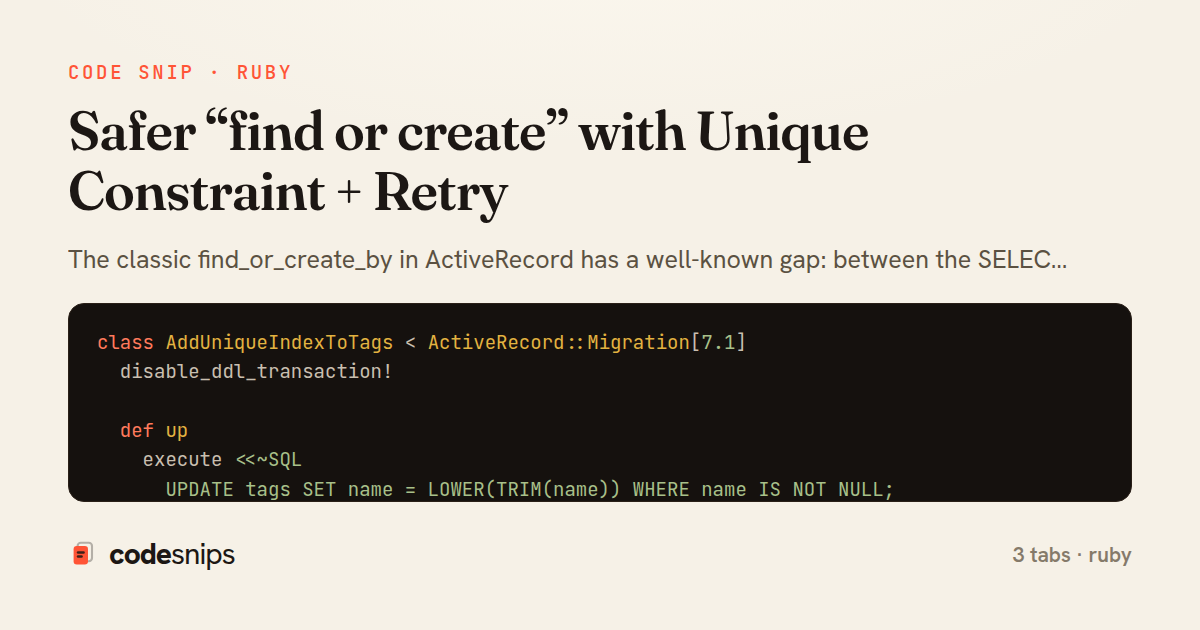
class AddUniqueIndexToTags < ActiveRecord::Migration[7.1]
  disable_ddl_transaction!

  def up
    execute <<~SQL
      UPDATE tags SET name = LOWER(TRIM(name)) WHERE name IS NOT NULL;
    SQL

    add_index :tags, :name,
              unique: true,
              algorithm: :concurrently,
              name: "index_tags_on_lower_name"
  end

  def down
    remove_index :tags, name: "index_tags_on_lower_name"
  end
end
class Tag < ApplicationRecord
  MAX_RETRIES = 3

  validates :name, presence: true, uniqueness: { case_sensitive: false }

  before_validation :normalize_name

  def self.find_or_create_safely(name, attrs = {})
    normalized = name.to_s.strip.downcase
    attempts = 0

    begin
      attempts += 1
      find_or_create_by(name: normalized) do |tag|
        tag.assign_attributes(attrs)
      end
    rescue ActiveRecord::RecordNotUnique
      existing = find_by(name: normalized)
      return existing if existing

      retry if attempts < MAX_RETRIES
      raise
    end
  end

  private

  def normalize_name
    self.name = name.to_s.strip.downcase if name.present?
  end
end
class TagsController < ApplicationController
  def create
    was_new = false

    tag = Tag.find_or_create_safely(tag_params[:name], color: tag_params[:color])
    was_new = tag.previous_changes.key?("id")

    if tag.persisted?
      render json: tag, status: (was_new ? :created : :ok)
    else
      render json: { errors: tag.errors.full_messages }, status: :unprocessable_entity
    end
  end

  private

  def tag_params
    params.require(:tag).permit(:name, :color)
  end
end
The classic find_or_create_by in ActiveRecord has a well-known gap: between the SELECT that checks for an existing row and the INSERT that creates it, another process can win the race and insert the same record. Under concurrency — parallel web requests, multiple background workers, retried jobs — this produces either duplicate rows or a RecordNotUnique exception surfacing to the user. The only durable fix is to let the database enforce uniqueness and then handle the collision gracefully.
The db/migrate/add_unique_index_to_tags.rb migration establishes that guarantee. It normalizes existing data with LOWER(name) before adding the index so the backfill does not fail, then creates a unique index using algorithm: :concurrently. Because concurrent index builds cannot run inside a transaction, disable_ddl_transaction! is required — a common pitfall when adding indexes to live Postgres tables without locking writes.
In Tag model, the retry logic lives in find_or_create_safely. It first attempts a normal find_or_create_by; if two callers race, the loser raises ActiveRecord::RecordNotUnique, which the rescue catches and re-reads the now-committed row with find_by. The bounded loop matters: on the rare occasion the row is deleted between the failed insert and the re-read, the method retries rather than returning nil or looping forever. Normalization happens in a before_validation callback so the value written matches exactly what the index enforces, avoiding case-sensitivity mismatches.
TagsController shows the caller. create simply delegates to Tag.find_or_create_safely, so the endpoint is naturally idempotent — repeated submissions converge on one row. It responds :created or :ok depending on whether a new record was actually inserted, giving clients honest semantics.
The trade-off is that this pattern relies on the exception path for correctness, and exceptions are comparatively expensive; under heavy contention it can also churn savepoints inside a surrounding transaction. For most workloads the collision is rare, so the cost is negligible, and the correctness guarantee — no duplicates, ever — comes from the index rather than from hopeful application logic.
Related snips
class CommentsController < ApplicationController
  before_action :set_post

  def create
    @comment = @post.comments.build(comment_params)
System test: asserting Turbo Stream responses
class Post < ApplicationRecord
  belongs_to :author, class_name: 'User'
  has_many :comments, dependent: :destroy

  scope :published, -> { where.not(published_at: nil).where('published_at <= ?', Time.current) }
  scope :draft, -> { where(published_at: nil) }
ActiveRecord scopes for reusable query logic
export interface RetryOptions {
  retries: number;
  baseMs: number;
  maxMs: number;
  signal?: AbortSignal;
  onRetry?: (attempt: number, delay: number, err: unknown) => void;
Exponential backoff with jitter for retries
module Api
  module V1
    class UsersController < BaseController
      def show
        user = User.includes(:profile).find(params[:id])
ETags for conditional requests and caching
class PostsController < ApplicationController
  def index
    @posts = Post.includes(:author)
                 .order(created_at: :desc)
                 .page(params[:page])
                 .per(10)
Turbo Frames: infinite scroll with lazy-loading frame
package dbutil

import (
  "context"

  "github.com/jackc/pgconn"
Retry Postgres serialization failures with bounded attempts
Share this code
Here's the card — post it anywhere.