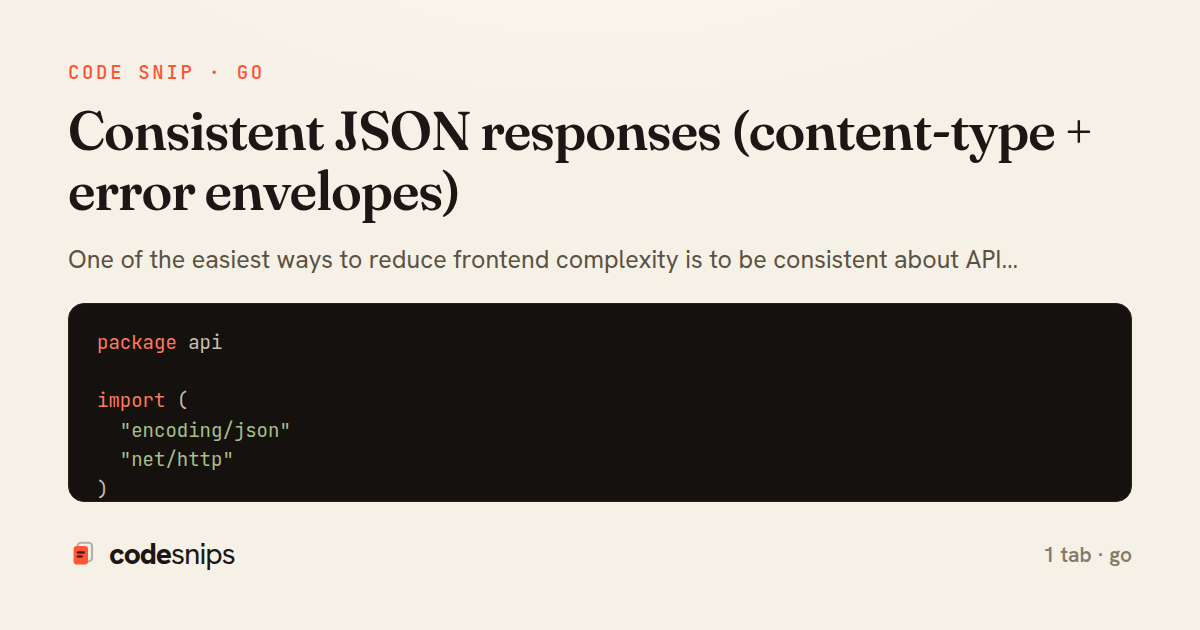
package api

import (
  "encoding/json"
  "net/http"
)

func WriteJSON(w http.ResponseWriter, status int, v any) {
  w.Header().Set("Content-Type", "application/json; charset=utf-8")
  w.WriteHeader(status)
  if err := json.NewEncoder(w).Encode(v); err != nil {
    http.Error(w, "internal server error", http.StatusInternalServerError)
  }
}

func WriteError(w http.ResponseWriter, status int, code string, details any) {
  payload := map[string]any{"error": code}
  if details != nil {
    payload["details"] = details
  }
  WriteJSON(w, status, payload)
}
One of the easiest ways to reduce frontend complexity is to be consistent about API responses. I keep a small helper that always sets Content-Type: application/json; charset=utf-8, uses a stable error envelope (error + optional details), and returns correct status codes. The tricky part is not overengineering: you don’t need a framework to do this, just a couple of functions that every handler uses. I also make sure JSON encoding errors are handled safely (by writing a plain 500 rather than partial JSON). In production, this helps with observability too: logs and APM can key off a stable error code instead of parsing freeform messages. It’s small glue code, but it makes the whole API feel “designed,” not accidental.
Related snips
package api

import (
  "net/http"
  "runtime/debug"
)
Expose build metadata for debugging deploys
payload = {
  sub: user.id,
  iss: 'https://auth.example.com',
  aud: 'codesnips-api',
  exp: 15.minutes.from_now.to_i,
  iat: Time.now.to_i,
JWT issuance and verification without common footguns
export interface RetryOptions {
  retries: number;
  baseMs: number;
  maxMs: number;
  signal?: AbortSignal;
  onRetry?: (attempt: number, delay: number, err: unknown) => void;
Exponential backoff with jitter for retries
module Api
  module V1
    class UsersController < BaseController
      def show
        user = User.includes(:profile).find(params[:id])
ETags for conditional requests and caching
package dbutil

import (
  "context"

  "github.com/jackc/pgconn"
Retry Postgres serialization failures with bounded attempts
type User {
    id: ID!
    name: String!
    email: String!
    posts: [Post!]!
    createdAt: String!
GraphQL API with Spring Boot
Share this code
Here's the card — post it anywhere.