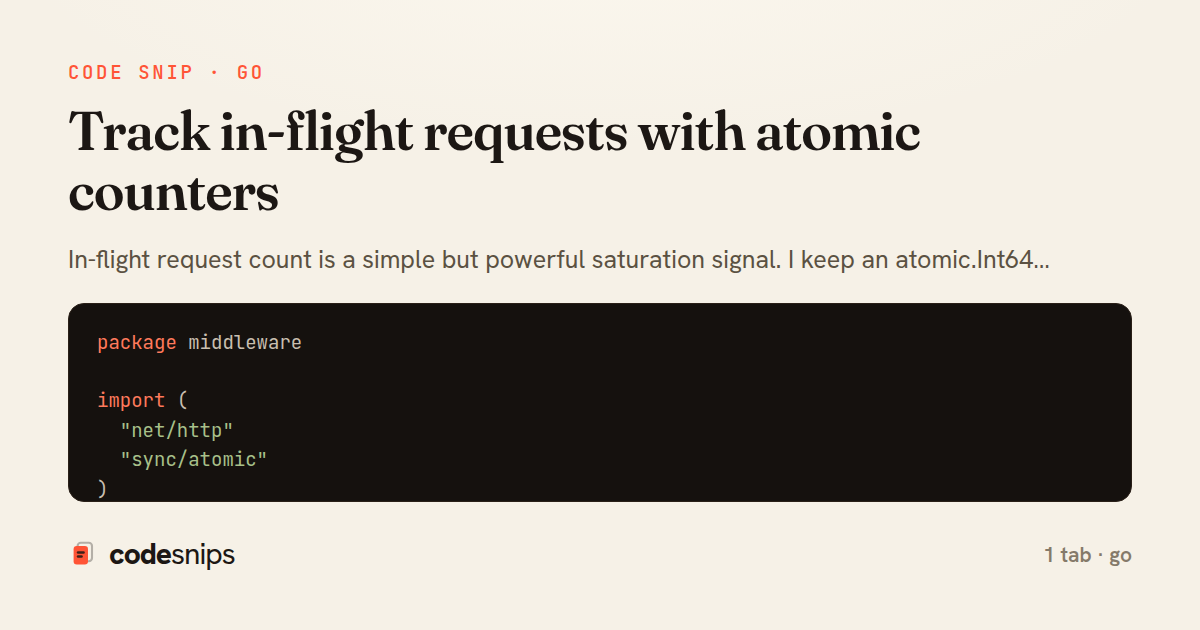
package middleware

import (
  "net/http"
  "sync/atomic"
)

type Gauge struct{ n atomic.Int64 }

func (g *Gauge) Value() int64 { return g.n.Load() }

func InFlight(g *Gauge) func(http.Handler) http.Handler {
  return func(next http.Handler) http.Handler {
    return http.HandlerFunc(func(w http.ResponseWriter, r *http.Request) {
      g.n.Add(1)
      defer g.n.Add(-1)
      next.ServeHTTP(w, r)
    })
  }
}
In-flight request count is a simple but powerful saturation signal. I keep an atomic.Int64 gauge that increments at the start of a request and decrements in a defer, which makes it robust even on early returns. This gauge can be exported via expvar, Prometheus, or logs at intervals. The key is correctness: always decrement, even if the handler panics (pair it with a recovery middleware) and always use atomic operations so you don’t introduce locks in the hottest path. In production, I use this in dashboards alongside p95 latency and error rate; when latency rises and in-flight rises, it’s often a sign of downstream contention. It’s also useful during deploys to confirm draining behavior: in-flight should fall to zero before shutdown completes. Small instrumentation like this goes a long way when you’re debugging under pressure.
Related snips
package api

import (
  "net/http"
  "runtime/debug"
)
Expose build metadata for debugging deploys
export interface RetryOptions {
  retries: number;
  baseMs: number;
  maxMs: number;
  signal?: AbortSignal;
  onRetry?: (attempt: number, delay: number, err: unknown) => void;
Exponential backoff with jitter for retries
package dbutil

import (
  "context"

  "github.com/jackc/pgconn"
Retry Postgres serialization failures with bounded attempts
// Creating a Promise
const myPromise = new Promise((resolve, reject) => {
  const success = true;

  setTimeout(() => {
    if (success) {
Promises and async/await patterns for asynchronous JavaScript
use crossbeam::channel::unbounded;
use std::thread;

fn main() {
    let (tx, rx) = unbounded();
Crossbeam for advanced concurrent data structures
use std::sync::mpsc;
use std::thread;

fn main() {
    let (tx, rx) = mpsc::channel();
Channels (mpsc) for message passing between threads
Share this code
Here's the card — post it anywhere.