class OverdueInvoicesQuery
  def initialize(relation: Invoice.all, as_of: Time.current)
    @relation = relation
    @as_of = as_of
  end

  def call
    past_due(unpaid(@relation))
  end

  private

  def unpaid(scope)
    scope.where(status: %w[open partial])
  end

  def past_due(scope)
    scope.where(arel_due_before)
  end

  def arel_due_before
    Invoice.arel_table[:due_on].lt(@as_of)
  end
end
class Invoice < ApplicationRecord
  belongs_to :account
  belongs_to :customer

  scope :for_currency, ->(code) { where(currency: code) }
  scope :recent, -> { order(created_at: :desc) }

  def self.overdue(relation: all, as_of: Time.current)
    OverdueInvoicesQuery.new(relation: relation, as_of: as_of).call
  end

  def self.total_outstanding
    where(status: %w[open partial]).sum(:balance_cents)
  end
end
class InvoicesController < ApplicationController
  def index
    invoices = current_account.invoices
    invoices = Invoice.overdue(relation: invoices) if params[:overdue].present?
    invoices = invoices.for_currency(params[:currency]) if params[:currency].present?

    @invoices = invoices
      .includes(:customer)
      .recent
      .page(params[:page])
      .per(25)

    @outstanding = invoices.total_outstanding
  end
end
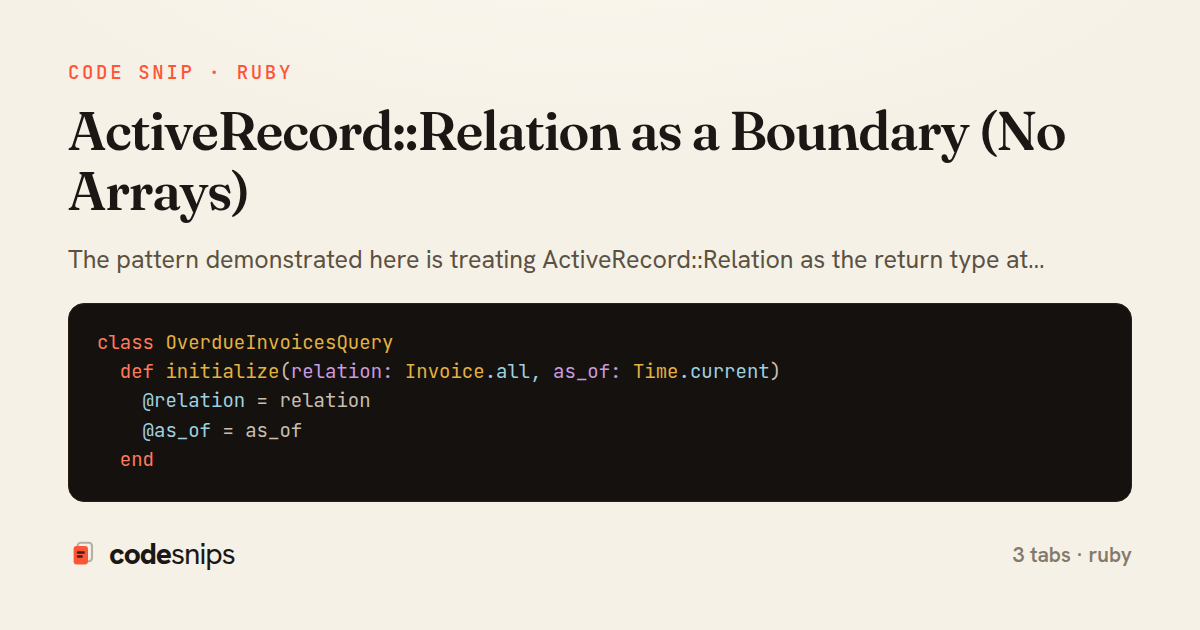
The pattern demonstrated here is treating ActiveRecord::Relation as the return type at every layer of the query stack, rather than eagerly materializing rows into arrays. A Relation is lazy and composable: it builds SQL but does not run until something enumerates it. The moment a method calls .to_a, .map, or .select {} (the block form), that laziness collapses, the query fires, and callers lose the ability to add where, order, limit, or includes downstream. Preserving the relation keeps composition, pagination, and eager-loading decisions in the hands of the caller.
In OverdueInvoicesQuery, the query object exposes a single call that returns a relation, chaining private helpers that each accept and return a relation. Because unpaid and past_due both end in .where(...), the class composes cleanly without ever touching the database. The initialize takes a relation: defaulting to Invoice.all — this is the key to composability, since a caller can inject an already-scoped relation (for example customer.invoices) and the query narrows it further. Nothing runs until enumeration.
In Invoice model, the scopes for_currency and recent return relations too, and overdue delegates straight into the query object. Notice overdue does not call .to_a; it hands back the relation so Invoice.overdue.for_currency("USD").limit(50) remains valid SQL composition rather than in-memory array filtering.
In InvoicesController, the boundary pays off: index starts from current_account.invoices, layers optional scopes based on params, applies includes(:customer) to avoid N+1, and only materializes via page(...).per(...) from Kaminari at the very end. Because each stage returned a relation, the pagination and eager-load happen in one round trip.
The trade-off is discipline — helpers must resist .select {}, .detect, and .map on relations, since those force loading. The payoff is that filtering, counting, and pagination all push down into the database, and callers compose behavior without re-querying. This approach is worth reaching for whenever a method feeds into further filtering or pagination; returning an array is only appropriate at the true end of the chain, in the view or serializer.
Related snips
class CommentsController < ApplicationController
  before_action :set_post

  def create
    @comment = @post.comments.build(comment_params)
System test: asserting Turbo Stream responses
class Post < ApplicationRecord
  belongs_to :author, class_name: 'User'
  has_many :comments, dependent: :destroy

  scope :published, -> { where.not(published_at: nil).where('published_at <= ?', Time.current) }
  scope :draft, -> { where(published_at: nil) }
ActiveRecord scopes for reusable query logic
module Api
  module V1
    class UsersController < BaseController
      def show
        user = User.includes(:profile).find(params[:id])
ETags for conditional requests and caching
class PostsController < ApplicationController
  def index
    @posts = Post.includes(:author)
                 .order(created_at: :desc)
                 .page(params[:page])
                 .per(10)
Turbo Frames: infinite scroll with lazy-loading frame
package dbutil

import (
  "context"

  "github.com/jackc/pgconn"
Retry Postgres serialization failures with bounded attempts
require "csv"

class PeopleCsvStream
  include Enumerable

  HEADERS = %w[id full_name email signed_up_at plan].freeze
Resilient CSV Export as a Streamed Response
Share this code
Here's the card — post it anywhere.