class CreateTopSellersMv < ActiveRecord::Migration[7.0]
  def up
    execute <<~SQL
      CREATE MATERIALIZED VIEW top_sellers AS
        SELECT p.id            AS product_id,
               p.name          AS product_name,
               SUM(oi.quantity) AS total_sold,
               SUM(oi.quantity * oi.unit_price_cents) AS revenue_cents
        FROM order_items oi
        JOIN products p ON p.id = oi.product_id
        WHERE oi.created_at >= NOW() - INTERVAL '30 days'
        GROUP BY p.id, p.name
        ORDER BY total_sold DESC
        LIMIT 100
      WITH DATA;
    SQL

    # Required for REFRESH ... CONCURRENTLY
    execute "CREATE UNIQUE INDEX index_top_sellers_on_product_id ON top_sellers (product_id);"
  end

  def down
    execute "DROP MATERIALIZED VIEW IF EXISTS top_sellers;"
  end
end
class TopSeller < ApplicationRecord
  self.table_name = "top_sellers"
  self.primary_key = "product_id"

  after_initialize { readonly! }

  scope :ranked, ->(limit = 25) { order(total_sold: :desc).limit(limit) }

  def self.refresh!
    connection.execute("REFRESH MATERIALIZED VIEW CONCURRENTLY top_sellers;")
  end

  def self.cache_version
    Rails.cache.read("top_sellers:version").to_i
  end

  def self.bump_cache_version!
    Rails.cache.increment("top_sellers:version", 1, initial: 1)
  end

  def revenue_dollars
    revenue_cents.to_i / 100.0
  end
end
class RefreshTopSellersJob
  include Sidekiq::Job

  sidekiq_options queue: :maintenance, retry: 2

  LOCK_KEY = "lock:refresh_top_sellers".freeze
  LOCK_TTL = 5.minutes.to_i

  def perform
    return unless acquire_lock

    TopSeller.refresh!
    TopSeller.bump_cache_version!
    Rails.logger.info("[RefreshTopSellersJob] refreshed at #{Time.current.iso8601}")
  ensure
    release_lock
  end

  private

  def acquire_lock
    Sidekiq.redis { |r| r.set(LOCK_KEY, jid, nx: true, ex: LOCK_TTL) }
  end

  def release_lock
    Sidekiq.redis do |r|
      r.del(LOCK_KEY) if r.get(LOCK_KEY) == jid
    end
  end
end
class LeaderboardController < ApplicationController
  def index
    version = TopSeller.cache_version

    @sellers = Rails.cache.fetch("top_sellers:list:v#{version}", expires_in: 10.minutes) do
      TopSeller.ranked(25).map do |s|
        {
          product_id: s.product_id,
          name: s.product_name,
          units: s.total_sold,
          revenue: s.revenue_dollars
        }
      end
    end

    render json: { generated_version: version, sellers: @sellers }
  end
end
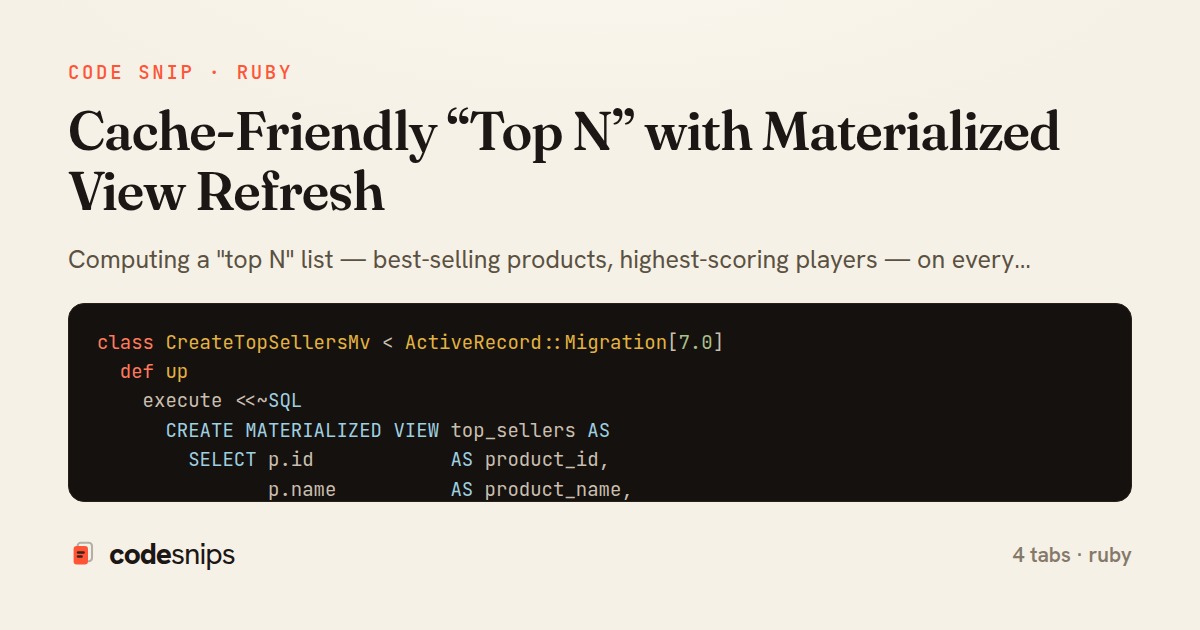
Computing a "top N" list — best-selling products, highest-scoring players — on every request is expensive because it forces the database to scan, aggregate, and sort large tables repeatedly. A materialized view solves this by precomputing the aggregate once and storing the result as a physical table that reads are cheap against. This snippet shows the full loop in Rails: a migration that defines the view, a read-only model that queries it, and a background job that refreshes it on a schedule.
The CreateTopSellersMV migration defines top_sellers with execute because materialized views are not part of the ActiveRecord schema DSL. The aggregation joins order_items to products, sums quantities, and keeps only the top 100 rows via ORDER BY ... LIMIT. Crucially it also creates a UNIQUE INDEX on product_id; that index is not an optimization here — it is a hard prerequisite for REFRESH MATERIALIZED VIEW CONCURRENTLY, which Postgres refuses to run without one.
In TopSeller model, the class points at the view as its table_name and calls readonly! in an after_initialize hook so no code accidentally attempts to write to a view. The ranked scope orders by the precomputed total_sold and applies a LIMIT, and refresh! wraps the raw REFRESH ... CONCURRENTLY statement. Concurrent refresh is the key trade-off: it rebuilds the view without taking an ACCESS EXCLUSIVE lock, so readers keep seeing the old snapshot until the new one is ready — at the cost of doing more work and requiring that unique index.
The RefreshTopSellersJob is a Sidekiq worker that calls TopSeller.refresh! and then bumps a cache key so any application-level cache of the rendered list is invalidated in lockstep. It guards against overlap using a Redis SETNX lock, because two concurrent REFRESH CONCURRENTLY calls on the same view would serialize and waste resources.
The pattern fits data that tolerates slight staleness: the view is eventually consistent with the base tables, refreshed every few minutes rather than per write. Pitfalls include the unique-index requirement, the disk and CPU cost of frequent refreshes, and remembering to schedule the job. When freshness must be exact, a plain query or a trigger-maintained summary table is more appropriate instead.
Related snips
class CommentsController < ApplicationController
  before_action :set_post

  def create
    @comment = @post.comments.build(comment_params)
System test: asserting Turbo Stream responses
class Post < ApplicationRecord
  belongs_to :author, class_name: 'User'
  has_many :comments, dependent: :destroy

  scope :published, -> { where.not(published_at: nil).where('published_at <= ?', Time.current) }
  scope :draft, -> { where(published_at: nil) }
ActiveRecord scopes for reusable query logic
module Api
  module V1
    class UsersController < BaseController
      def show
        user = User.includes(:profile).find(params[:id])
ETags for conditional requests and caching
class PostsController < ApplicationController
  def index
    @posts = Post.includes(:author)
                 .order(created_at: :desc)
                 .page(params[:page])
                 .per(10)
Turbo Frames: infinite scroll with lazy-loading frame
package dbutil

import (
  "context"

  "github.com/jackc/pgconn"
Retry Postgres serialization failures with bounded attempts
require "csv"

class PeopleCsvStream
  include Enumerable

  HEADERS = %w[id full_name email signed_up_at plan].freeze
Resilient CSV Export as a Streamed Response
Share this code
Here's the card — post it anywhere.