class DynamicFinder
  def initialize(records)
    @records = records
  end

  def method_missing(method_name, *args, &block)
    if method_name.to_s =~ /^find_by_(.+)$/
      attribute = $1
      find_by_attribute(attribute, args.first)
    else
      super
    end
  end

  def respond_to_missing?(method_name, include_private = false)
    method_name.to_s.start_with?('find_by_') || super
  end

  private

  def find_by_attribute(attribute, value)
    @records.find { |record| record[attribute.to_sym] == value }
  end
end

# Usage:
users = [
  { id: 1, name: 'Alice', email: 'alice@example.com' },
  { id: 2, name: 'Bob', email: 'bob@example.com' }
]

finder = DynamicFinder.new(users)
finder.find_by_name('Alice')   # => { id: 1, name: 'Alice', ... }
finder.find_by_email('bob@example.com')  # => { id: 2, ... }
class QueryBuilder
  attr_reader :conditions

  def initialize
    @conditions = []
  end

  def self.build(&block)
    builder = new
    builder.instance_eval(&block)
    builder
  end

  def where(field, value)
    @conditions << { field: field, operator: '=', value: value }
    self
  end

  def greater_than(field, value)
    @conditions << { field: field, operator: '>', value: value }
    self
  end

  def less_than(field, value)
    @conditions << { field: field, operator: '<', value: value }
    self
  end

  def to_sql
    conditions.map { |c| "#{c[:field]} #{c[:operator]} #{c[:value]}" }.join(' AND ')
  end
end

# Usage with DSL:
query = QueryBuilder.build do
  where :status, 'active'
  greater_than :age, 18
  less_than :score, 100
end

puts query.to_sql
# => "status = active AND age > 18 AND score < 100"
class Configuration
  SETTINGS = %i[database cache storage email].freeze

  SETTINGS.each do |setting|
    # Getter
    define_method(setting) do
      instance_variable_get("@#{setting}")
    end

    # Setter
    define_method("#{setting}=") do |value|
      instance_variable_set("@#{setting}", value)
    end

    # Predicate
    define_method("#{setting}?") do
      !!instance_variable_get("@#{setting}")
    end
  end

  def configure(&block)
    instance_eval(&block)
    self
  end
end

# Usage:
config = Configuration.new.configure do
  self.database = 'postgresql'
  self.cache = 'redis'
  self.email = 'sendgrid'
end

config.database?  # => true
config.storage?   # => false
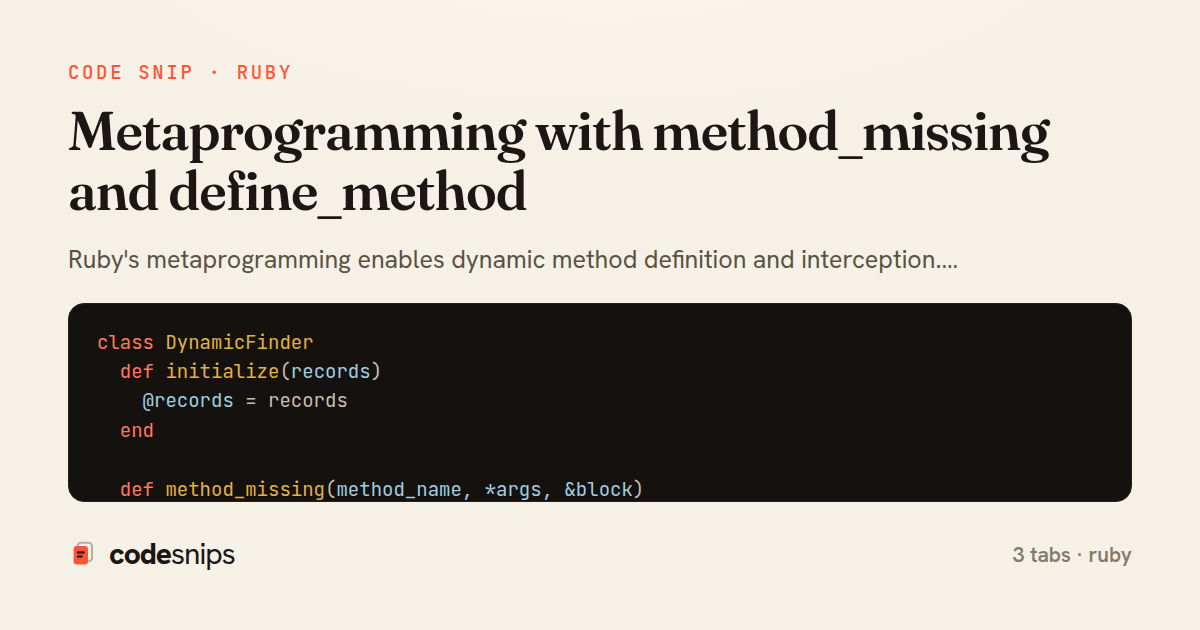
Ruby's metaprogramming enables dynamic method definition and interception. method_missing catches undefined method calls, allowing DSL creation and proxy patterns. I implement it carefully with respond_to_missing? for proper introspection. define_method creates methods dynamically at runtime, useful for reducing repetition. Class and instance variables can be manipulated via class_variable_set and instance_variable_set. send and public_send invoke methods dynamically. Metaprogramming powers Rails' magic—associations, validations, callbacks. I use it judiciously to create expressive APIs without sacrificing clarity. Understanding Ruby's object model—classes are objects, methods are objects—unlocks powerful patterns. Metaprogramming reduces boilerplate while maintaining Ruby's elegance and readability.
Related snips
class Money
  include Comparable

  attr_reader :amount, :currency

  def initialize(amount, currency = 'USD')
Value objects for domain modeling
# app/mailers/user_mailer.rb
class UserMailer < ApplicationMailer
  default from: 'noreply@example.com'

  def welcome_email(user)
    @user = user
ActionMailer advanced patterns for transactional emails
# BAD: N+1 query problem
@users = User.all
@users.each do |user|
  puts user.posts.count  # Fires query for each user!
end
ActiveRecord query optimization and N+1 prevention
macro_rules! create_function {
    ($func_name:ident) => {
        fn $func_name() {
            println!("Called {}", stringify!($func_name));
        }
    };
Declarative macros (macro_rules!) for code generation
# Installation
# rails active_storage:install
# rails db:migrate

# config/storage.yml
local:
ActiveStorage for file uploads and attachments
# app/channels/chat_channel.rb
class ChatChannel < ApplicationCable::Channel
  def subscribed
    # Subscribe to a specific room
    room = Room.find(params[:room_id])
ActionCable for real-time WebSocket communication
Share this code
Here's the card — post it anywhere.