ruby
146 lines · 2 tabs
Sarah Mitchell
Feb 2026
2 tabs
class UserRegistrationForm
  include ActiveModel::Model
  include ActiveModel::Attributes

  attribute :email, :string
  attribute :name, :string
  attribute :password, :string
  attribute :password_confirmation, :string
  attribute :bio, :string
  attribute :accept_terms, :boolean

  validates :email, presence: true, format: { with: URI::MailTo::EMAIL_REGEXP }
  validates :name, presence: true, length: { minimum: 2 }
  validates :password, presence: true, length: { minimum: 8 }
  validates :password_confirmation, presence: true
  validates :accept_terms, acceptance: true
  validate :passwords_match

  def save
    return false unless valid?

    ActiveRecord::Base.transaction do
      user = create_user
      create_profile(user)
      send_welcome_email(user)
      user
    end
  rescue ActiveRecord::RecordInvalid => e
    errors.add(:base, e.message)
    false
  end

  private

  def passwords_match
    if password != password_confirmation
      errors.add(:password_confirmation, "doesn't match password")
    end
  end

  def create_user
    User.create!(
      email: email,
      name: name,
      password: password
    )
  end

  def create_profile(user)
    user.create_profile!(bio: bio)
  end

  def send_welcome_email(user)
    UserMailer.welcome(user).deliver_later
  end
end

# Controller usage:
# def create
#   @form = UserRegistrationForm.new(registration_params)
#
#   if @form.save
#     redirect_to root_path, notice: "Welcome!"
#   else
#     render :new
#   end
# end
class OrderForm
  include ActiveModel::Model
  include ActiveModel::Attributes

  attribute :user_id, :integer
  attribute :shipping_address, :string
  attribute :billing_address, :string
  attribute :items, default: []

  validates :user_id, presence: true
  validates :shipping_address, presence: true
  validates :billing_address, presence: true
  validate :items_present

  def initialize(attributes = {})
    super
    @items ||= []
  end

  def add_item(product_id:, quantity:, price:)
    @items << { product_id: product_id, quantity: quantity, price: price }
  end

  def save
    return false unless valid?

    ActiveRecord::Base.transaction do
      order = create_order
      create_order_items(order)
      create_shipping_address(order)
      order
    end
  rescue => e
    errors.add(:base, e.message)
    false
  end

  def total_amount
    items.sum { |item| item[:quantity] * item[:price] }
  end

  private

  def items_present
    errors.add(:items, "must have at least one item") if items.empty?
  end

  def create_order
    Order.create!(
      user_id: user_id,
      total_amount: total_amount,
      status: 'pending'
    )
  end

  def create_order_items(order)
    items.each do |item|
      order.order_items.create!(
        product_id: item[:product_id],
        quantity: item[:quantity],
        price: item[:price]
      )
    end
  end

  def create_shipping_address(order)
    order.create_shipping_address!(
      address: shipping_address,
      address_type: 'shipping'
    )

    unless shipping_address == billing_address
      order.create_billing_address!(
        address: billing_address,
        address_type: 'billing'
      )
    end
  end
end
2 files · ruby
Explain with highlit
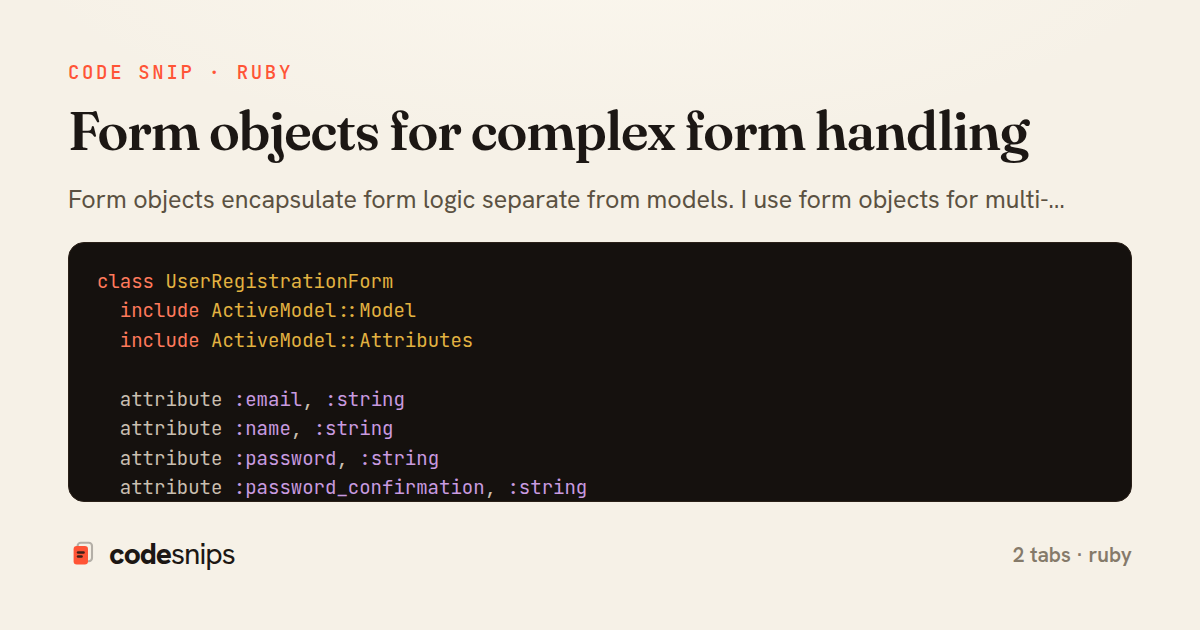
Form objects encapsulate form logic separate from models. I use form objects for multi-model forms, complex validations, or forms not directly mapping to models. Form objects include ActiveModel modules for validations and callbacks. They handle parameter whitelisting, validation, and persistence. Form objects keep models focused on business logic, controllers thin. They're especially useful for wizard-style forms spanning multiple steps. Testing form objects is straightforward—no database setup needed for validation tests. Form objects improve code organization in complex applications. Following Single Responsibility Principle, they make forms maintainable and testable.
Related snips
ruby
class CommentsController < ApplicationController
  before_action :set_post

  def create
    @comment = @post.comments.build(comment_params)
System test: asserting Turbo Stream responses
rails
hotwire
turbo
by codesnips
4 tabs
ruby
class Money
  include Comparable

  attr_reader :amount, :currency

  def initialize(amount, currency = 'USD')
Value objects for domain modeling
ruby
value-objects
domain-driven-design
by Sarah Mitchell
2 tabs
ruby
class Post < ApplicationRecord
  belongs_to :author, class_name: 'User'
  has_many :comments, dependent: :destroy

  scope :published, -> { where.not(published_at: nil).where('published_at <= ?', Time.current) }
  scope :draft, -> { where(published_at: nil) }
ActiveRecord scopes for reusable query logic
rails
activerecord
patterns
by Alex Kumar
1 tab
ruby
module Api
  module V1
    class UsersController < BaseController
      def show
        user = User.includes(:profile).find(params[:id])
ETags for conditional requests and caching
rails
caching
http-caching
by Alex Kumar
1 tab
ruby
class PostsController < ApplicationController
  def index
    @posts = Post.includes(:author)
                 .order(created_at: :desc)
                 .page(params[:page])
                 .per(10)
Turbo Frames: infinite scroll with lazy-loading frame
rails
turbo
hotwire
by codesnips
4 tabs
ruby
require "csv"

class PeopleCsvStream
  include Enumerable

  HEADERS = %w[id full_name email signed_up_at plan].freeze
Resilient CSV Export as a Streamed Response
rails
performance
streaming
by codesnips
3 tabs
Share this code
Here's the card — post it anywhere.