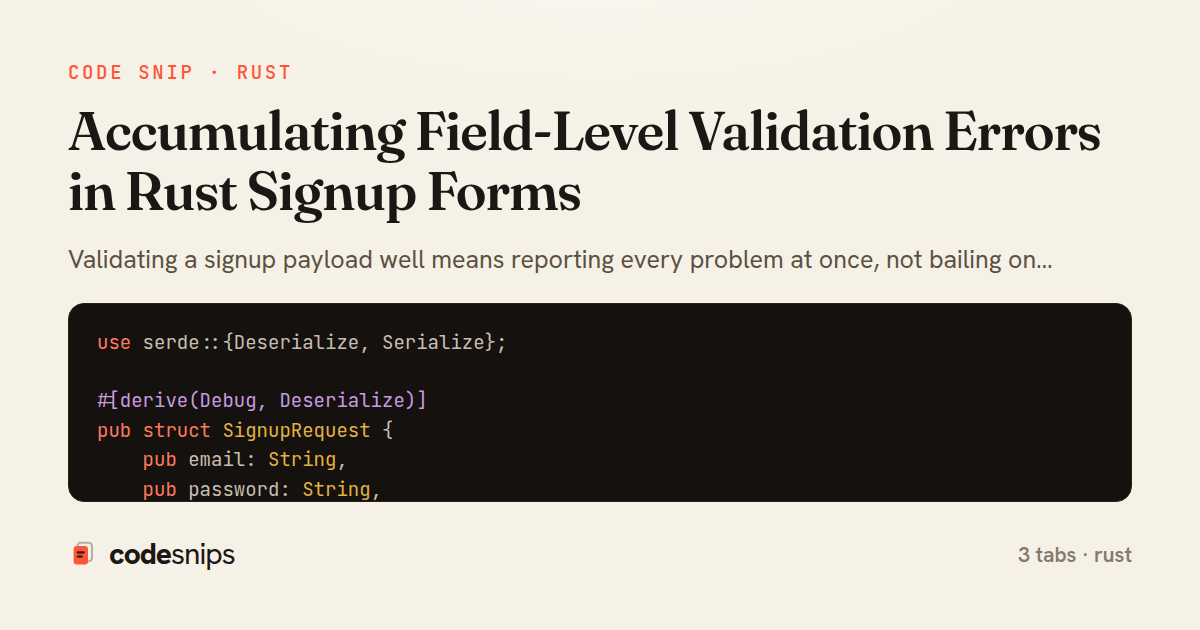
use serde::{Deserialize, Serialize};

#[derive(Debug, Deserialize)]
pub struct SignupRequest {
    pub email: String,
    pub password: String,
    pub password_confirmation: String,
    pub age: i32,
}

#[derive(Debug, Serialize)]
pub struct FieldError {
    pub field: &'static str,
    pub message: String,
}

#[derive(Debug)]
pub struct NewUser {
    pub email: String,
    pub password: String,
    pub age: u8,
}
use crate::dto::{FieldError, NewUser, SignupRequest};

fn push_err(errors: &mut Vec<FieldError>, field: &'static str, message: &str) {
    errors.push(FieldError { field, message: message.to_string() });
}

fn valid_email(value: &str) -> bool {
    let parts: Vec<&str> = value.split('@').collect();
    parts.len() == 2 && !parts[0].is_empty() && parts[1].contains('.')
}

fn strong_password(value: &str) -> bool {
    value.len() >= 8
        && value.chars().any(|c| c.is_ascii_digit())
        && value.chars().any(|c| c.is_ascii_alphabetic())
}

impl SignupRequest {
    pub fn validate(self) -> Result<NewUser, Vec<FieldError>> {
        let mut errors: Vec<FieldError> = Vec::new();

        if !valid_email(&self.email) {
            push_err(&mut errors, "email", "must be a valid email address");
        }
        if !strong_password(&self.password) {
            push_err(&mut errors, "password", "must be 8+ chars with letters and digits");
        }
        if self.password != self.password_confirmation {
            push_err(&mut errors, "password_confirmation", "does not match password");
        }
        if self.age < 13 || self.age > 120 {
            push_err(&mut errors, "age", "must be between 13 and 120");
        }

        if errors.is_empty() {
            Ok(NewUser {
                email: self.email,
                password: self.password,
                age: self.age as u8,
            })
        } else {
            Err(errors)
        }
    }
}
use axum::{http::StatusCode, response::IntoResponse, Json};
use serde_json::json;

use crate::dto::SignupRequest;

pub async fn signup(Json(payload): Json<SignupRequest>) -> impl IntoResponse {
    match payload.validate() {
        Ok(new_user) => {
            // persist new_user here; the password never reaches the response
            let body = json!({ "email": new_user.email, "age": new_user.age });
            (StatusCode::CREATED, Json(body))
        }
        Err(errors) => {
            let body = json!({ "errors": errors });
            (StatusCode::UNPROCESSABLE_ENTITY, Json(body))
        }
    }
}
Validating a signup payload well means reporting every problem at once, not bailing on the first bad field. A form that rejects a password, then rejects the email on the next round-trip, frustrates users and wastes requests. This snippet models an error-accumulating validator in Rust, keeping the happy path type-safe while gathering all field errors into a single structured response.
The SignupRequest DTO tab defines the raw inbound shape with serde Deserialize, matching whatever JSON the client sends. It is deliberately "loose" — email, password, and age are plain owned values that may be malformed. Alongside it lives FieldError, a Serialize struct carrying a field name and a human-readable message, so the API can return a flat list the frontend can attach to individual inputs.
The Validator tab holds the core pattern. Rather than returning Result and short-circuiting on the first failure, SignupRequest::validate pushes into a Vec<FieldError> as it checks each rule, then decides at the end. The push_err helper keeps each check to one readable line. Individual predicates like valid_email and password strength are kept small and independent so they can run regardless of what earlier fields did. Only after all checks run does it branch: if errors.is_empty() it constructs a validated NewUser (a distinct type that proves the data is clean), otherwise it returns Err(errors) with the full set. This is the "parse, don't validate" idea — the successful branch yields a different, stronger type, so downstream code cannot accidentally use an unvalidated SignupRequest.
The trade-off is that accumulation requires owning a mutable errors vector and running checks eagerly, versus the terser ? operator that stops early. For user-facing forms that cost is worth it; for internal invariants, fail-fast is usually better.
The HTTP handler tab shows the wiring under axum: the extractor deserializes the body, validate runs, and the result maps to either 201 Created or 422 Unprocessable Entity with the JSON error array. Returning 422 with a machine-readable body lets the client render inline messages without guessing. A subtle pitfall the code avoids is leaking the raw password into logs or responses — only the validated NewUser moves forward, and FieldError messages never echo the submitted secret.
Related snips
payload = {
  sub: user.id,
  iss: 'https://auth.example.com',
  aud: 'codesnips-api',
  exp: 15.minutes.from_now.to_i,
  iat: Time.now.to_i,
JWT issuance and verification without common footguns
module Api
  module V1
    class UsersController < BaseController
      def show
        user = User.includes(:profile).find(params[:id])
ETags for conditional requests and caching
struct Config<'a> {
    name: &'a str,
    value: &'a str,
}

fn parse_config(line: &str) -> Config {
Lifetime annotations for flexible borrowing in structs
type User {
    id: ID!
    name: String!
    email: String!
    posts: [Post!]!
    createdAt: String!
GraphQL API with Spring Boot
class SignupForm
  include ActiveModel::Model
  include ActiveModel::Attributes

  attribute :account_name, :string
  attribute :email, :string
Shallow Controller, Deep Params: Form Object Pattern
// Creating a Promise
const myPromise = new Promise((resolve, reject) => {
  const success = true;

  setTimeout(() => {
    if (success) {
Promises and async/await patterns for asynchronous JavaScript
Share this code
Here's the card — post it anywhere.