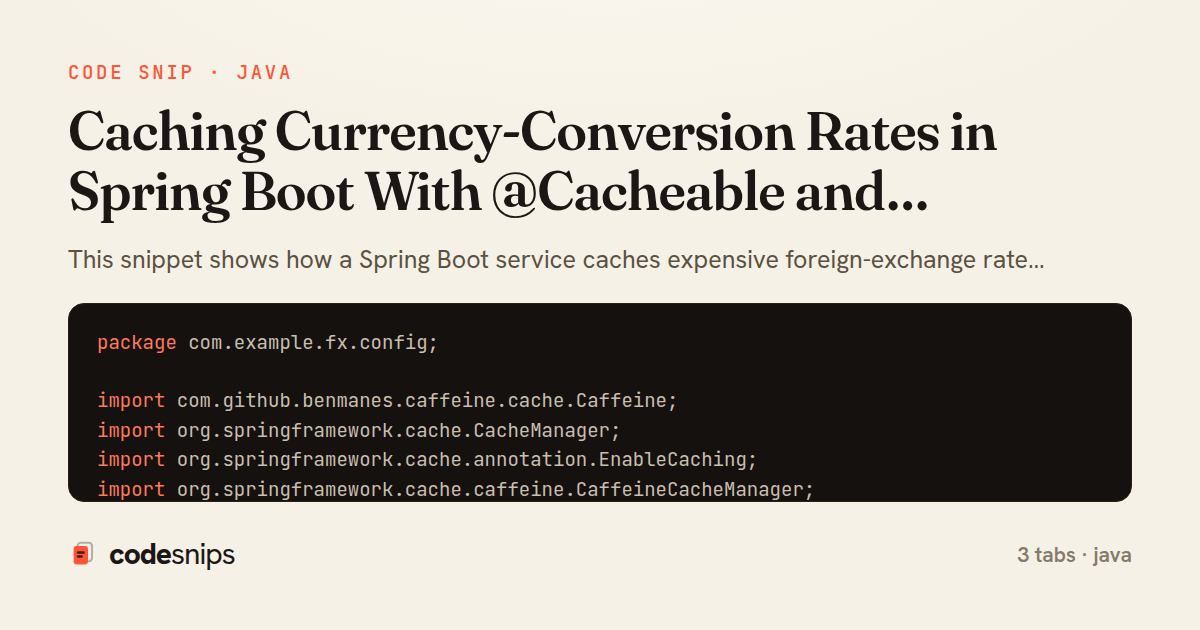
package com.example.fx.config;

import com.github.benmanes.caffeine.cache.Caffeine;
import org.springframework.cache.CacheManager;
import org.springframework.cache.annotation.EnableCaching;
import org.springframework.cache.caffeine.CaffeineCacheManager;
import org.springframework.context.annotation.Bean;
import org.springframework.context.annotation.Configuration;
import org.springframework.scheduling.annotation.EnableScheduling;

import java.time.Duration;

@Configuration
@EnableCaching
@EnableScheduling
public class CacheConfig {

    @Bean
    public CacheManager cacheManager() {
        CaffeineCacheManager manager = new CaffeineCacheManager("fxRates");
        manager.setCaffeine(Caffeine.newBuilder()
                .maximumSize(500)
                .expireAfterWrite(Duration.ofMinutes(5))
                .recordStats());
        return manager;
    }
}
package com.example.fx.service;

import org.springframework.cache.annotation.CacheEvict;
import org.springframework.cache.annotation.Cacheable;
import org.springframework.scheduling.annotation.Scheduled;
import org.springframework.stereotype.Service;
import org.springframework.web.client.RestClient;

import java.math.BigDecimal;

@Service
public class CurrencyRateService {

    private final RestClient restClient;

    public CurrencyRateService(RestClient.Builder builder) {
        this.restClient = builder.baseUrl("https://api.example-fx.com").build();
    }

    @Cacheable(value = "fxRates", key = "#from + '-' + #to", unless = "#result == null")
    public BigDecimal getRate(String from, String to) {
        return fetchRateFromProvider(from, to);
    }

    @CacheEvict(value = "fxRates", allEntries = true)
    @Scheduled(fixedRate = 300_000)
    public void refreshAllRates() {
        // Cache cleared proactively; next reads repopulate lazily.
    }

    private BigDecimal fetchRateFromProvider(String from, String to) {
        RateResponse response = restClient.get()
                .uri("/latest?base={base}&symbols={sym}", from, to)
                .retrieve()
                .body(RateResponse.class);
        if (response == null || response.rate() == null) {
            return null;
        }
        return response.rate();
    }

    public record RateResponse(String base, String symbol, BigDecimal rate) {
    }
}
package com.example.fx.web;

import com.example.fx.service.CurrencyRateService;
import org.springframework.http.ResponseEntity;
import org.springframework.web.bind.annotation.GetMapping;
import org.springframework.web.bind.annotation.RequestParam;
import org.springframework.web.bind.annotation.RestController;

import java.math.BigDecimal;
import java.math.RoundingMode;

@RestController
public class ConversionController {

    private final CurrencyRateService rateService;

    public ConversionController(CurrencyRateService rateService) {
        this.rateService = rateService;
    }

    @GetMapping("/convert")
    public ResponseEntity<ConversionResult> convert(
            @RequestParam String from,
            @RequestParam String to,
            @RequestParam BigDecimal amount) {

        BigDecimal rate = rateService.getRate(from.toUpperCase(), to.toUpperCase());
        if (rate == null) {
            return ResponseEntity.status(502).build();
        }
        BigDecimal converted = amount.multiply(rate).setScale(2, RoundingMode.HALF_UP);
        return ResponseEntity.ok(new ConversionResult(from, to, amount, rate, converted));
    }

    public record ConversionResult(String from, String to, BigDecimal amount,
                                   BigDecimal rate, BigDecimal result) {
    }
}
This snippet shows how a Spring Boot service caches expensive foreign-exchange rate lookups so that repeated conversions do not hammer a slow, rate-limited upstream provider. The pattern is Spring's declarative caching abstraction: methods annotated with @Cacheable transparently store their return value keyed by the arguments, and subsequent calls with the same key skip the method body entirely and return the cached value.
In CacheConfig, @EnableCaching activates the annotation processing, and a Caffeine-backed CacheManager bounds the cache with maximumSize and a expireAfterWrite TTL. Bounding matters: an unbounded cache of currency pairs would grow forever and a stale rate that never expires would be worse than a cache miss. The write-based expiry means a rate is trusted for five minutes regardless of read traffic, which is a sensible freshness window for FX quotes.
In CurrencyRateService, getRate carries @Cacheable(value = "fxRates", key = "#from + '-' + #to"). The explicit SpEL key composes a stable cache key from both arguments so that USD-EUR and EUR-USD never collide. The unless = "#result == null" guard prevents a failed or empty lookup from being cached, which avoids pinning a bad value for the whole TTL. The actual fetchRateFromProvider call is the expensive part being protected — a remote HTTP round trip.
The refreshAllRates method is annotated with @CacheEvict(value = "fxRates", allEntries = true) and driven by @Scheduled, so every five minutes the entire cache is flushed proactively. Combining a TTL with scheduled eviction gives two independent freshness mechanisms and a clean way to force-clear on demand.
In ConversionController, the endpoint simply multiplies an amount by the cached rate; it is unaware of caching, which is the whole point of the abstraction — cross-cutting concerns stay out of business logic. A key pitfall to remember is that @Cacheable and @CacheEvict rely on Spring's proxy, so self-invocation within the same bean bypasses the cache; calls must cross the proxy boundary to take effect. This approach fits any read-heavy lookup with an expensive, idempotent source and tolerable staleness.
Related snips
export interface RetryOptions {
  retries: number;
  baseMs: number;
  maxMs: number;
  signal?: AbortSignal;
  onRetry?: (attempt: number, delay: number, err: unknown) => void;
Exponential backoff with jitter for retries
module Api
  module V1
    class UsersController < BaseController
      def show
        user = User.includes(:profile).find(params[:id])
ETags for conditional requests and caching
require "csv"

class PeopleCsvStream
  include Enumerable

  HEADERS = %w[id full_name email signed_up_at plan].freeze
Resilient CSV Export as a Streamed Response
type User {
    id: ID!
    name: String!
    email: String!
    posts: [Post!]!
    createdAt: String!
GraphQL API with Spring Boot
Rails.application.configure do
  config.after_initialize do
    Bullet.enable = true
    Bullet.alert = false
    Bullet.bullet_logger = true
    Bullet.console = true
N+1 query detection with Bullet gem
json.array! @posts do |post|
  json.cache! ['v1', post], expires_in: 1.hour do
    json.id post.id
    json.title post.title
    json.excerpt post.excerpt
    json.published_at post.published_at
Fragment caching for expensive JSON serialization
Share this code
Here's the card — post it anywhere.