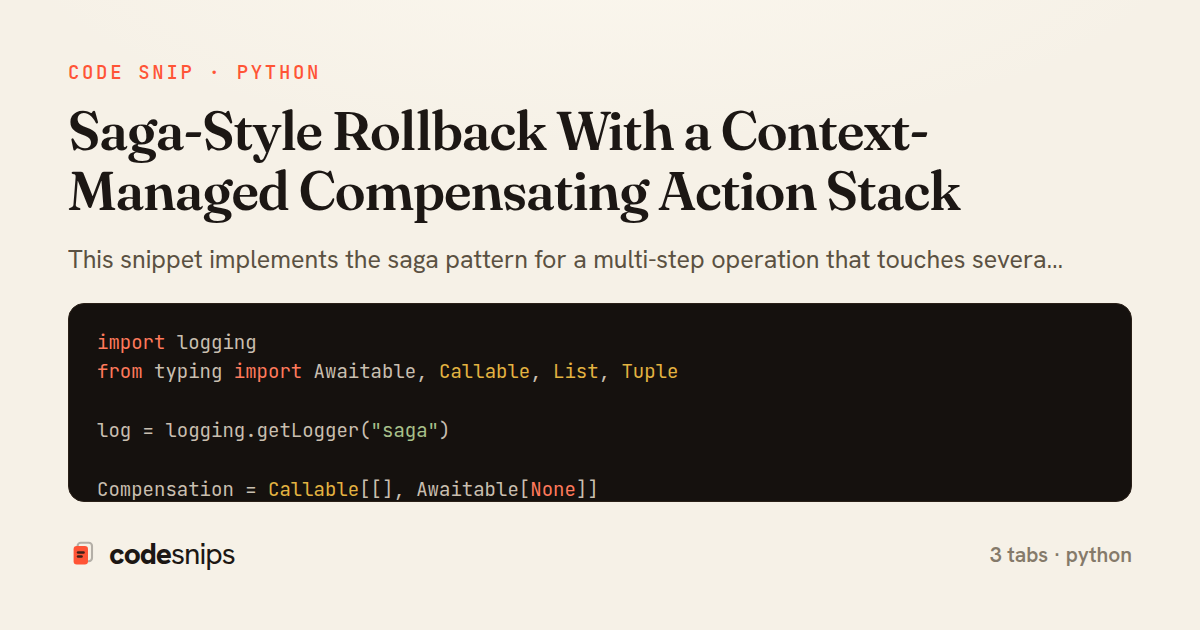
import logging
from typing import Awaitable, Callable, List, Tuple

log = logging.getLogger("saga")

Compensation = Callable[[], Awaitable[None]]


class CompensationError(Exception):
    def __init__(self, failures):
        self.failures = failures
        joined = ", ".join(f"{n}: {e!r}" for n, e in failures)
        super().__init__(f"compensation failed for [{joined}]")


class Saga:
    def __init__(self, name: str):
        self.name = name
        self._stack: List[Tuple[str, Compensation]] = []
        self._committed = False

    def add_compensation(self, name: str, undo: Compensation) -> None:
        self._stack.append((name, undo))

    async def run_step(self, name: str, do: Awaitable, undo: Compensation):
        result = await do
        # only register the undo once the forward step has actually succeeded
        self.add_compensation(name, undo)
        return result

    def commit(self) -> None:
        self._committed = True

    async def _compensate(self) -> None:
        failures = []
        while self._stack:
            name, undo = self._stack.pop()
            try:
                log.info("compensating step %s", name)
                await undo()
            except Exception as exc:  # keep unwinding; collect for later
                log.exception("compensation for %s failed", name)
                failures.append((name, exc))
        if failures:
            raise CompensationError(failures)

    async def __aenter__(self) -> "Saga":
        return self

    async def __aexit__(self, exc_type, exc, tb) -> bool:
        if exc_type is None:
            self.commit()
            return False
        log.warning("saga %s failed with %r; rolling back", self.name, exc)
        await self._compensate()
        return False  # re-raise the original exception
import logging

from saga import Saga

log = logging.getLogger("provisioning")


async def provision_tenant(tenant_id: str, plan: str, compute, dns, billing):
    async with Saga(f"provision:{tenant_id}") as saga:
        vm = await saga.run_step(
            "create_vm",
            compute.create_vm(tenant_id, plan),
            lambda: compute.delete_vm_if_exists(tenant_id),
        )

        record = await saga.run_step(
            "create_dns",
            dns.upsert_record(f"{tenant_id}.app.example.com", vm.ip),
            lambda: dns.delete_record_if_exists(f"{tenant_id}.app.example.com"),
        )

        # this step raises -> DNS record then VM are torn down in reverse
        hold = await saga.run_step(
            "billing_hold",
            billing.place_hold(tenant_id, plan),
            lambda: billing.release_hold(tenant_id),
        )

        return {"vm": vm.id, "dns": record.name, "hold": hold.id}
import asyncio
from types import SimpleNamespace
from unittest.mock import AsyncMock

import pytest

from provisioning import provision_tenant


@pytest.mark.asyncio
async def test_billing_failure_rolls_back_vm_and_dns():
    compute = SimpleNamespace(
        create_vm=AsyncMock(return_value=SimpleNamespace(id="vm-1", ip="10.0.0.5")),
        delete_vm_if_exists=AsyncMock(),
    )
    dns = SimpleNamespace(
        upsert_record=AsyncMock(return_value=SimpleNamespace(name="t1.app.example.com")),
        delete_record_if_exists=AsyncMock(),
    )
    billing = SimpleNamespace(
        place_hold=AsyncMock(side_effect=RuntimeError("card declined")),
        release_hold=AsyncMock(),
    )

    with pytest.raises(RuntimeError, match="card declined"):
        await provision_tenant("t1", "pro", compute, dns, billing)

    # forward billing never succeeded, so its compensation must NOT run
    billing.release_hold.assert_not_awaited()
    # completed steps are undone in reverse order
    dns.delete_record_if_exists.assert_awaited_once_with("t1.app.example.com")
    compute.delete_vm_if_exists.assert_awaited_once_with("t1")
This snippet implements the saga pattern for a multi-step operation that touches several external systems which cannot participate in a single database transaction. When step three fails, there is no ROLLBACK to lean on, so each already-completed step must be compensated — the created VM deleted, the DNS record removed, the billing hold released. The core idea is to record a compensating action immediately after each forward step succeeds, then, on failure, replay those compensations in reverse (LIFO) order.
In saga.py, the Saga class is an async context manager built around a stack of (name, coro_factory) pairs. add_compensation pushes a callable that undoes the step just performed; run_step is a convenience that executes a forward action and registers its compensation atomically so there is never a window where a step succeeded but its undo is unrecorded. The magic lives in __aexit__: if the block exits with an exception, _compensate is invoked, popping the stack and awaiting each undo in reverse. Compensations are best-effort — failures are collected into CompensationError rather than raised immediately, because aborting rollback halfway would leave even more orphaned resources. On a clean exit the stack is simply commit()-ed and discarded.
Compensating actions must be idempotent and tolerant of partial state: a delete may run against a resource that was never fully created, so each undo swallows not-found conditions. This is the central trade-off of sagas versus real transactions — there is no isolation and no atomicity, only eventual cleanup, so intermediate states are briefly visible to other observers.
provisioning.py shows the pattern in use. provision_tenant opens a Saga and calls run_step for the VM, DNS, and billing operations. Because the injected billing.place_hold raises, control unwinds through __aexit__, and the DNS record and VM are torn down in reverse order automatically — the caller never writes explicit cleanup. Each forward call is paired with a lambda capturing the identifiers it needs to compensate.
The pattern is worth reaching for whenever a workflow spans multiple non-transactional resources and a half-finished workflow is worse than none. The main pitfalls are non-idempotent compensations, forgetting to register an undo before the next step runs, and compensations that themselves depend on state a later failing step never produced.
Related snips
export interface RetryOptions {
  retries: number;
  baseMs: number;
  maxMs: number;
  signal?: AbortSignal;
  onRetry?: (attempt: number, delay: number, err: unknown) => void;
Exponential backoff with jitter for retries
package dbutil

import (
  "context"

  "github.com/jackc/pgconn"
Retry Postgres serialization failures with bounded attempts
// Creating a Promise
const myPromise = new Promise((resolve, reject) => {
  const success = true;

  setTimeout(() => {
    if (success) {
Promises and async/await patterns for asynchronous JavaScript
module EmailNormalization
  extend ActiveSupport::Concern

  included do
    attr_accessor :soft_warnings
Soft Validation: Normalize + Validate Email
class CreateDeadJobs < ActiveRecord::Migration[7.1]
  def change
    create_table :dead_jobs do |t|
      t.string  :jid, null: false
      t.string  :queue, null: false
      t.string  :klass, null: false
Background Job Dead Letter Queue (DLQ) Table
import axios from 'axios';

export type NormalizedErrors = {
  fields: Record<string, string>;
  formLevel: string | null;
};
Frontend: normalize and display server validation errors
Share this code
Here's the card — post it anywhere.