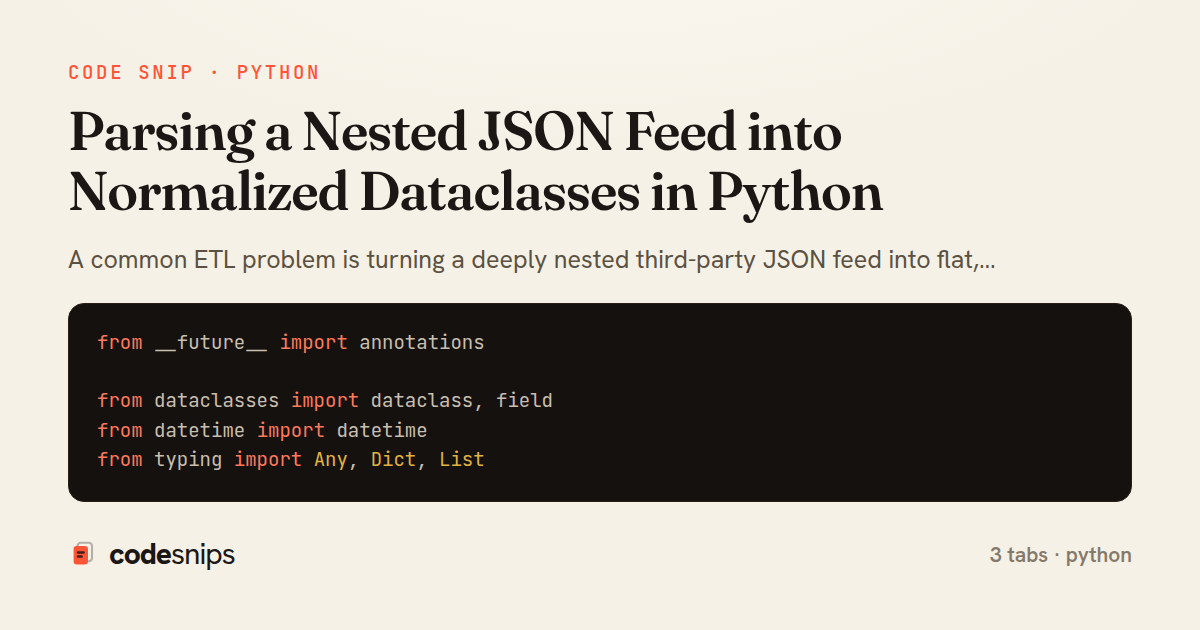
from __future__ import annotations

from dataclasses import dataclass, field
from datetime import datetime
from typing import Any, Dict, List


@dataclass(frozen=True)
class Author:
    id: int
    name: str
    email: str = ""

    @classmethod
    def from_dict(cls, data: Dict[str, Any]) -> "Author":
        return cls(
            id=int(data["id"]),
            name=data["name"].strip(),
            email=data.get("email", ""),
        )


@dataclass
class Comment:
    id: int
    body: str
    created_at: datetime

    @classmethod
    def from_dict(cls, data: Dict[str, Any]) -> "Comment":
        return cls(
            id=int(data["id"]),
            body=data["body"],
            created_at=datetime.fromisoformat(data["created_at"]),
        )


@dataclass
class Article:
    id: int
    title: str
    author: Author
    comments: List[Comment] = field(default_factory=list)

    @classmethod
    def from_dict(cls, data: Dict[str, Any]) -> "Article":
        return cls(
            id=int(data["id"]),
            title=data["title"],
            author=Author.from_dict(data["author"]),
            comments=[Comment.from_dict(c) for c in data.get("comments", [])],
        )
from __future__ import annotations

import json
from dataclasses import dataclass, field
from pathlib import Path
from typing import Any, Dict, List, Union

from entities import Article, Author


@dataclass
class ImportError:
    payload: Dict[str, Any]
    reason: str


@dataclass
class ImportResult:
    articles: List[Article] = field(default_factory=list)
    errors: List[ImportError] = field(default_factory=list)


class FeedImporter:
    @classmethod
    def load(cls, source: Union[str, Path]) -> ImportResult:
        raw = json.loads(Path(source).read_text(encoding="utf-8"))
        return cls.from_records(raw.get("articles", []))

    @classmethod
    def from_records(cls, records: List[Dict[str, Any]]) -> ImportResult:
        result = ImportResult()
        for record in records:
            try:
                result.articles.append(Article.from_dict(record))
            except (KeyError, ValueError, TypeError) as exc:
                result.errors.append(ImportError(payload=record, reason=str(exc)))
        return result

    @staticmethod
    def _dedupe_authors(articles: List[Article]) -> List[Author]:
        by_id: Dict[int, Author] = {}
        for article in articles:
            by_id.setdefault(article.author.id, article.author)
        return list(by_id.values())
from datetime import datetime

from entities import Comment
from feed_importer import FeedImporter

FIXTURE = [
    {
        "id": 1,
        "title": "Normalizing feeds",
        "author": {"id": "42", "name": " Ada "},
        "comments": [
            {"id": 9, "body": "nice", "created_at": "2024-01-02T10:00:00"},
        ],
    },
    {"id": 2, "author": {"id": 7, "name": "Grace"}},  # missing title
]


def test_nested_comments_are_typed():
    result = FeedImporter.from_records(FIXTURE)
    article = result.articles[0]
    assert isinstance(article.comments[0], Comment)
    assert isinstance(article.comments[0].created_at, datetime)
    assert article.author.name == "Ada"


def test_bad_record_is_collected_not_raised():
    result = FeedImporter.from_records(FIXTURE)
    assert len(result.articles) == 1
    assert len(result.errors) == 1
    assert "title" in result.errors[0].reason


def test_authors_dedupe_by_id():
    result = FeedImporter.from_records(FIXTURE)
    authors = FeedImporter._dedupe_authors(result.articles)
    assert len(authors) == 1
A common ETL problem is turning a deeply nested third-party JSON feed into flat, strongly-typed domain objects that the rest of an application can consume without reaching into raw dictionaries. This snippet shows how to do that with plain dataclasses and a small set of from_dict factory methods, keeping the mapping logic in one place and the rest of the code free of dict.get calls.
The entities.py tab defines the target shape. Each entity is a @dataclass — Author, Comment, and Article — and normalization means the nested comment array on the feed becomes a real list of Comment objects rather than nested dicts. The from_dict classmethods act as the boundary between untyped input and typed output: Author.from_dict coerces the id to int, Comment.from_dict parses the ISO timestamp into a datetime, and Article.from_dict fans out over the raw comments list to build child objects. Defaults such as field(default_factory=list) keep the type honest when the feed omits a key.
The feed_importer.py tab drives the traversal. FeedImporter.load reads the feed and returns a flat ImportResult that separates a list of articles from a list of errors, so one malformed record does not abort the whole batch. The importer catches KeyError and ValueError per article and records the offending payload, a pattern that matters when ingesting real feeds where a single missing field is routine. _dedupe_authors shows a second normalization step: authors are collapsed by id so the same person referenced across many articles is stored once.
The test_importer.py tab documents the contract with a fixture. It asserts that nested comments become Comment instances, that timestamps are parsed to datetime, and that a record missing title lands in errors rather than raising. This tests the resilience guarantee explicitly.
The trade-off is that hand-written from_dict methods are more verbose than a schema library like pydantic, but they add zero dependencies and make the coercion rules obvious. This approach fits well for small-to-medium feeds where the shape is known and clarity beats configuration.
Related snips
from sklearn.pipeline import Pipeline
from sklearn.preprocessing import StandardScaler, MinMaxScaler, RobustScaler
from sklearn.linear_model import LogisticRegression

standard_pipeline = Pipeline([
    ('scaler', StandardScaler()),
Scaling and normalization choices for different model families
class SignupForm
  include ActiveModel::Model
  include ActiveModel::Attributes

  attribute :account_name, :string
  attribute :email, :string
Shallow Controller, Deep Params: Form Object Pattern
<!DOCTYPE html>
<html lang="en">
<head>
  <meta charset="UTF-8">
  <title>Form Validation Example</title>
  <style>
HTML forms with validation and accessibility
module EmailNormalization
  extend ActiveSupport::Concern

  included do
    attr_accessor :soft_warnings
Soft Validation: Normalize + Validate Email
class PostSerializer < ActiveModel::Serializer
  attributes :id, :title, :excerpt, :body, :published_at, :views, :likes_count, :comments_count

  attribute :can_edit, if: :current_user_can_edit?

  belongs_to :author, serializer: UserSummarySerializer
Serializers with ActiveModel::Serializers
class PostsController < ApplicationController
  def index
    posts = Post.for_feed.page(params[:page]).per(25)

    render json: {
      data: posts.map { |post| PostSerializer.new(post).as_json },
N+1 Proof Serialization with preloaded associations
Share this code
Here's the card — post it anywhere.